


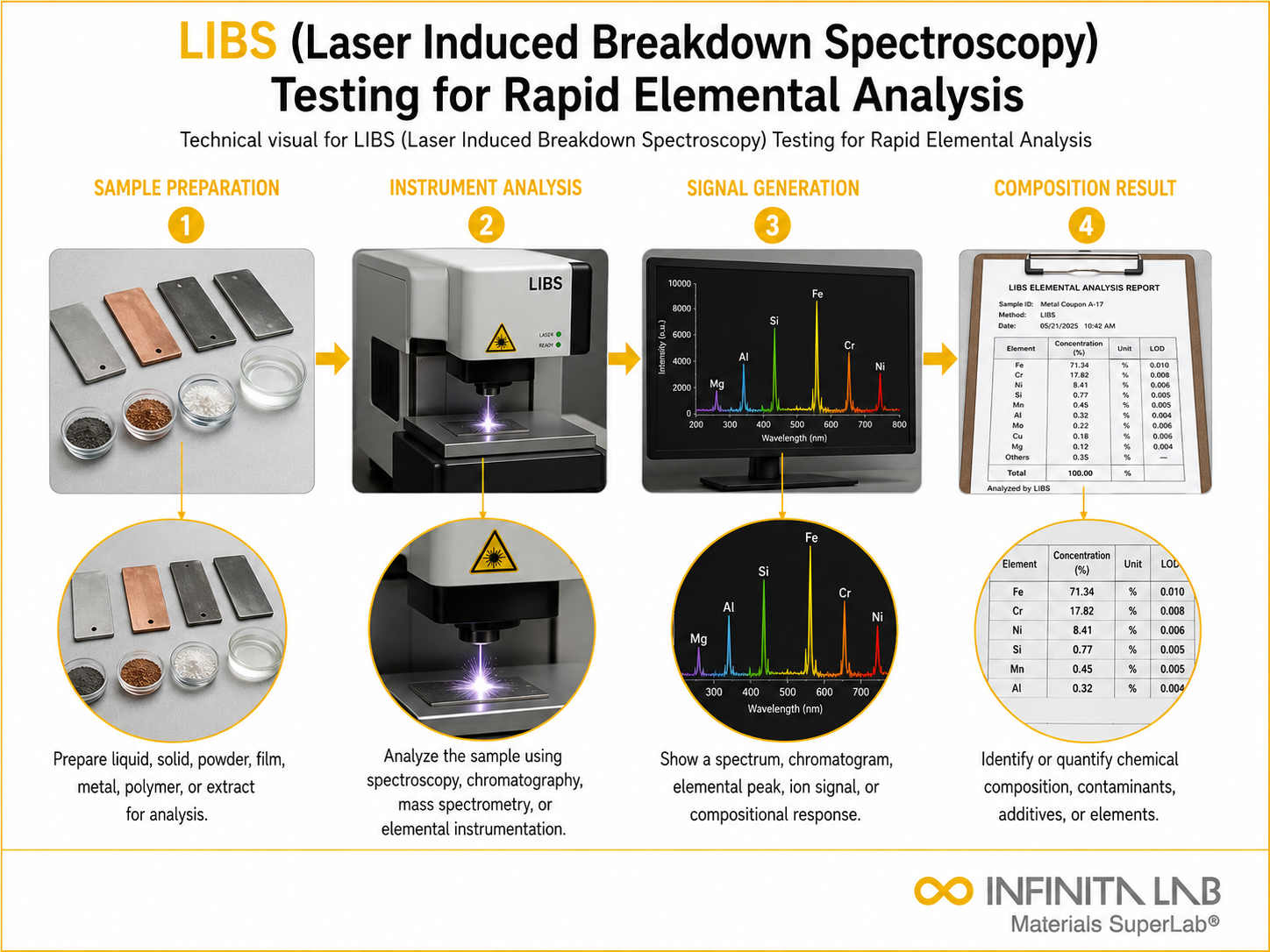
LIBS (Laser Induced Breakdown Spectroscopy) Testing for Rapid Elemental Analysis
Laser Diffractometry is an optical technique that uses diffraction patterns for particle size analysis of suspensions, colloidal dispersions, dry powders and aerosols. Characteristic light scattering patterns are analyzed using Fraunhofer and Mie theories to determine particle size distributions. This test is offered by Infinita Lab, USA, to clients in the USA and across the world through its vast laboratory network.
TRUSTED BY


Precision Testing Solutions for Accurate, Reliable, and Standards-Compliant Results
- Overview
- Scope, Applications, and Benefits
- Test Process
- Specifications
- Instrumentation
- Results and Deliverables
LIBS Overview
Laser Induced Breakdown Spectroscopy (LIBS) is a rapid elemental analysis technique that uses a high-energy laser pulse to create a micro-plasma on the sample surface. The emitted light from the plasma contains characteristic spectral lines, which are analyzed to determine the elemental composition of the material.
LIBS is widely used for real-time, in-situ analysis of solids, liquids, and gases with minimal or no sample preparation. It enables multi-element detection with fast response time, making it suitable for industrial quality control, environmental monitoring, metallurgy, and advanced material characterization applications.

Scope, Applications, and Benefits
Scope
LIBS is applied for qualitative and quantitative elemental analysis across a wide range of materials under laboratory and field conditions. It is especially valuable for rapid screening and on-site analysis.
- Applicable to metals, alloys, ceramics, polymers, liquids, and gases
- Enables real-time and in-situ elemental analysis
- Requires minimal or no sample preparation
- Detects major, minor, and trace elements simultaneously
- Suitable for both conductive and non-conductive materials
- Supports depth profiling through repeated laser pulses
- Used for material identification and sorting applications
- Applicable in harsh and remote environments
Applications
- Metal and alloy composition analysis
- Scrap sorting and recycling industries
- Environmental monitoring and soil analysis
- Pharmaceutical and chemical material verification
- Defense and forensic material identification
Benefits
- Rapid and real-time elemental analysis
- Minimal sample preparation required
- Multi-element detection capability
- Portable and field-deployable systems available
- Non-contact and minimally destructive technique
LIBS Test Process
Laser Focusing
High-energy laser pulse is focused onto the sample surface.
1Plasma Generation
Laser interaction creates a micro-plasma by vaporizing material.
2Emission Detection
Plasma emits light containing characteristic spectral lines.
3Spectral Analysis
Emission spectrum is analyzed to determine elemental composition.
4LIBS Technical Specification
| Parameter | Details |
|---|---|
| Method | Laser-induced plasma generation and optical emission spectroscopy |
| Measurement Type | Qualitative and quantitative elemental analysis |
| Sample Type | Solids, liquids, gases, metals, and non-metals |
| Loading Type | Laser energy-induced plasma formation |
| Measurement Basis | Spectral emission lines corresponding to elemental signatures |
| Units | wt%, ppm, spectral intensity (counts) |
| Laser Type | Nd:YAG or pulsed laser systems |


Instrumentation Used for Testing
- Pulsed laser source (Nd:YAG laser)
- Optical emission spectrometer
- Fiber optic light collection system
- Sample positioning stage
- Data acquisition and spectral analysis software
Results and Deliverables
- Elemental composition profile
- Quantitative concentration data (wt%, ppm)
- Spectral emission graphs
- Depth profiling results
- Material identification report
Frequently Asked Questions
LIBS directly ablates a microscopic amount of material using a focused laser pulse to generate plasma. The emitted spectrum is captured instantly, allowing rapid identification and quantification of elements without complex sample preparation steps.
Accuracy depends on calibration models, plasma stability, matrix effects, and signal normalization. Using certified reference materials and advanced calibration techniques significantly improves quantitative reliability and reduces variability across different sample types.
Plasma temperature influences excitation of atoms and emission intensity. Stable plasma conditions ensure consistent spectral signals, improving repeatability and accuracy of elemental identification and quantification.
LIBS may have lower sensitivity for certain trace elements and can be affected by matrix effects. However, it offers rapid analysis, portability, and minimal preparation advantages.
Yes, LIBS can detect light elements, which are often difficult to analyze using other techniques, making it valuable for specialized applications like battery and hydrogen analysis.
Why Choose Infinita Lab for Advanced Materials Testing and Characterization?
At the core of this breadth is our network of 2,000+ accredited laboratories across the USA, offering access to over 10,000 testing methods and analytical services. From advanced materials characterization (SEM, TEM, RBS, XPS) to mechanical, chemical, environmental, biological, and standardized ASTM/ISO-compliant testing, we deliver unmatched flexibility, specialization, and scale. You are never limited by geography, facility, or methodology — Infinita Lab connects you to the right expertise and testing solution, every time.

Looking for a Trusted Partner for Accurate and Reliable Testing Services?
Send query us at hello@infinitlab.com or call us at (888) 878-3090 to learn more about our services and how we can support you.



Request a Quote
Submit your material details and receive testing procedures, pricing, and turnaround time within 24 hours.
 Quick Turnaround and Hasslefree process
 Confidentiality Guarantee
 Free, No-obligation Consultation
 100% Customer Satisfaction
