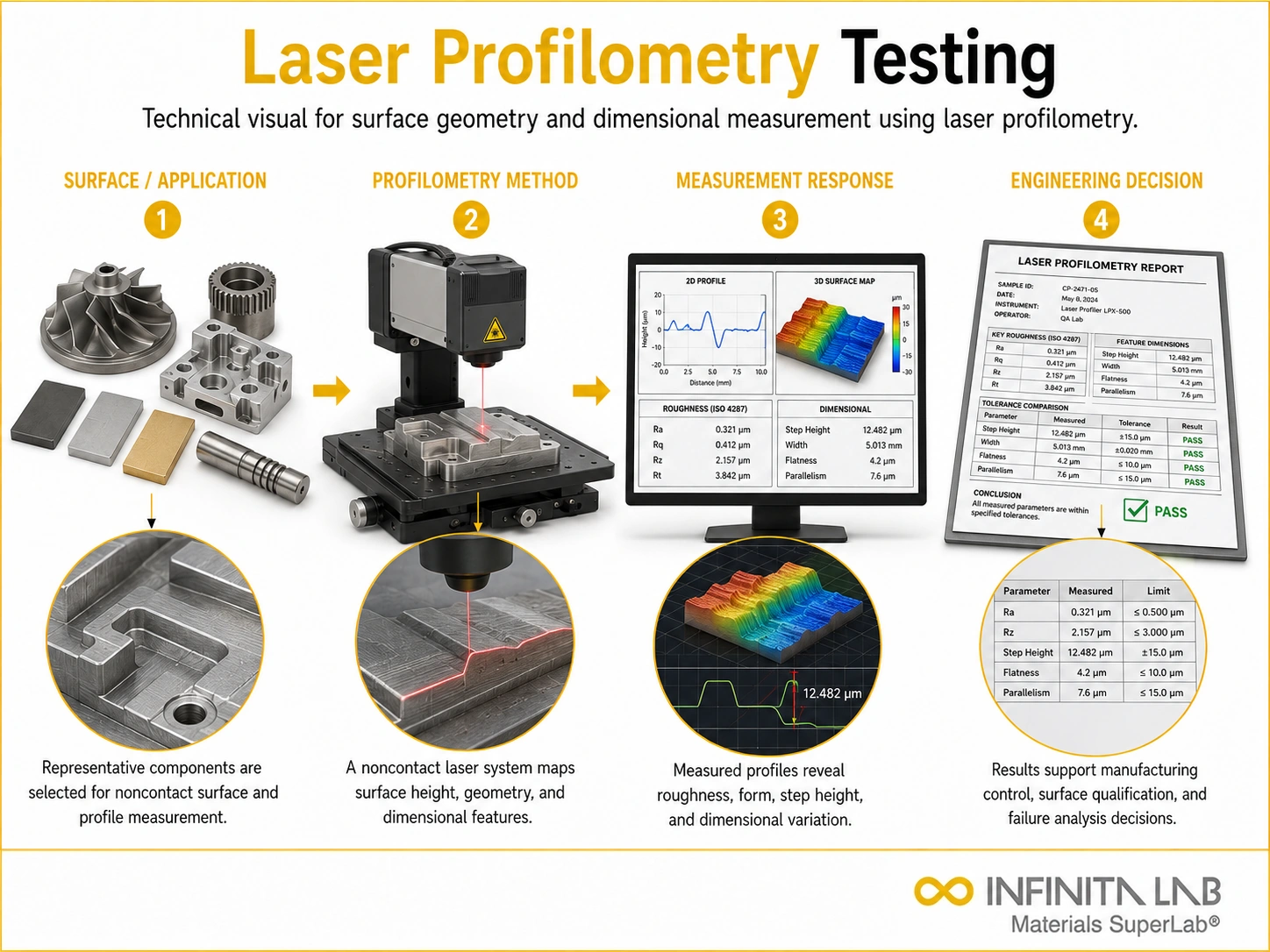


What Is Laser Profilometry Surface Measurement?
Laser profilometry is a non-contact surface measurement technique used to evaluate surface topography, roughness, and profile characteristics with high precision. It utilizes a laser beam to scan the surface and capture height variations, generating detailed three-dimensional surface maps for analysis.
This technique is widely applied in manufacturing, materials science, and precision engineering to assess surface quality, wear, coatings, and dimensional accuracy. Laser profilometry provides fast, high-resolution measurements without physically contacting the sample, making it ideal for delicate, soft, or highly polished surfaces.

Applications and Benefits of Laser Profilometry Surface Measurement Testing
Scope
Laser profilometry enables detailed surface characterization by measuring height variations and texture features across a wide range of materials and geometries.
- Applicable to metals, polymers, ceramics, and coated surfaces
- Measures surface roughness, waviness, and profile geometry
- Supports 2D profile and 3D surface mapping
- Suitable for flat, curved, and complex geometries
- Enables non-contact inspection of sensitive surfaces
- Used for wear, corrosion, and coating thickness evaluation
- Applicable in both laboratory and inline inspection systems
- Supports high-speed scanning for production environments
- Enables micro and macro-scale surface analysis
Applications
- Surface roughness and texture measurement
- Coating thickness and uniformity evaluation
- Wear and corrosion analysis
- Precision machining and manufacturing inspection
- Semiconductor and electronics surface characterization
Benefits
- Non-contact and non-destructive measurement
- High precision and resolution
- Fast data acquisition and analysis
- Suitable for delicate and complex surfaces
- Provides detailed 3D surface visualization
Our Testing Procedure
Surface Scanning
Laser beam scans the sample surface across the measurement area.
1Signal Detection
Reflected laser light is captured by sensors to determine height variations.
2Data Acquisition
Surface profile data is recorded in real-time during scanning.
3Profile Analysis
Software processes data to generate surface maps and roughness parameters.
4Laser Profilometry Technical Specification
| Parameter | Details |
|---|---|
| Method | Optical triangulation or interferometric laser scanning |
| Measurement Type | Surface topography, roughness, and profile analysis |
| Sample Type | Solid surfaces including metals, polymers, ceramics, and coatings |
| Loading Type | Non-contact optical scanning using laser beam |
| Units | µm, nm, Ra, Rz, surface height (Z-axis) |
| Resolution Range | Nanometer to micrometer level depending on system |
| Scan Area | From microns to several centimeters |


- Laser profilometer (optical scanning system)
- Optical triangulation sensors
- Interferometric measurement systems
- Precision motion stage
- Data acquisition and analysis software
Equipment and Instrumentation Used for Testing
What You Receive: Test Report, Data, and Certification
- Surface roughness parameters (Ra, Rz, etc.)
- 2D surface profile graphs
- 3D surface topography maps
- Coating thickness and wear analysis reports
- Detailed inspection and measurement report
Laser Profilometry Surface Measurement FAQs
Laser profilometry uses optical triangulation or interferometry to detect height variations from reflected laser signals. Precise sensor calibration and high-resolution detectors enable accurate measurement of micro-scale surface features without physically contacting the sample.
Accuracy depends on sensor resolution, surface reflectivity, scanning speed, environmental vibrations, and calibration. Proper setup and stable conditions ensure reliable roughness parameter evaluation.
Highly reflective or transparent surfaces can distort laser signals, affecting accuracy. Adjustments such as wavelength selection or surface treatment improve measurement reliability.
Optical triangulation measures height based on reflected beam position, suitable for general profiling, while interferometry uses light interference for nanometer-scale precision.
Uncertainty arises from surface reflectivity variations, sensor noise, calibration errors, environmental vibrations, and improper alignment. Controlling these factors and using reference standards ensures reliable and repeatable measurements.
A laser profilometer measures an object's surface profile, dimensions, and height variations without physical contact. It projects a laser line onto the surface and captures the reflected light using an optical sensor. Using laser triangulation, the instrument calculates surface heights and generates a profile for evaluating dimensions, contours, and surface irregularities.
Inline optical measurement uses laser scanners or optical sensors to measure complex component shapes directly on a production line. The system captures surface profiles as the component moves past the sensors and combines the measurements into dimensional or three-dimensional data. Software compares the results with reference specifications to identify deviations in height, width, contour, and other geometric features for real-time quality control.
Why Choose Infinita Lab for Laser Profilometry Surface Measurement Testing
When your Laser Profilometry Surface Measurement results have to hold up - for compliance, a customer audit, or an engineering decision - accuracy and an unbiased third-party report matter more than price. Infinita Lab routes your laser profilometry surface measurement testing to ISO/IEC 17025-accredited U.S. partner labs with hands-on method experience, so you get defensible data, transparent reporting, and turnaround times built around your project deadline - not ours.

Looking for an Accredited Partner for Laser Profilometry Surface Measurement Testing?
Send query us at hello@infinitalab.com or call us at (888) 878-3090 to learn more about our services and how we can support you.





