


EMC Testing Services
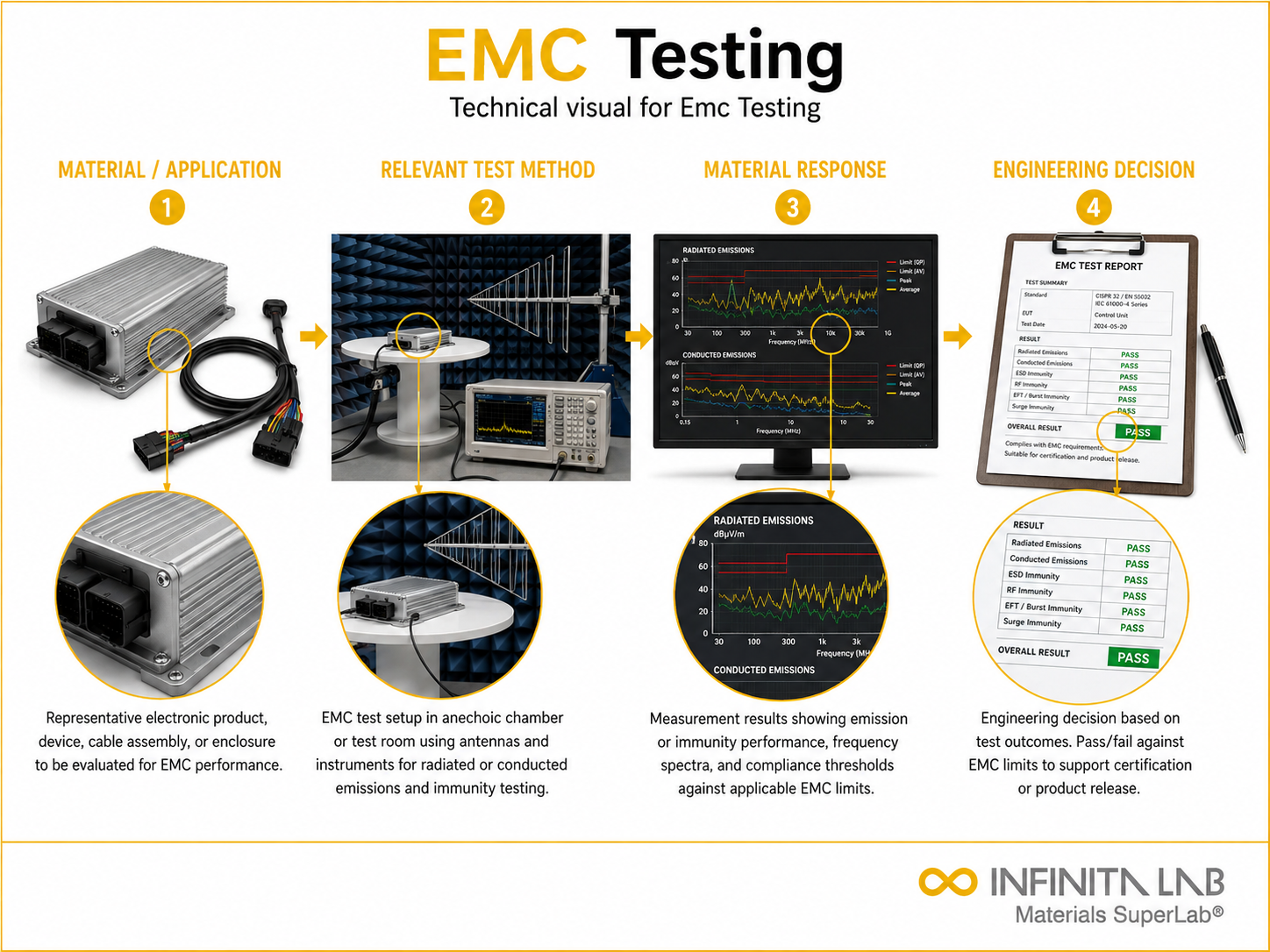
EMC testing ensures that a device or system can operate safely and without disruption in its environment. EMC and EMI testing determines the ability of a device to coexist with other devices. Regulatory EMC/EMI requirements must be met to help a company strengthen its competitive position in the market. Accredited NRTL certification providers and ISO/IEC 17025:2017 certified laboratories can help with conformity assessments.
TRUSTED BY


Get compliant results — request your EMC testing quote
- Overview
- Scope, Applications, and Benefits
- Test Process
- Specifications
- Instrumentation
- Results and Deliverables
What Is EMC?
Electromagnetic Compatibility (EMC) testing evaluates whether an electrical or electronic device can operate correctly in its intended electromagnetic environment without generating interference that disrupts other equipment, and without being unacceptably disrupted by interference from other sources. It addresses two complementary concerns: emissions – the electromagnetic energy a device radiates or conducts out into its surroundings – and immunity (or susceptibility) – how well a device continues to function when subjected to external electromagnetic disturbances.
EMC and EMI (Electromagnetic Interference) are closely related terms. EMI refers to the interference itself, while EMC is the broader objective of designing equipment that neither causes nor is unduly affected by EMI. Testing covers both radiated and conducted phenomena across a wide frequency range, using calibrated antennas, receivers, and disturbance generators in controlled environments such as anechoic chambers and shielded rooms.
EMC testing is a regulatory requirement for most electronic products entering major markets. Devices must meet the emission limits and immunity levels defined by the applicable regional and product-specific standards before they can be marketed. Beyond regulatory needs, EMC evaluation during development reduces the risk of late-stage redesign and field interference problems that are far more expensive to fix after a product is in production.

Applications and Benefits of EMC Testing
Scope
EMC testing covers the measurement of electromagnetic emissions from a device and the evaluation of its immunity to electromagnetic disturbances, across the frequency ranges defined by the applicable standards. Testing is divided into two broad categories – emissions and immunity – each comprising several individual test types:
- Radiated emissions – measurement of electromagnetic energy radiated from the device, typically across 30 MHz to several GHz, using calibrated antennas in an anechoic or semi-anechoic chamber
- Conducted emissions – measurement of disturbances the device puts back onto its power and signal lines, typically across 150 kHz to 30 MHz, using a Line Impedance Stabilisation Network (LISN)
- Radiated immunity – evaluation of device performance while exposed to a defined radiated field strength across a swept frequency range
- Conducted immunity – evaluation of device performance while disturbances are injected onto its power and signal lines
- Transient immunity – including electrostatic discharge (ESD), electrical fast transient/burst (EFT), surge, and voltage dips/interruptions
- Applicable standards – including the CISPR and IEC 61000 series, FCC Part 15, EN product standards, MIL-STD-461 (military), DO-160 (aerospace), and automotive standards such as CISPR 25 and ISO 11452
Applications
- Consumer and commercial electronics – emissions and immunity evaluation of IT equipment, appliances, lighting, and consumer devices against FCC Part 15 and CISPR/EN standards before market entry
- Industrial equipment – EMC evaluation of motor drives, power supplies, control systems, and instrumentation that must operate in electrically noisy industrial environments without malfunctioning or causing interference
- Medical devices – EMC testing per IEC 60601-1-2, ensuring medical electronic equipment neither emits harmful interference nor malfunctions when exposed to disturbances in clinical environments
- Automotive and EV electronics – component and vehicle-level EMC per CISPR 25, ISO 11452, and ISO 7637, covering the demanding electromagnetic environment of modern vehicles with high-power electronics
- Aerospace and defense – EMC evaluation per MIL-STD-461 and DO-160 for equipment that must function in environments with stringent emission and susceptibility requirements
- Wireless and IoT devices – emissions evaluation alongside radio testing for connected devices that combine intentional radiators with digital electronics
- Pre-design and design validation – early EMC screening during development to identify and resolve emission or immunity problems before final design freeze
Benefits
- Required for market access in most regions – emissions and immunity requirements are mandatory for electronic products in the US, EU, and most major markets; EMC data is a prerequisite for marketing a product
- Covers both directions of interference – EMC testing evaluates both what a device emits and how it withstands external disturbances, addressing the full electromagnetic interaction rather than just one side
- Reduces costly late-stage redesign – identifying EMC problems during development, when fixes are inexpensive, avoids the far greater cost of redesigning a product that fails EMC testing after tooling and production are committed
- Prevents field interference and malfunction – a product that passes EMC testing is far less likely to cause or suffer interference problems in actual use, reducing warranty issues and customer complaints
- Spans regulatory and military/aerospace needs – the same core measurement disciplines support both commercial regulatory testing and the more stringent MIL-STD and DO-160 requirements, allowing one evaluation framework to serve many product types
Our Testing Procedure
Plan the Test
Select applicable EMC standards, limits, test types, frequency ranges, and operating modes.
1Set Up the DUT
Arrange the device, cables, and support equipment in the required test environment and confirm normal operation.
2Perform EMC Testing
Measure conducted and radiated emissions, then apply immunity disturbances such as ESD, surge, EFT, and radiated fields.
3Evaluate and Report
Compare results with limits and performance criteria, document failures or margins, and record the test configuration.
4Test parameters and requirements
| Parameter | Details |
|---|---|
| Test Categories | Emissions (radiated, conducted); Immunity (radiated, conducted, transient) |
| Radiated Emissions Range | Typically 30 MHz to several GHz |
| Conducted Emissions Range | Typically 150 kHz to 30 MHz |
| Immunity Tests | Radiated immunity, conducted immunity, ESD, EFT/burst, surge, voltage dips/interruptions |
| Applicable Standards | CISPR series, IEC 61000 series, FCC Part 15, EN product standards, IEC 60601-1-2, MIL-STD-461, DO-160, CISPR 25, ISO 11452 |
| Test Environments | Anechoic / semi-anechoic chamber, shielded room |
| Key Equipment | EMI receiver/spectrum analyzer, LISN, calibrated antennas, ESD/EFT/surge generators |
| Performance Criteria | Defined per standard (e.g., normal operation, temporary degradation, no malfunction) |
| Product Types | Consumer, industrial, medical, automotive, aerospace, wireless/IoT electronics |


- EMI test receiver/spectrum analyzer
- Semi-anechoic or fully anechoic chamber
- Shielded room / screened enclosure
- Calibrated measurement antennas (biconical, log-periodic, horn)
- Line Impedance Stabilization Network (LISN)
- ESD simulator (electrostatic discharge gun)
- EFT/burst generator
- Surge generator
- RF signal generators and power amplifiers for immunity testing
- Field probes and monitoring equipment for the DUT
Equipment and Instrumentation Used for Testing
What You Receive: Test Report, Data, and Certification
- EMC test report – results for each emissions and immunity test performed, against the applicable standard’s limits and performance criteria
- Emission plots – radiated and conducted emission measurements plotted against the limit lines, with margins identified
- Immunity results – performance of the device under each immunity test, with the applied levels and the observed performance criteria status
- Pass/fail determination – outcome for each test type against the applicable standard
- Exceedance and anomaly documentation – any frequencies or tests where the device exceeded limits or showed degradation, with supporting detail
- Test configuration records – DUT operating mode, cabling, support equipment, and chamber setup used during testing
EMC FAQs
Electromagnetic interference, or EMI, is unwanted electrical noise that affects equipment operation. EMC is the ability of equipment to function properly within its electromagnetic environment.
Emissions are electromagnetic signals unintentionally generated by a product. Testing determines whether conducted and radiated emissions remain within applicable limits.
Immunity testing determines whether equipment continues operating when exposed to electromagnetic disturbances. Performance is evaluated during and after each applied test.
Radiated emissions testing measures electromagnetic energy released through the air from equipment, cables and enclosures. Measurements are commonly performed using antennas in controlled test environments.
Conducted emissions testing measures unwanted electrical noise travelling through power or communication cables. A line impedance stabilisation network is commonly used during testing.
Why Choose Infinita Lab for EMC Testing?
At the core of this breadth is our network of 2,000+ accredited laboratories across the USA, offering access to over 10,000 testing methods and analytical services. From advanced materials characterization (SEM, TEM, RBS, XPS) to mechanical, chemical, environmental, biological, and standardized ASTM/ISO-compliant testing, we deliver unmatched flexibility, specialization, and scale. You are never limited by geography, facility, or methodology — Infinita Lab connects you to the right expertise and testing solution, every time.

Looking for an Accredited Partner for EMC Testing?
Send query us at hello@infinitalab.com or call us at (888) 878-3090 to learn more about our services and how we can support you.



Request a Quote
Submit your material details and receive testing procedures, pricing, and turnaround time within 24 hours.
 Quick Turnaround and Hasslefree process
 Confidentiality Guarantee
 Free, No-obligation Consultation
 100% Customer Satisfaction
