

What Is ASTM E1462 Photovoltaic Module Insulation Integrity?
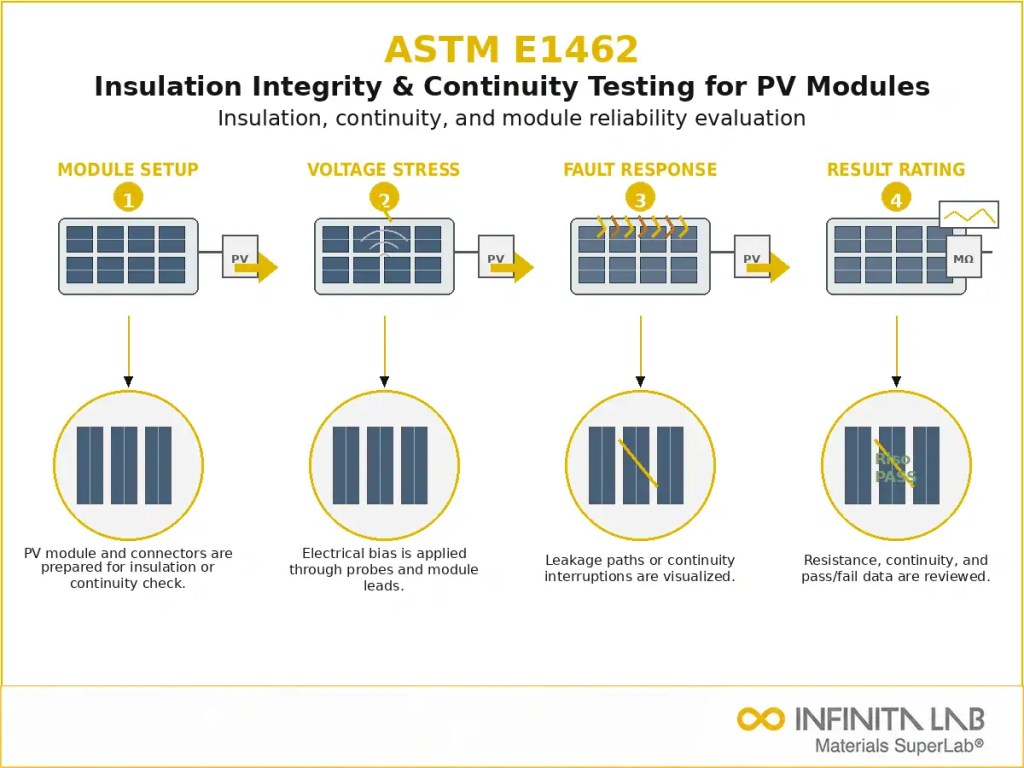
ASTM E1462 defines a test method for evaluating the insulation integrity and electrical continuity of photovoltaic modules. The method assesses the ability of a module’s insulation system to withstand applied voltages without electrical breakdown, leakage, or failure, ensuring safe operation under service conditions. It also verifies continuity of conductive paths within the module to confirm proper electrical performance and assembly quality.
This standard is essential for validating the durability and safety of photovoltaic modules used in real-world environments. By subjecting modules to high-voltage stress, it helps identify insulation defects, moisture ingress, or manufacturing inconsistencies. The results support quality assurance, certification, and long-term reliability of solar energy systems, ensuring that modules meet required safety and performance expectations.
Applications and Benefits of ASTM E1462 Photovoltaic Module Insulation Integrity Testing
Scope
ASTM E1462 covers the determination of insulation integrity and electrical continuity in photovoltaic modules using applied voltage and leakage current measurement. It is applicable to crystalline silicon and thin-film photovoltaic modules. The method evaluates insulation performance between conductive components and grounded parts under controlled conditions.
Scope includes:
- Evaluation of insulation integrity in photovoltaic modules
- Measurement of leakage current under applied voltage
- Verification of electrical continuity in conductive paths
- Applicable to crystalline silicon and thin-film modules
- Detection of insulation breakdown or defects
Applications
- Quality control of photovoltaic module manufacturing
- Safety testing for solar energy systems
- Certification and compliance of PV modules
- Reliability assessment of solar panels
- Research and development in photovoltaic technology
- Inspection of installed solar modules in the field
Benefits
- Ensures electrical safety of photovoltaic modules
- Detects insulation defects and manufacturing flaws
- Improves long-term reliability of solar systems
- Supports regulatory and certification compliance
- Enhances quality assurance processes
- Reduces risk of electrical failure and hazards
Our ASTM E1462 Testing Procedure
Specimen Preparation
The photovoltaic module is cleaned and inspected to ensure it is in proper test condition.
1Electrical Connection Setup
Test electrodes are connected to the module’s conductive parts and insulation reference points.
2Voltage Application
A specified high voltage is applied between conductive components and grounded parts.
3Leakage Measurement and Evaluation
Leakage current and continuity are measured to assess insulation integrity and detect any breakdown.
4ASTM E1462 Test Parameters and Requirements
| Parameter | Details |
|---|---|
| Standard | ASTM E1462 |
| Test Principle | High voltage application to evaluate insulation resistance and leakage current |
| Applicable Materials | Photovoltaic modules including crystalline silicon and thin-film types |
| Voltage Range | Defined based on module rating and test requirements |
| Measurement Parameter | Leakage current and insulation resistance |
| Test Environment | Controlled temperature and humidity conditions |
| Electrode Configuration | Conductive probes connected to terminals and frame |


- High-voltage insulation tester (hipot tester)
- Digital multimeter or continuity tester
- Environmental chamber
- Test electrodes and connecting probes
- Data acquisition and monitoring system
Equipment and Instrumentation Used for ASTM E1462 Testing
What You Receive: Test Report, Data, and Certification
- Insulation resistance values
- Leakage current measurements
- Pass/fail assessment of module insulation integrity
- Electrical continuity verification results
- Test report with voltage and environmental conditions
- Compliance documentation for certification
ASTM E1462 Photovoltaic Module Insulation Integrity FAQs
ASTM E1462 evaluates insulation integrity and electrical continuity of photovoltaic modules by applying high voltage and measuring leakage current. It ensures modules can operate safely without electrical breakdown, supporting reliability, safety, and compliance with industry standards in real-world applications.
Insulation integrity prevents leakage currents, electrical faults, and safety hazards. It ensures that conductive components remain isolated from grounded parts, protecting users, improving efficiency, and maintaining long-term durability and safe operation of photovoltaic systems.
Leakage current represents unintended electrical flow through insulation. Elevated leakage indicates insulation degradation, defects, or contamination, which can compromise safety, reduce efficiency, and signal potential failure in photovoltaic modules under operational conditions.
Factors include temperature, humidity, contamination, surface condition, and test setup accuracy. Improper handling or environmental variations can influence leakage current and insulation performance, affecting the reliability of results.
Leakage current limits define acceptable insulation performance. Staying within these limits ensures the module operates safely and efficiently without electrical hazards or energy losses.
Why Choose Infinita Lab for Photovoltaic Module Insulation Integrity Testing?
When your Photovoltaic Module Insulation Integrity results have to hold up - for compliance, a customer audit, or an engineering decision - ASTM E1462 accuracy and an unbiased third-party report matter more than price. Infinita Lab routes your ASTM E1462 photovoltaic module insulation integrity testing to ISO/IEC 17025-accredited U.S. partner labs with hands-on method experience, so you get defensible data, transparent reporting, and turnaround times built around your project deadline - not ours.

Looking for an Accredited Partner for ASTM E1462 Photovoltaic Module Insulation Integrity Testing?
Send query us at hello@infinitalab.com or call us at (888) 878-3090 to learn more about our services and how we can support you.



