


ISO 4649: Abrasion Testing Services
DIN 53516 / ISO 4649 Abrasion Testing is a crucial method for evaluating the wear resistance of rubber materials such as conveyor/drive belts, soles, and tires. These materials are subjected to significant stress during their service life and need to withstand misuse and wear. The DIN Abrasion test helps verify the safety and durability of rubber materials before they are used in large quantities.
TRUSTED BY


Get ISO 4649 compliant results — request your abrasion testing quote
- Overview
- Scope, Applications, and Benefits
- Test Process
- Specifications
- Instrumentation
- Results and Deliverables
What Is ISO 4649 Abrasion?
ISO 4649 evaluates the abrasion resistance of vulcanized rubber and elastomeric materials by measuring the volume loss produced when a test specimen is subjected to controlled abrasive wear against a rotating abrasive surface under specified load conditions. The test determines the ability of rubber compounds to resist mechanical wear, frictional damage, and progressive material removal during repeated surface contact. ISO 4649 is widely used to qualify tires, conveyor belts, footwear soles, industrial hoses, seals, rollers, and high-wear elastomeric products exposed to abrasive service environments.
ISO 4649 is the modern international replacement for the withdrawn DIN 53516 standard and is commonly referenced alongside ASTM D5963 for global rubber abrasion testing programs. The method compares specimen performance against International Reference Rubber No. 3 (IRB3) to normalize results across laboratories and correct for abrasive sheet variability. ISO 4649 Method A typically uses a rotating specimen holder for standard cylindrical rubber specimens, whereas Method B is used for fixed or anisotropic materials in which directional wear characteristics are important. Lower volume loss values indicate higher abrasion resistance and improved durability under service conditions.

Applications and Benefits of ISO 4649 Abrasion Testing
Scope
DIN Abrasion testing evaluates the abrasion resistance of rubber and elastomer materials under controlled laboratory conditions. The test simulates mechanical wear by pressing a specimen against a rotating abrasive surface and measuring the resulting material volume loss, helping assess durability and wear performance.
The scope includes:
Measurement of abrasion resistance of rubber and elastomers
Determination of volume loss due to abrasion
Evaluation of wear performance of rubber products
Testing of vulcanized rubber and thermoplastic elastomers
Material comparison for quality control and product development
Applications
- Automotive – tire tread compounds, sidewall materials, vibration isolation systems, and abrasion-resistant automotive elastomers
- Footwear Industry – shoe soles, safety footwear outsoles, sports shoe compounds, and high-wear elastomeric materials
- Mining & Bulk Material Handling – conveyor belt covers, transfer chute liners, rollers, and wear-resistant industrial rubber systems
- Industrial Equipment – seals, gaskets, rollers, industrial hoses, and elastomeric drive components exposed to friction and abrasion
- Oil & Gas – abrasion-resistant seals, drilling hoses, elastomeric liners, and industrial rubber systems used in harsh operating environments
- Construction & Infrastructure – rubber flooring, expansion joints, vibration pads, and wear-resistant elastomeric assemblies
- Transportation & Railway – anti-vibration pads, suspension elastomers, rubber couplings, and abrasion-resistant railway components
- Consumer Products – sporting goods, protective equipment, rubber grips, wheels, and high-durability molded elastomeric products
Benefits
Determines wear resistance of materials
Helps select durable rubber compounds
Supports quality control in manufacturing
Enables material comparison and optimization
Improves product lifespan and performance
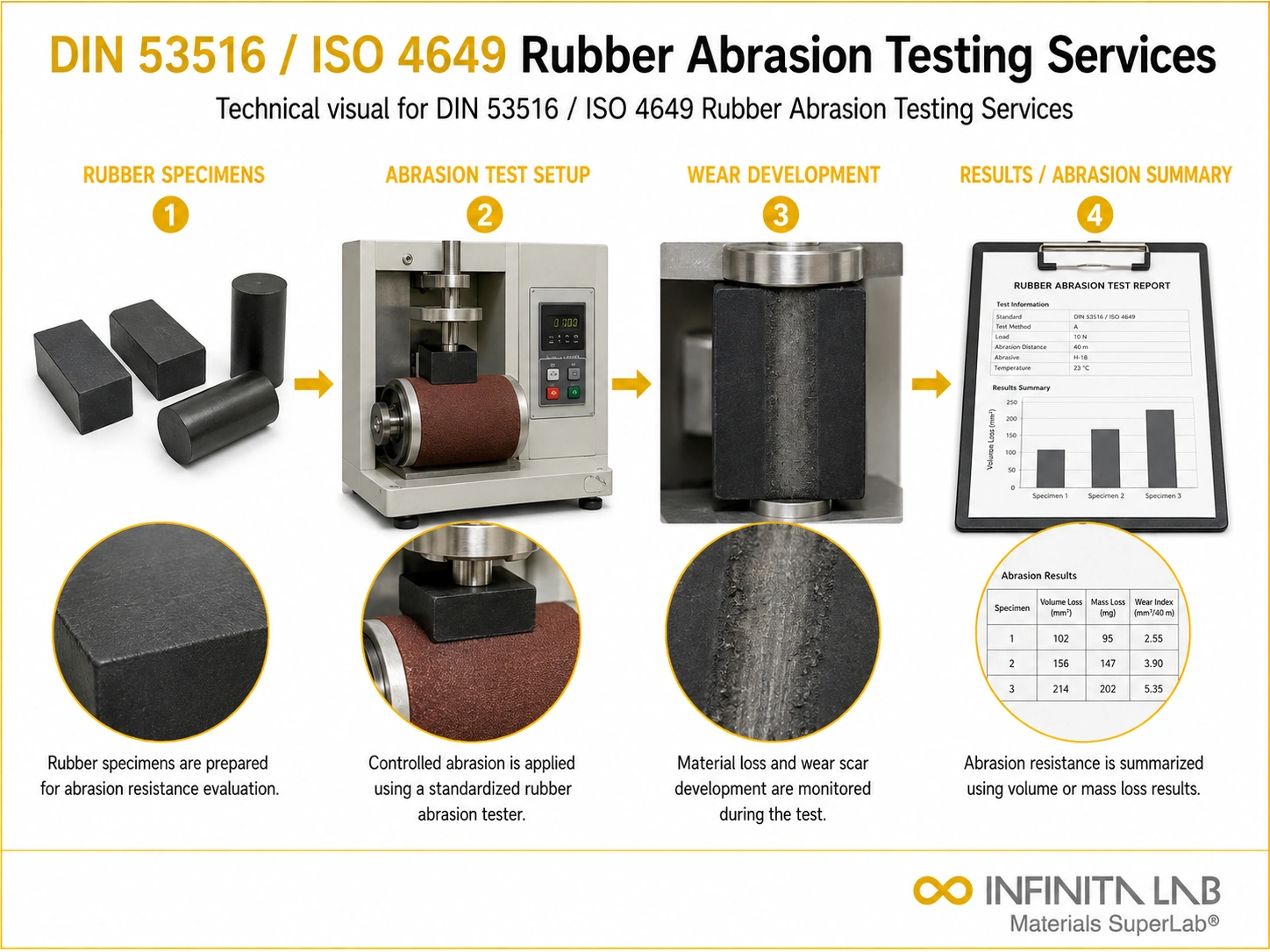
Our ISO 4649 Testing Procedure
Specimen Preparation
Rubber specimens are cut into cylindrical shapes and conditioned according to standard test requirements.
1Instrument Setup
The abrasion tester is prepared with a standardized abrasive sheet and the required load is applied.
2Abrasion Testing
The specimen is pressed against the rotating abrasive drum while moving across the surface for a specified distance.
3Measurement of Abrasion Loss
The mass or volume loss of the specimen is measured and converted into abrasion volume loss.
4ISO 4649 Test Parameters and Requirements
| Parameter | Details |
|---|---|
| Test Principle | Rotating drum abrasion method |
| US Equivalent Standard | ASTM D5963 |
| Applicable Materials | Rubber, elastomers, thermoplastic elastomers |
| Specimen Shape | Cylindrical test piece |
| Specimen Diameter | ~16 mm |
| Typical Specimen Height | Approximately 8 mm |
| Specimen Thickness | ~6–10 mm |
| Applied Load | Typically 10 N |
| Abrasion Distance | Approximately 40 m sliding distance |
| Abrasive Surface | Standard abrasive paper sheet |
| Measured Parameter | Abrasion volume loss (mm³) |
| Method Variants | Method A (rotating specimen) / Method B (fixed specimen) |
| Typical Benchmark Values | Premium tire compounds: <80 mm³ |
| Conveyor Belt Compounds | Approximately <100–120 mm³ |
| Footwear Outsole Compounds | Approximately <150 mm³ |
| Typical Sample Requirement | Minimum 3 specimens per material |
| Evaluation Method | Mass loss converted to volume loss |


DIN Abrasion Tester (Rotating Drum Abrasion Tester)
Abrasive Paper Drum
Specimen Holder
Precision Analytical Balance
Vernier Caliper / Thickness Gauge
Equipment and Instrumentation Used for ISO 4649 Testing
What You Receive: Test Report, Data, and Certification
Abrasion volume loss (mm³)
Material wear resistance evaluation
Test conditions and parameters
Comparison with reference rubber material
Detailed laboratory test report
ISO 4649 Abrasion FAQs
DIN abrasion testing evaluates the wear resistance of rubber and elastomer materials by measuring material loss when a test specimen is rubbed against abrasive paper under controlled pressure and movement conditions.
Abrasion resistance testing helps determine how well rubber materials withstand wear during service, ensuring durability and performance in applications involving friction, sliding contact, or repeated mechanical stress.
The test is commonly applied to rubber, elastomers, thermoplastic elastomers, and similar materials used in tires, conveyor belts, footwear soles, seals, and industrial components.
Industries such as automotive, footwear manufacturing, mining, material handling, and industrial equipment production rely on this testing to evaluate wear resistance of rubber components.
Results are reported as volume loss, typically expressed in cubic millimeters, indicating the amount of material removed from the specimen during the abrasion test under standardized conditions.
ISO 4649 is the modern international replacement for the withdrawn DIN 53516 standard. While the methods are similar, ISO 4649 provides more specific protocols for rotating and non-rotating test pieces.
It is measured by the volume loss (in mm³) of a cylindrical specimen after it is rubbed against a standardized abrasive sheet on a rotating drum.
A lower volume loss indicates higher abrasion resistance and better durability of the material.
It is primarily designed for vulcanized rubber, elastomers, and thermoplastic elastomers used in high-wear environments.
The standard applied load is typically 10 Newtons (10 N).
To ensure they can withstand the constant friction of transporting heavy or abrasive materials without premature failure.
Infinita Lab provides comprehensive B2B ISO 4649 and DIN 53516 testing services across the United States through our network of accredited labs.
Why Choose Infinita Lab for Abrasion Testing?
At the core of this breadth is our network of 2,000+ accredited laboratories across the USA, offering access to over 10,000 testing methods and analytical services. From advanced materials characterization (SEM, TEM, RBS, XPS) to mechanical, chemical, environmental, biological, and standardized ASTM/ISO-compliant testing, we deliver unmatched flexibility, specialization, and scale. You are never limited by geography, facility, or methodology — Infinita Lab connects you to the right expertise and testing solution, every time.

Looking for an Accredited Partner for ISO 4649 Abrasion Testing?
Send query us at hello@infinitalab.com or call us at (888) 878-3090 to learn more about our services and how we can support you.



Request a Quote
Submit your material details and receive testing procedures, pricing, and turnaround time within 24 hours.
 Quick Turnaround and Hasslefree process
 Confidentiality Guarantee
 Free, No-obligation Consultation
 100% Customer Satisfaction
