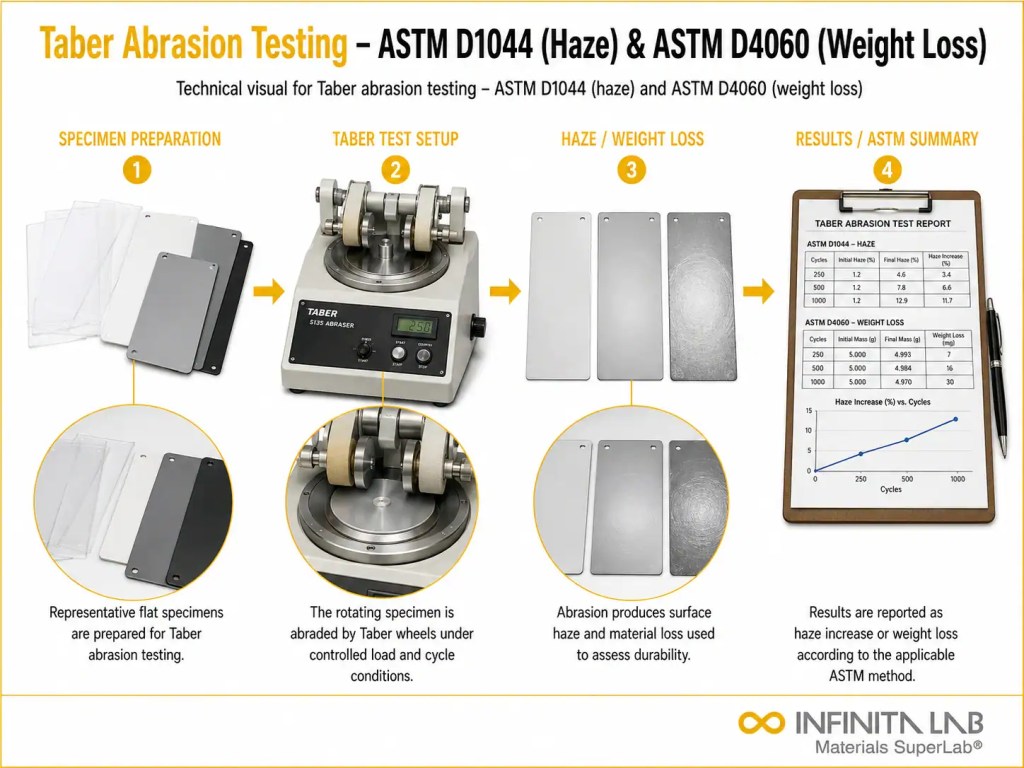


What Is ASTM D1044 Taber Abrasion?
The Taber abrasion test provides data on the surface abrasion resistance of plastic materials, organic coatings, and surface treatments under controlled exposure to an abrasion wheel. ASTM D 1044 provides data on the abrasion resistance of transparent plastic materials, expressed as the percentage increase in haze, while ASTM D 4060 provides data on the abrasion resistance of coatings and surface materials, expressed as the percentage weight loss.
Applications and Benefits of ASTM D1044 Taber Abrasion Testing
Scope
ASTM D 1044 tests transparent plastic materials for percentage increase in haze after specified taber abrasion wheel cycles using a calibrated hazemeter, while ASTM D 4060 tests coated materials for weight loss after specified abrasion cycles using a precision analytical balance.
Taber abrasion testing evaluates:
- Percentage haze increase in transparent plastic materials following defined abrasion wheel cycles
- Weight loss and abrasion resistance index of organic coatings and surface treatment systems
- Comparative abrasion resistance of plastic materials, coatings, and surface treatment systems
- Effect of coating thickness, surface hardness, and material formulation on abrasion performance
- Compliance against the defined haze increase and weight loss abrasion resistance requirements
Applications
- Optical lenses, transparent covers, and glazing materials requiring haze abrasion data
- Automotive headlamp lenses, instrument panel covers, and transparent plastic components
- Organic coatings, paints, varnishes, and industrial surface treatments requiring weight loss data
- Floor coatings, deck treatments, and protective coating systems requiring abrasion assessment
- Material suppliers and coating formulators requiring ASTM D 1044 and ASTM D 4060 test data
Benefits
- Provides reliable optical and gravimetric abrasion resistance data for material and coating selection
- Supports material specification compliance and supplier verification programs
- Identifies abrasion resistance deficiencies in plastic surfaces and coating systems before production
- Delivers traceable abrasion test records for engineering and research submissions
- Reduces design risk by verifying abrasion performance early in the material approval cycle
Our ASTM D1044 Testing Procedure
Sample Preparation
Specimens prepared, conditioned, and weighed or haze-measured per applicable ASTM requirements.
1Initial Measurement
Haze measured per ASTM D 1044 or specimen mass recorded per ASTM D 4060 before abrasion.
2Taber Abrasion Exposure
Specimens subjected to defined Taber abrasion wheel cycles under specified contact load.
3Post-Abrasion Evaluation
Haze increase or weight loss measured and assessed against criteria for test compliance result.
4ASTM D1044 Test Parameters and Requirements
| Parameter | Details |
|---|---|
| Applicable Materials | Transparent plastics, organic coatings, paints, varnishes, and surface treatment systems |
| Specimen Geometry | Defined specimen dimensions per ASTM D 1044 and ASTM D 4060 requirements |
| Abrasion Conditions | Defined Taber wheel type, contact load, and cycle count per applicable ASTM standard |
| Measured Parameters | Percentage haze increase (D 1044) and weight loss and abrasion resistance index (D 4060) |
| Measured Outputs | Haze values, weight loss, abrasion resistance index, and test compliance result |


- Taber abrasion tester with defined abrasion wheel and contact load
- Calibrated hazemeter per ASTM D 1003 for haze measurement
- Precision analytical balance for initial and post-abrasion mass measurement
- Specimen conditioning chamber with temperature and humidity control
- Abrasion wheel refacing tool for consistent wheel surface preparation
- Data acquisition and test reporting system
Equipment and Instrumentation Used for ASTM D1044 Testing
What You Receive: Test Report, Data, and Certification
- Initial and post-abrasion haze measurements and percentage haze increase per ASTM D 1044
- Initial and post-abrasion mass measurements and weight loss values per ASTM D 4060
- Abrasion resistance index data for all tested coating and surface material specimens
- Test compliance result assessed against the defined haze and weight loss specification requirements
- Combined ASTM D 1044 and ASTM D 4060 test report
ASTM D1044 Taber Abrasion FAQs
ASTM D1044 and ASTM D4060 test procedures use a rotating platform with wheels to test abrasion resistance by measuring haze or weight loss, assessing the durability of materials such as coatings, plastics, and surfaces.
ASTM D1044 measures abrasion resistance by checking the increase in haze on transparent materials after abrasion. ASTM D4060 measures abrasion resistance by looking at the weight loss of coated or solid materials.
Taber abrasion tests are used on plastics, coatings, laminates, painted surfaces, flooring materials, and clear panels. These materials are found in automotive, electronics, architectural glazing, and industrial applications.
In Taber abrasion testing, samples rotate on a platform. Abrasive wheels apply controlled pressure, gradually wearing down the surface. This method assesses resistance to abrasion.
These tests measure abrasion resistance in a controlled lab setting. They might not fully reflect real-world wear, where various abrasives, contact pressures, environmental factors, and multi-directional stresses affect surface durability.
ASTM D4060 evaluates the abrasion resistance of organic coatings applied to flat, rigid surfaces, such as metal panels. The coated specimen is mounted on a rotating platform of a Taber Abraser, where two weighted abrasive wheels make contact with its surface. As the platform rotates, the wheels create repeated friction and wear. The specimen is evaluated after a specified number of cycles by measuring its weight loss, coating thickness reduction, or wear resistance. The results help determine how well a coating withstands abrasion during manufacturing and service.
DIN 53109 determines the abrasion resistance of paper and board using the abrasion wheel method. A prepared paper or board specimen is exposed to controlled rubbing against an abrasive wheel under specified test conditions. The test can be performed on both dry and moist specimens. After abrasion, the material loss is evaluated by weighing the specimen before and after testing. The results indicate the surface's resistance to wear and help assess the durability and quality of paper and board products.
Why Choose Infinita Lab for Taber Abrasion Testing?
When your Taber Abrasion results have to hold up - for compliance, a customer audit, or an engineering decision - ASTM D1044 accuracy and an unbiased third-party report matter more than price. Infinita Lab routes your ASTM D1044 taber abrasion testing to ISO/IEC 17025-accredited U.S. partner labs with hands-on method experience, so you get defensible data, transparent reporting, and turnaround times built around your project deadline - not ours.

Looking for an Accredited Partner for ASTM D1044 Taber Abrasion Testing?
Send query us at hello@infinitalab.com or call us at (888) 878-3090 to learn more about our services and how we can support you.



