


ASTM G65: Dry Sand Rubber Wheel Abrasion Testing Services
Accredited ASTM G65 dry sand rubber wheel abrasion testing from Infinita Lab, performed to the exact standard requirements - accurate, reproducible results with full documentation for compliance, R&D, and quality control programs.
TRUSTED BY


Get ASTM G65 compliant results - request your dry sand rubber wheel abrasion testing quote
- Overview
- Scope, Applications, and Benefits
- Test Process
- Specifications
- Instrumentation
- Results and Deliverables
ASTM G65 Abrasion Test – Overview
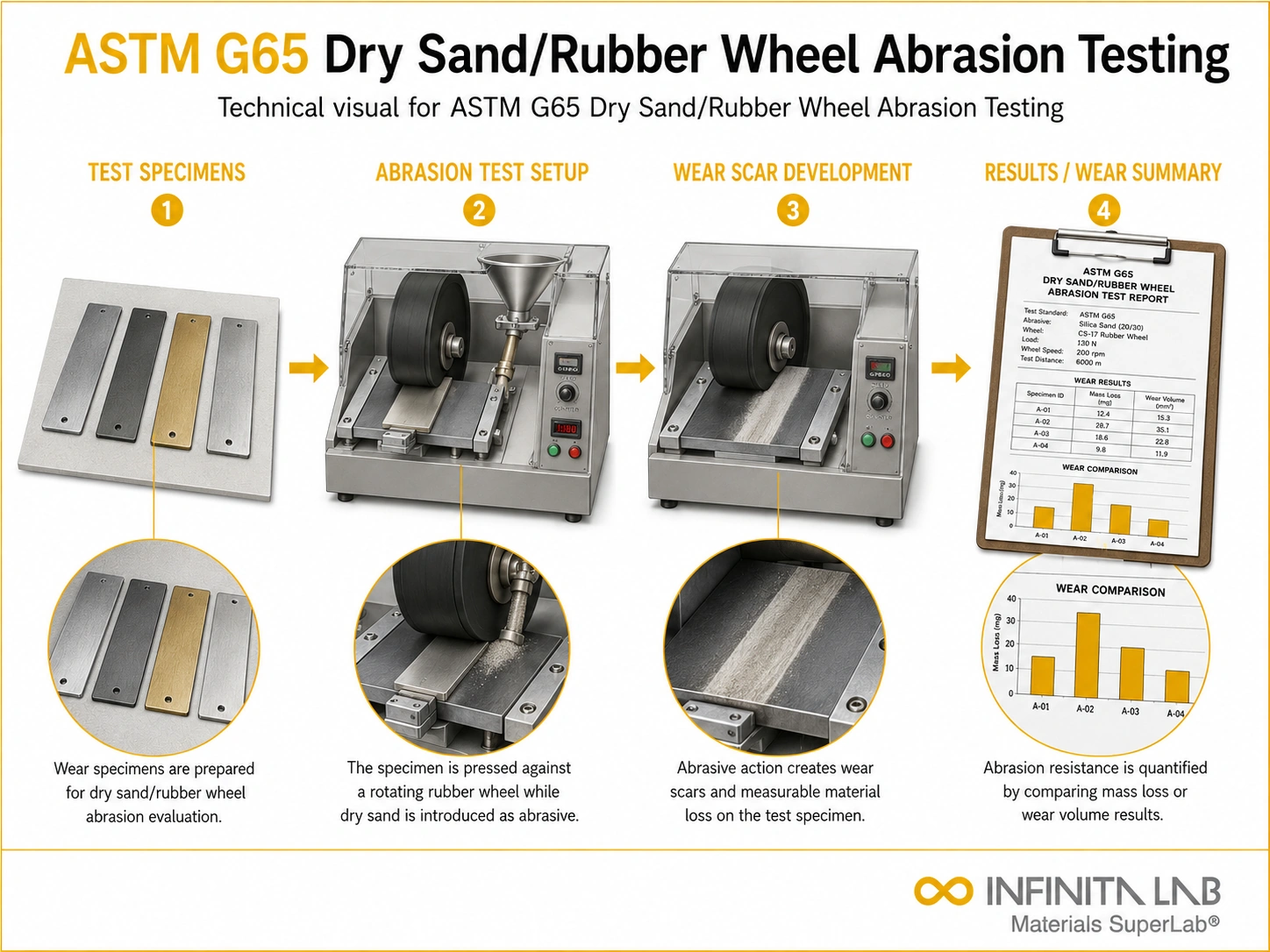
ASTM G65 is the standard test method for measuring the abrasion resistance of metallic materials, hard coatings, and hard-facing overlays using a dry sand/rubber wheel apparatus. The method quantifies how a material withstands low-stress, three-body abrasive wear, the kind of gradual material loss that occurs when loose abrasive particles are trapped and dragged between a moving surface and a softer counter-body, similar to conditions found in mining, earthmoving, and mineral-processing equipment. During the test, a flat specimen is pressed with a controlled, fixed load against a rotating rubber-rimmed steel wheel while a metered stream of dry, rounded quartz sand is fed into the contact zone between the wheel and the specimen. The sand acts as the abrasive medium, and the rubber wheel’s controlled hardness ensures consistent, reproducible contact conditions from test to test and lab to lab. After a specified number of wheel revolutions, the specimen is removed, cleaned, and weighed, and the mass loss is converted into a volume loss figure using the material’s density, giving a result that can be compared fairly across materials of different densities. ASTM G65 defines five procedures, A through E, which vary the applied load, sand flow, and revolution count to suit materials ranging from thick wear-resistant plate and hard facing deposits to thin coatings that would otherwise be worn through. Because the method isolates abrasive wear from other degradation mechanisms, it is widely specified by OEMs and fabricators of wear parts, coating suppliers, and metallurgical laboratories to rank candidate alloys, weld overlays, and thermal spray coatings before they are committed to service in abrasive environments.

Applications and Benefits of ASTM G65 Dry Sand Rubber Wheel Abrasion Testing
Scope
- Covers laboratory determination of the resistance of metallic materials to scratching abrasion produced by dry sand under controlled load and sliding conditions.
- Applies to a rotating rubber-rimmed wheel apparatus with sand fed at a metered rate between the wheel and a flat test specimen.
- Defines five standard procedures (A, B, C, D, and E) that vary applied load, wheel revolutions, and test duration for different material and coating thicknesses.
- Specifies the abrasive as rounded silica sand of a controlled grain size and size distribution to ensure consistent cutting action.
- Establishes requirements for the rubber wheel’s dimensions and durometer hardness so that contact conditions remain reproducible.
- Requires reporting of results as volume loss, calculated from measured mass loss and known material density.
- Applies to metallic materials and coatings that can be prepared as flat, rigid test specimens of the required dimensions.
- Notes that results are comparative rather than absolute, since abrasive wear performance depends on the specific abrasive, load, and counter-body used.
- Excludes wear mechanisms other than low-stress dry sand abrasion, such as erosion, gouging abrasion, or corrosive wear.
- Allows testing of coated, hardfaced, or surface-treated specimens provided the coating thickness is compatible with the selected procedure.
Applications
- Ranking wear-resistant steels, white cast irons, and abrasion-resistant alloys for use in ground-engaging and material-handling equipment.
- Evaluating hard-facing weld overlays applied to buckets, dredge parts, crusher components, and other high-wear surfaces.
- Screening thermal spray coatings, such as tungsten carbide or chrome carbide cermets, for abrasion resistance before field deployment.
- Comparing heat-treated or surface-hardened steel grades intended for chutes, hoppers, liners, and conveyor components.
- Supporting material selection for mining, quarrying, cement, agriculture, and earthmoving equipment exposed to loose particulate abrasives.
- Qualifying new alloy or coating formulations during product development against established baseline materials.
- Providing comparative data for failure analysis and root-cause investigations involving premature abrasive wear.
Benefits
- Delivers quantitative, repeatable volume-loss data that supports objective comparison between competing materials and coatings.
- Uses standardised apparatus and procedures, allowing results to be compared across laboratories and over time.
- Simulates a common real-world wear mechanism, giving engineers relevant data for design and material selection decisions.
- Requires relatively small, easily prepared specimens, keeping sample costs and lead times manageable.
- Supports procurement and quality assurance by verifying that incoming materials or coatings meet specified abrasion-resistance targets.
- Offers a well-established, widely recognised benchmark that is broadly accepted across mining, industrial, and manufacturing sectors.
Our ASTM G65 Testing Procedure
Specimen Preparation
Samples are machined to specified dimensions and cleaned to remove contaminants before testing.
1Test Setup
The specimen is pressed against a rotating rubber wheel while dry sand is introduced between the contact surfaces.
2Abrasion Exposure
Controlled load, wheel speed, and sand flow create continuous abrasive wear on the specimen surface.
3Wear Measurement
Material loss is measured after testing, typically by weight or volume change, to determine abrasion resistance.
4ASTM G65 Test Parameters and Requirements
| Parameter | Details |
|---|---|
| Test Principle | Three-body abrasive wear using dry sand and rubber wheel |
| Specimen Size (typical) | ~25 mm × 75 mm × 3–12 mm |
| Abrasive Size | 212–300 µm (as specified in ASTM G65) |
| Test Duration | Fixed revolutions or time (method dependent) |
| Environment | Ambient laboratory conditions |
| Wear Measurement | Mass loss and calculated volume loss |
| Units | mm³ volume loss or mass loss (g) |


- Dry sand/rubber wheel abrasion tester – Drives the rotating rubber-rimmed wheel against the specimen under a controlled, applied load.
- Calibrated sand feed system – Meters a controlled, consistent flow of abrasive sand into the wheel/specimen contact zone throughout the test.
- Analytical balance – Provides precise before-and-after mass measurements used to determine mass loss.
- Precision load cell or deadweight loading system – Applies and verifies the specified normal load on the specimen during testing.
- Tachometer or speed control system – Monitors and maintains the rubber wheel’s rotational speed within specification.
- Specimen preparation equipment – Includes machining, grinding, and surface-finishing tools used to produce compliant test coupons.
- Sieve and grain-size verification equipment – Confirms the abrasive sand meets the required particle size distribution before use.
Equipment and Instrumentation Used for ASTM G65 Testing
What You Receive: Test Report, Data, and Certification
- A detailed test report documenting the procedure used, applied load, revolutions, and all as-run test parameters.
- Volume loss results (mm³) for each specimen, calculated from measured mass loss and material density.
- Comparative data tables when multiple materials, coatings, or heat treatments are tested side by side.
- Photographic documentation of specimen wear scars and surface condition before and after testing, where requested.
- Traceable records of specimen identification, balance calibration, and sand batch verification supporting data integrity.
- A clear summary interpretation to support material selection, quality assurance, or failure-analysis decisions.
ASTM G65 Dry Sand Rubber Wheel Abrasion FAQs
The ASTM G65 test simulates sliding abrasion conditions under moderate pressure. It uses dry sand metered between a rubber wheel and a block coupon of the material being evaluated.
The rubber wheel allows abrasive particles to embed slightly, ensuring consistent contact and controlled abrasion. This prevents excessive impact forces and ensures the wear mechanism remains dominated by sliding abrasion rather than impact erosion.
It uses controlled parameters such as load, sand flow rate, wheel speed, and test duration, minimizing variability and ensuring consistent results across laboratories.
Coatings may exhibit initial high resistance but can fail rapidly once worn through, exposing the substrate, which significantly affects overall wear performance.
Two-body abrasion involves direct contact between surfaces, while three-body abrasion involves loose particles acting as the abrasive medium, as in ASTM G65.
ASTM G65 evaluates abrasion resistance using a dry sand/rubber wheel apparatus. A controlled stream of abrasive sand passes between a rotating rubber wheel and the test specimen, and the resulting volume loss is measured; lower volume loss indicates greater abrasion resistance.
ASTM G65 can be used to evaluate the abrasion resistance of cement-based liners or other wear-resistant materials when they are suitable for the test method. However, ASTM G65 itself is specifically written for metallic materials and their surface treatments, so its applicability to cement liners should be confirmed based on the project requirements.
Why Choose Infinita Lab for Dry Sand Rubber Wheel Abrasion Testing
When your Dry Sand Rubber Wheel Abrasion results have to hold up - for compliance, a customer audit, or an engineering decision - ASTM G65 accuracy and an unbiased third-party report matter more than price. Infinita Lab routes your ASTM G65 dry sand rubber wheel abrasion testing to ISO/IEC 17025-accredited U.S. partner labs with hands-on method experience, so you get defensible data, transparent reporting, and turnaround times built around your project deadline - not ours.

Need ASTM G65 Dry Sand Rubber Wheel Abrasion Testing You Can Rely On?
Send query us at hello@infinitalab.com or call us at (888) 878-3090 to learn more about our services and how we can support you.



Request a Quote
Submit your material details and receive testing procedures, pricing, and turnaround time within 24 hours.
 Quick Turnaround and Hasslefree process
 Confidentiality Guarantee
 Free, No-obligation Consultation
 100% Customer Satisfaction
