


ASTM C241: Stone Foot Traffic Abrasion Resistance Testing Services
Accredited ASTM C241 stone foot traffic abrasion resistance testing from Infinita Lab, performed to the exact standard requirements - accurate, reproducible results with full documentation for compliance, R&D, and quality control programs.
TRUSTED BY


Get ASTM C241 compliant results - request your stone foot traffic abrasion resistance testing quote
- Overview
- Scope, Applications, and Benefits
- Test Process
- Specifications
- Instrumentation
- Results and Deliverables
What Is ASTM C241 Stone Foot Traffic Abrasion Resistance?
ASTM C241/C241M, Standard Test Method for Abrasion Resistance of Stone Subjected to Foot Traffic, is ASTM International’s longstanding procedure for measuring how natural building stone holds up against the wear foot traffic causes over time. The method dates back decades. It was most recently revised as the C241/C241M-21 edition, and it still sits under Subcommittee C18.01 within Committee C18 on Dimension Stone. Labs use it regularly today, especially for harder, coarse-grained stones like granite, where the newer rotary-platform alternative, C1353/C1353M, doesn’t fit the job.
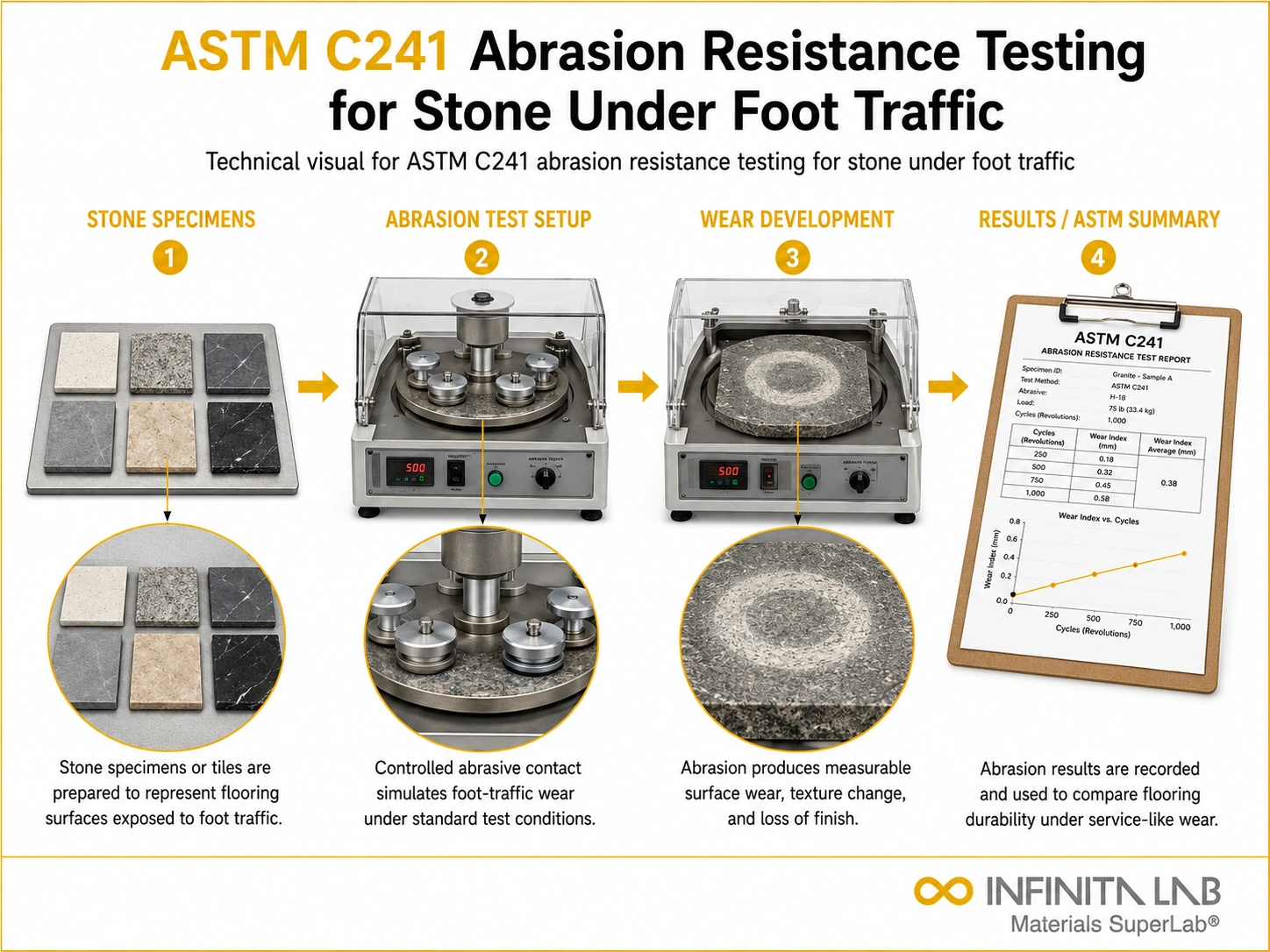
At the center of the test sits a Dorry-type abrasion machine – a motor-driven, horizontal grinding lap, roughly 10 inches across, spinning at a fixed 45 rpm. At least three square stone specimens go into individual holders. Each one measures about 2 inches on a side and roughly 1 inch thick, with rounded edges, and gets pressed against the rotating lap under a 2,000-gram load. Abrasive grit feeds onto the lap continuously throughout the run – traditionally a coarse aluminum oxide known as No. 60 Alundum – and each specimen takes 225 revolutions of abrasion.
Wear gets quantified as weight loss -, how much material is ground away during the run. That figure feeds into a formula along with the stone’s bulk specific gravity and average specimen weight, producing an abrasive hardness value reported to two significant figures and averaged across the specimen set. This isn’t a pass/fail test. Its real value is comparative: ranking abrasion resistance across different stone types, or flagging variability within a single quarry’s output, rather than checking compliance against some fixed number.

Applications and Benefits of ASTM C241 Stone Foot Traffic Abrasion Resistance Testing
Scope
ASTM C241/C241M determines the abrasion resistance of stone surfaces by simulating foot traffic conditions using controlled abrasive action.
It helps compare material performance and suitability for flooring and paving applications.
- This standard lays out a lab method for measuring how natural building stone resists the surface wear that foot traffic produces.
- It covers all types of dimension stone – marble, granite, limestone, slate, and other quarried stone meant for floors, steps, and similarly trafficked surfaces.
- Testing happens on a Dorry-type abrasion machine, fitted with a rotating horizontal grinding lap about 10 inches across.
- At least three specimens get tested per sample set, each a 2-inch square with rounded edges so that the result can be averaged.
- A fixed 2,000-gram load holds each specimen against the lap, while a measured charge of coarse aluminum oxide grit feeds continuously onto the abrading surface.
- The lap spins at a constant 45 rpm. Each specimen gets 225 revolutions during the run.
- Material lost from each specimen gets weighed, then converted – using the stone’s bulk specific gravity – into an abrasive hardness value expressed to two significant figures.
- Results come out as an average across the specimen set, not a single pass/fail determination, since the method’s built for comparative ranking.
- It’s especially suited to harder, coarse-grained stones such as granite, where the rotary-platform alternative, ASTM C1353/C1353M, isn’t considered appropriate.
- No coverage here for impact resistance, chemical attack, or weathering – just mechanical wear from repeated abrasive contact.
Applications
- Specifiers use it to evaluate candidate stone slabs or tiles before committing to high-traffic flooring in commercial lobbies, transit stations, and public buildings.
- Comparing abrasion resistance across quarries or stone types helps during material selection for paving and walkway projects.
- It verifies consistency of abrasion performance across production batches from the same quarry source.
- Useful for architectural specification documents and stone supplier qualification programs.
- Maintenance planning benefits too – results flag which stones will likely show wear sooner in heavily trafficked zones.
- Restoration and historic preservation projects rely on it when replacement stone has to match the wear characteristics of existing material.
- It also feeds comparative data into research on new stone sources or quarry development.
Benefits
- A standardized, repeatable way to compare durability across stone types before anything gets installed.
- Specifying a stone that wears unevenly or wears out fast under heavy pedestrian use becomes far less likely.
- Long-term maintenance cost planning gets easier, since lower-abrasion-resistance stones get flagged early.
- Architects, specifiers, and quarries gain a shared, recognized benchmark for talking about stone performance.
- Project budgets stay protected, too – durability issues surface before installation, not after the wear is already visible.
- And it offers a comparative basis for choosing between stones that look alike but perform very differently underfoot.
Our ASTM C241 Testing Procedure
Sample Preparation
Stone specimen is cut and finished to specified dimensions and surface condition.
1Mounting
Sample is fixed in the abrasion testing machine securely.
2Abrasion Testing
Abrasive load is applied with rotating action to simulate foot traffic wear.
3Measurement
Material loss is measured to determine abrasion resistance value.
4ASTM C241 Test Parameters and Requirements
| Parameter | Details |
|---|---|
| Material Type | Natural stones such as marble, granite, and limestone. |
| Test Method | Rotating abrasive wheel with controlled load. |
| Abrasive Medium | Standard abrasive grit used for wear simulation. |
| Load Application | Defined load applied during testing. |
| Test Duration | Fixed number of revolutions or cycles. |
| Measured Parameter | Volume loss or wear depth. |
| Result Unit | Abrasion resistance index or loss value. |
| Surface Condition | Polished or finished stone surfaces. |


- Dorry Abrasion Machine – Supplies the rotating grinding lap and specimen holders, applying controlled load and abrasive contact.
- Analytical/Precision Balance – Weighs each specimen before and after abrasion so weight loss can be determined.
- Abrasive Grit Feed System – Keeps a steady, measured charge of abrasive grit flowing onto the lap throughout the run.
- Specimen Holders with Load Weights – Pin each specimen against the lap under the fixed 2,000-gram load.
- Drying Oven – Dries specimens completely before each weighing step, so moisture doesn’t skew the results.
- Callipers and Dimensional Gauges – Check that specimen dimensions meet the required size and thickness before testing starts.
- Specific Gravity Test Setup – Determines the bulk specific gravity value that feeds into the abrasive hardness calculation.
Equipment and Instrumentation Used for ASTM C241 Testing
What You Receive: Test Report, Data, and Certification
- A detailed test report stating the abrasive hardness value for each specimen, plus the averaged result for the full set.
- Full documentation of specimen dimensions, before-and-after weights, and the specific gravity used in the calculations.
- A record of test conditions – abrasive charge, load, speed, number of revolutions – kept for the file.
- Comparative data you can use to rank the sample against other stone types or sources.
- Descriptive notes on specimen condition before and after the abrasion cycle, if you ask for them.
- And, when needed, a certified lab report to support specification documents, submittals, or quarry qualification files.
ASTM C241 Stone Foot Traffic Abrasion Resistance FAQs
ASTM C241/C241M is a test method used to evaluate the abrasion resistance of natural stone surfaces under simulated foot traffic, helping determine durability and suitability for flooring applications in high-traffic environments.
Abrasion resistance indicates how well a stone can withstand wear from foot traffic, ensuring long-term durability, maintaining appearance, and reducing maintenance or replacement costs in heavily used areas.
Lower material loss indicates higher abrasion resistance, meaning the stone is more durable and better suited for high-traffic applications.
ASTM C241/C241M specifically simulates foot traffic using rotating abrasive action, making it more relevant for flooring applications compared to general abrasion tests that may not replicate pedestrian wear conditions accurately.
It helps architects and engineers choose materials that can withstand heavy foot traffic, reducing maintenance costs and ensuring long-term performance in commercial spaces like malls, airports, and offices.
Why Choose Infinita Lab for Stone Foot Traffic Abrasion Resistance Testing
When your Stone Foot Traffic Abrasion Resistance results have to hold up - for compliance, a customer audit, or an engineering decision - ASTM C241 accuracy and an unbiased third-party report matter more than price. Infinita Lab routes your ASTM C241 stone foot traffic abrasion resistance testing to ISO/IEC 17025-accredited U.S. partner labs with hands-on method experience, so you get defensible data, transparent reporting, and turnaround times built around your project deadline - not ours.

Need ASTM C241 Stone Foot Traffic Abrasion Resistance Testing You Can Rely On?
Send query us at hello@infinitalab.com or call us at (888) 878-3090 to learn more about our services and how we can support you.



Request a Quote
Submit your material details and receive testing procedures, pricing, and turnaround time within 24 hours.
 Quick Turnaround and Hasslefree process
 Confidentiality Guarantee
 Free, No-obligation Consultation
 100% Customer Satisfaction
