

What Is ASTM D6279 High Gloss Coating Rub Abrasion Mar?
ASTM D6279, Standard Test Method for Rub Abrasion Mar Resistance of High Gloss Coatings, outlines how labs test whether a glossy coating keeps its looks after it’s been rubbed, wiped, or cleaned repeatedly. ASTM Committee D01 on Paint and Related Coatings, Materials, and Applications maintains it. The current edition is D6279-26, filed under Book of Standards Volume 06.02. It doesn’t hand you a simple pass or fail. Instead, it builds comparative data: a coating gets abraded under set, repeatable conditions, then the gloss loss is checked against an untouched reference spot on that same panel.
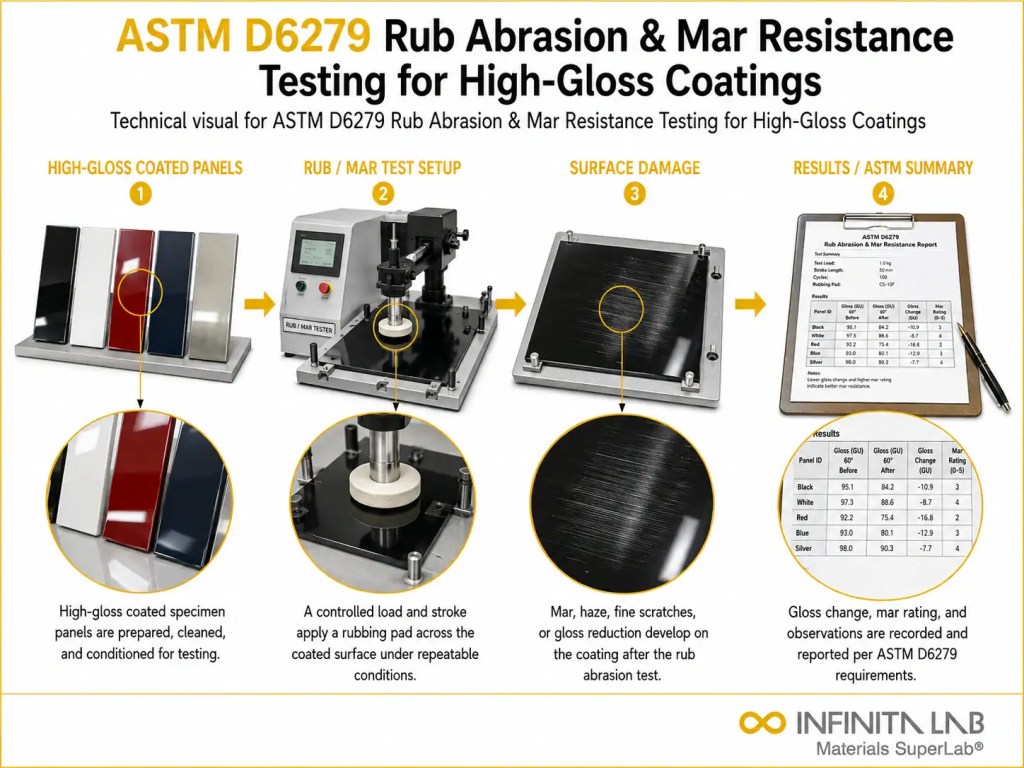
Two abrasion routes live inside this method: dry rub and wet rub. Please run both. The standard suggests doing so if you want the coating fully characterized, since marring in the field shows up differently depending on whether the contact is dry wiping or damp, cleaning-type use. Either way, a weighted friction pad moves back and forth across the coated panel for a set number of strokes, wearing a defined track into the surface. After that, a gloss meter reads specular gloss inside the abraded zone and compares it against the untouched portion of the panel. What comes out is a gloss-retention value, a number that reflects how well the coating resists surface marring relative to itself.
Because the results are comparative by nature, D6279 warns against treating data from different labs, or different reference coatings, as interchangeable unless they share a baseline. The standard also points toward D6037 as a complementary dry-abrasion method, one offering sharper discrimination for coatings that are exceptionally mar-resistant. D6279 isn’t built to stand alone. It’s one piece of a larger coatings-durability testing toolkit.
Applications and Benefits of ASTM D6279 High Gloss Coating Rub Abrasion Mar Testing
Scope
ASTM D6279-15 evaluates:
- ASTM D6279 lays out a standardized way to evaluate the relative rub abrasion mar resistance of high-gloss coatings applied to flat, rigid test panels.
- Results are comparative, not absolute. A tested coating only matters when benchmarked directly against a known reference formulation under identical conditions.
- This scope includes two abrasion routes: dry rub and wet rub. Running both gives the fuller picture of a coating’s mar performance.
- Mar resistance gets quantified by measuring specular gloss in the abraded area and comparing it to an unabraded reference area on that same test panel.
- A reciprocating, weighted friction pad traverses the coated surface for a defined number of strokes, leaving a consistent abrasion track behind.
- Panels are typically prepared in pairs for each coating under evaluation. Black substrates are generally preferred – they cut down on measurement variability tied to underlying color.
- Cross-laboratory comparisons of gloss-retention data need caution, unless everyone involved is working from a shared reference standard.
- D6279 references ASTM D6037 as an alternate dry-abrasion method, useful when better discrimination is needed among exceptionally mar-resistant, high-performance coatings.
- ASTM Committee D01 on Paint and Related Coatings, Materials, and Applications holds jurisdiction over the standard, which is published within Book of Standards Volume 06.02.
- Since the method targets surface-level gloss change rather than coating hardness or adhesion, it’s typically used alongside other coating-performance tests rather than as a standalone qualification method.
Applications
- Clear coats and topcoats on automotive exterior and interior trim components get evaluated this way routinely.
- Marine coatings facing repeated wiping, cleaning, and handling in service – this method fits them well.
- Toys and other consumer products with high-gloss finishes, the kind that see constant handling, are a frequent target too.
- Comparing competing coating formulations during product development and reformulation projects.
- Quality control programs lean on it to monitor batch-to-batch gloss-retention consistency.
- Screening candidate coatings for appearance-critical applications, where surface marring would be a visible, obvious problem.
- Validating supplier-submitted coating systems against an OEM’s internal mar-resistance requirements.
Benefits
- Swaps subjective visual judgment calls for objective, gloss-based data.
- Dry-wipe marring and wet-cleaning marring behave differently, and two separate test routes capture both.
- Equipment stays relatively accessible, so routine quality control testing isn’t a stretch.
- Repeatable, side-by-side results make ranking multiple coating candidates straightforward.
- Manufacturers can spot which coatings will likely hold their appearance through manufacturing, shipping, and everyday handling.
- Pairs well with other durability standards, like D6037, for a fuller mar- and abrasion-resistance profile.
Our ASTM D6279 Testing Procedure
Panel Preparation & Curing
The coating is applied uniformly, and the panels are dried or cured under controlled conditions.
1Abrasion Treatment
Panels are marred using dry media, wet media, or both over a defined area.
2Control Selection & Gloss Measurement
An unabraded area is retained; gloss is measured on both the unabraded and the glossed areas.
3Mar Resistance Calculation
Percent gloss retention is calculated to determine mar resistance.
4ASTM D6279 Test Parameters and Requirements
| Parameter | Details |
|---|---|
| Applicable Materials | High gloss coatings |
| Specimen Size | 101.6 × 152.4 mm (4 × 6 in.) |
| Optional Panel Size | 101.6 × 304.8 mm (4 × 12 in.) |
| Number of Specimens | Minimum two panels per coating |
| Recommended Colour | Black coatings for consistency |
| Measurement Output | Percent gloss retention |
| Measured Property | Mar resistance |


- Reciprocating Rub/Mar Tester – Drives the weighted friction pad back and forth across the coated panel, producing a controlled, repeatable abrasion track.
- Gloss Meter – Reads specular gloss on abraded and unabraded areas alike, so gloss retention and relative mar resistance can be calculated.
- Coating Application Equipment – Puts down the test coating in a controlled, consistent film, so every specimen starts from comparable conditions.
- Film Thickness Gauge – Checks that each coated panel’s dry film thickness sits within the intended range before testing even begins.
- Environmental Conditioning Chamber – Keeps panels at standard laboratory atmosphere, so temperature and humidity don’t creep into the gloss readings.
- Dry and Wet Abrasive Media – Supplies the friction surfaces used in the dry rub and wet rub procedures, respectively.
- Data Logging Software – Tracks gloss readings and abrasion parameters, keeping reporting consistent and side-by-side comparisons easy to line up.
Equipment and Instrumentation Used for ASTM D6279 Testing
What You Receive: Test Report, Data, and Certification
- A detailed test report documenting gloss readings before and after abrasion for both the dry and wet rub procedures.
- Calculated gloss-retention values, plus a relative mar-resistance ranking, for each coating evaluated.
- Side-by-side comparative data, useful for ranking multiple coating formulations against a reference standard.
- Records of test panel preparation, conditioning, and abrasion parameters used during the evaluation.
- Photographic or visual records of abraded panel areas, where requested, to back up the numerical gloss data.
- A final summary suitable for supplier qualification, internal R&D records, or customer-facing quality documentation.
ASTM D6279 High Gloss Coating Rub Abrasion Mar FAQs
ASTM D6279 determines the relative rub abrasion and mar resistance of high-gloss coatings. Mar resistance is evaluated by measuring the coating's ability to retain gloss after abrasion compared with the unabraded surface.
The method is intended for high-gloss coatings applied to flat, rigid surfaces. It is particularly relevant to coatings used on products such as automobiles, boats, toys, and other applications where maintaining surface appearance is important.
Yes. ASTM D6279 includes wet-rub and dry-rub abrasion tests. The standard indicates that both should be performed when a more complete characterization of a coating's mar resistance is required.
Mar resistance is assessed by comparing the gloss of the abraded area with the gloss of the unabraded area. A coating that retains more of its original gloss after rubbing demonstrates better relative mar resistance.
Yes. The method is primarily intended for relative performance ranking among coatings tested under comparable conditions. The resulting mar-resistance values do not have absolute significance, so comparisons between laboratories should be made cautiously and preferably with a common reference standard.
Why Choose Infinita Lab for High Gloss Coating Rub Abrasion Mar Testing
When your High Gloss Coating Rub Abrasion Mar results have to hold up - for compliance, a customer audit, or an engineering decision - ASTM D6279 accuracy and an unbiased third-party report matter more than price. Infinita Lab routes your ASTM D6279 high gloss coating rub abrasion mar testing to ISO/IEC 17025-accredited U.S. partner labs with hands-on method experience, so you get defensible data, transparent reporting, and turnaround times built around your project deadline - not ours.

Need ASTM D6279 High Gloss Coating Rub Abrasion Mar Testing You Can Rely On?
Send query us at hello@infinitalab.com or call us at (888) 878-3090 to learn more about our services and how we can support you.



