


ASTM G48: Pitting Crevice Corrosion Testing Services
ASTM G48 describes laboratory tests for comparing the resistance of stainless steels and related alloys to the initiation of pitting and crevice corrosion by the use of Ferric Chloride Solution. The ASTM G48 test is frequently used for corrosion testing within the metal industries.
TRUSTED BY


Get ASTM G48 compliant results — request your pitting crevice corrosion testing quote
- Overview
- Scope, Applications, and Benefits
- Test Process
- Specifications
- Instrumentation
- Results and Deliverables
What Is ASTM G48 Pitting Crevice Corrosion?
ASTM G48 covers laboratory test methods for comparing the resistance of stainless steels and related alloys to the initiation of pitting and crevice corrosion using a ferric chloride solution. Pitting and crevice corrosion are localized forms of attack – rather than thinning a surface uniformly, they concentrate at small sites, forming pits or attacking shielded crevices, and can perforate a component while most of its surface still looks sound. For stainless steels and nickel alloys, which rely on a passive oxide film for their corrosion resistance, chloride environments are the classic trigger for this localized breakdown.
The test uses an acidified ferric chloride solution, an aggressive chloride environment that promotes pitting and crevice attack, to challenge the alloy’s passive film. By exposing specimens to this solution under defined conditions – and, for crevice testing, with an attached crevice-forming device – the test reveals how resistant the alloy is to localized corrosion initiation. The standard contains several methods (commonly referred to as Methods A through F) covering pitting resistance, crevice resistance, and the determination of critical pitting and crevice temperatures.
ASTM G48 is one of the most widely used corrosion tests in the metals industry, particularly for ranking and qualifying stainless steels, duplex stainless steels, and nickel-based alloys for service in chloride-containing environments such as marine, chemical processing, and oil and gas applications. It is frequently specified to confirm that an alloy or weldment has the localized corrosion resistance expected for its grade.

Applications and Benefits of ASTM G48 Pitting Crevice Corrosion Testing
Scope
ASTM G48 covers the evaluation of pitting and crevice corrosion resistance of stainless steels and related alloys by exposure to ferric chloride solution. The standard provides several methods to address different objectives:
- Method A – ferric chloride pitting test, evaluating resistance to pitting by mass loss and pit examination after exposure
- Method B – ferric chloride crevice test, using a crevice-forming device to evaluate crevice corrosion resistance
- Methods C and D – determination of the critical pitting temperature (CPT) and critical crevice temperature (CCT), the minimum temperatures at which pitting or crevice attack initiates
- Methods E and F – additional procedures for critical temperature determination on specific product forms
- Evaluation basis – mass loss, presence and depth of pits, crevice attack, and/or critical temperature, depending on the method
- Applicable materials – stainless steels, duplex and super-duplex stainless steels, nickel-based alloys, and related alloys (including welds)
- Test environment – acidified ferric chloride solution under controlled temperature and exposure time
Applications
- Stainless steel and alloy ranking – comparing the localized corrosion resistance of different stainless steels and nickel alloys to support material selection for chloride environments
- Duplex and super-duplex stainless steel qualification – confirming the pitting/crevice resistance of duplex grades, which are widely used precisely for their localized corrosion resistance
- Weldment qualification – evaluating welds and heat-affected zones, where the localized corrosion resistance is often lower than the base metal, a common concern in fabricated stainless components
- Oil and gas / marine / chemical processing – qualifying alloys for service in chloride-rich environments where pitting and crevice corrosion are primary degradation risks
- Material acceptance testing – verifying that a heat or product form meets a specified pitting/crevice resistance requirement (often referenced via critical pitting/crevice temperature)
- Process and metallurgical verification – confirming that processing (such as solution annealing of duplex stainless steel) achieved the intended corrosion resistance
- Failure investigation – assessing whether inadequate localized corrosion resistance contributed to a pitting or crevice corrosion failure
Benefits
- Directly evaluates localized corrosion, the real risk for stainless – uniform corrosion is rarely what fails stainless steel in chloride service; pitting and crevice attack are, and G48 targets exactly these mechanisms
- Aggressive ferric chloride gives a discriminating challenge – the severe test environment effectively separates alloys by their localized corrosion resistance, making it a strong tool for ranking and qualification
- Critical temperature methods give a comparative ranking number – CPT and CCT provide a single comparative temperature that ranks alloys and is widely used in material specifications
- Reveals weldment weaknesses – because it can test welds and heat-affected zones, G48 catches cases where fabrication has reduced the localized corrosion resistance below that of the base metal
- Widely recognized for specification and acceptance – as a standard, well-established corrosion test, G48 results are accepted across the metals supply chain for material qualification in chloride environments
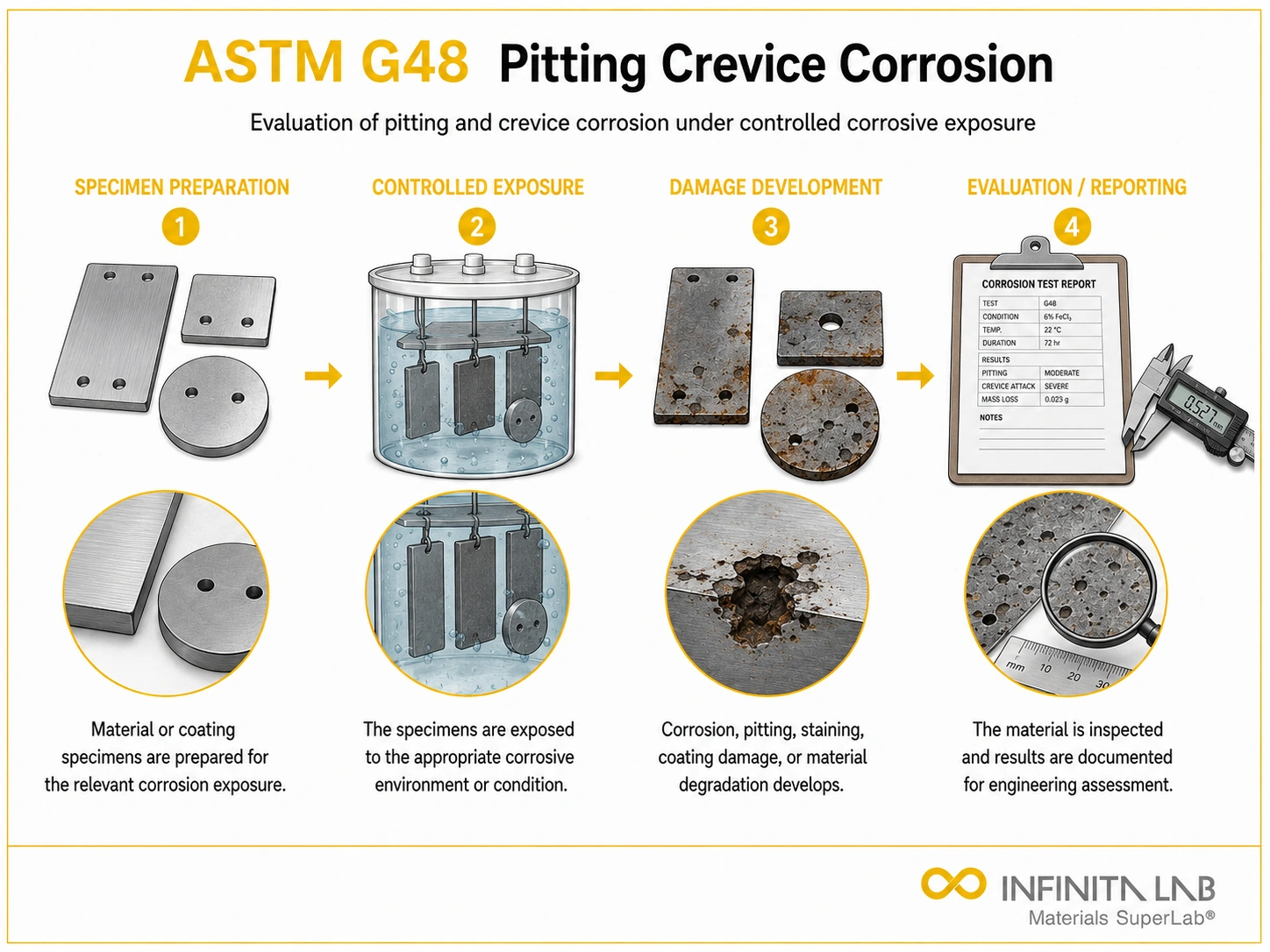
Our ASTM G48 Testing Procedure
Prepare the Specimens
Cut, finish, clean, and measure the samples, adding crevice assemblies where required.
1Prepare the Test Solution
Make the acidified ferric chloride solution and set the specified test temperature.
2Expose the Specimens
Immerse the samples for the required duration or apply stepped temperatures for CPT/CCT testing.
3Evaluate and Report
Assess mass loss, pitting, crevice attack, or critical temperature and report compliance with the test criteria.
4ASTM G48 Test Parameters and Requirements
| Parameter | Details |
|---|---|
| Methods | A (pitting), B (crevice), C/D (CPT/CCT), E/F (critical temperature, product-specific) |
| Test Solution | Acidified ferric chloride solution |
| Evaluation Basis | Mass loss, pit presence/depth, crevice attack, critical temperature |
| Critical Temperatures | Critical pitting temperature (CPT), critical crevice temperature (CCT) |
| Applicable Materials | Stainless steels, duplex/super-duplex, nickel-based alloys, weldments |
| Crevice Device | Crevice-forming assembly (Methods B/D and as applicable) |
| Controlled Variables | Solution composition, temperature, exposure time |


- Analytical balance for mass-loss determination
- Temperature-controlled bath or environmental control for the test solution
- Crevice-forming devices/assemblies (crevice methods)
- Optical microscope/stereo microscope for pit and crevice examination
- Pit depth measurement equipment
- Corrosion-resistant test vessels for ferric chloride exposure
- Specimen preparation equipment (cutting, surface finishing, cleaning)
Equipment and Instrumentation Used for ASTM G48 Testing
What You Receive: Test Report, Data, and Certification
- Corrosion test report – the method(s) used, test solution, temperature, exposure conditions, and results
- Pitting results – mass loss and pit observations (presence, number, depth) for pitting methods
- Crevice results – crevice attack assessment for crevice methods, including the crevice device used
- Critical temperature – determined critical pitting temperature (CPT) and/or critical crevice temperature (CCT) where those methods are run
- Specimen examination – visual and microscopic documentation of localized attack
- Comparison against specification (where provided) – results against the acceptance criterion (e.g., maximum mass loss or minimum critical temperature)
- Sample records – alloy grade/heat, product form, surface finish, weld details (if applicable), and specimen identification
ASTM G48 Pitting Crevice Corrosion FAQs
Pitting corrosion is a highly localised attack that produces small cavities or holes in a metal surface. Although pits may appear minor externally, they can penetrate deeply and cause rapid component failure.
ASTM G48 includes six procedures: Methods A and B for ferric chloride pitting and crevice tests, and Methods C through F for determining critical pitting or crevice temperatures.
Critical pitting temperature is the lowest temperature at which pitting initiates under the test conditions. Critical crevice temperature similarly identifies the minimum temperature at which crevice corrosion begins.
Prepared specimens are immersed in a controlled ferric chloride solution for a specified time and temperature. Crevice testing uses a controlled crevice former attached to the specimen surface.
Surface finish, grinding, pickling, heat treatment, alloy composition and specimen preparation can influence performance. ASTM notes that altered surfaces may not fully represent the condition of the original component.
Why Choose Infinita Lab for Geotextile Trapezoidal Tear Strength Testing?
At the core of this breadth is our network of 2,000+ accredited laboratories across the USA, offering access to over 10,000 testing methods and analytical services. From advanced materials characterization (SEM, TEM, RBS, XPS) to mechanical, chemical, environmental, biological, and standardized ASTM/ISO-compliant testing, we deliver unmatched flexibility, specialization, and scale. You are never limited by geography, facility, or methodology — Infinita Lab connects you to the right expertise and testing solution, every time.

Need ASTM G48 Pitting Crevice Corrosion Testing You Can Rely On?
Send query us at hello@infinitalab.com or call us at (888) 878-3090 to learn more about our services and how we can support you.



Request a Quote
Submit your material details and receive testing procedures, pricing, and turnaround time within 24 hours.
 Quick Turnaround and Hasslefree process
 Confidentiality Guarantee
 Free, No-obligation Consultation
 100% Customer Satisfaction
