


ASTM E477: Duct Liner Silencer Acoustic Testing Services
Accredited ASTM E477 duct liner silencer acoustic testing from Infinita Lab, performed to the exact standard requirements - accurate, reproducible results with full documentation for compliance, R&D, and quality control programs.
TRUSTED BY


Get ASTM E477 compliant results - request your duct liner silencer acoustic testing quote
- Overview
- Scope, Applications, and Benefits
- Test Process
- Specifications
- Instrumentation
- Results and Deliverables
What Is ASTM E477 Duct Liner Silencer Acoustic?
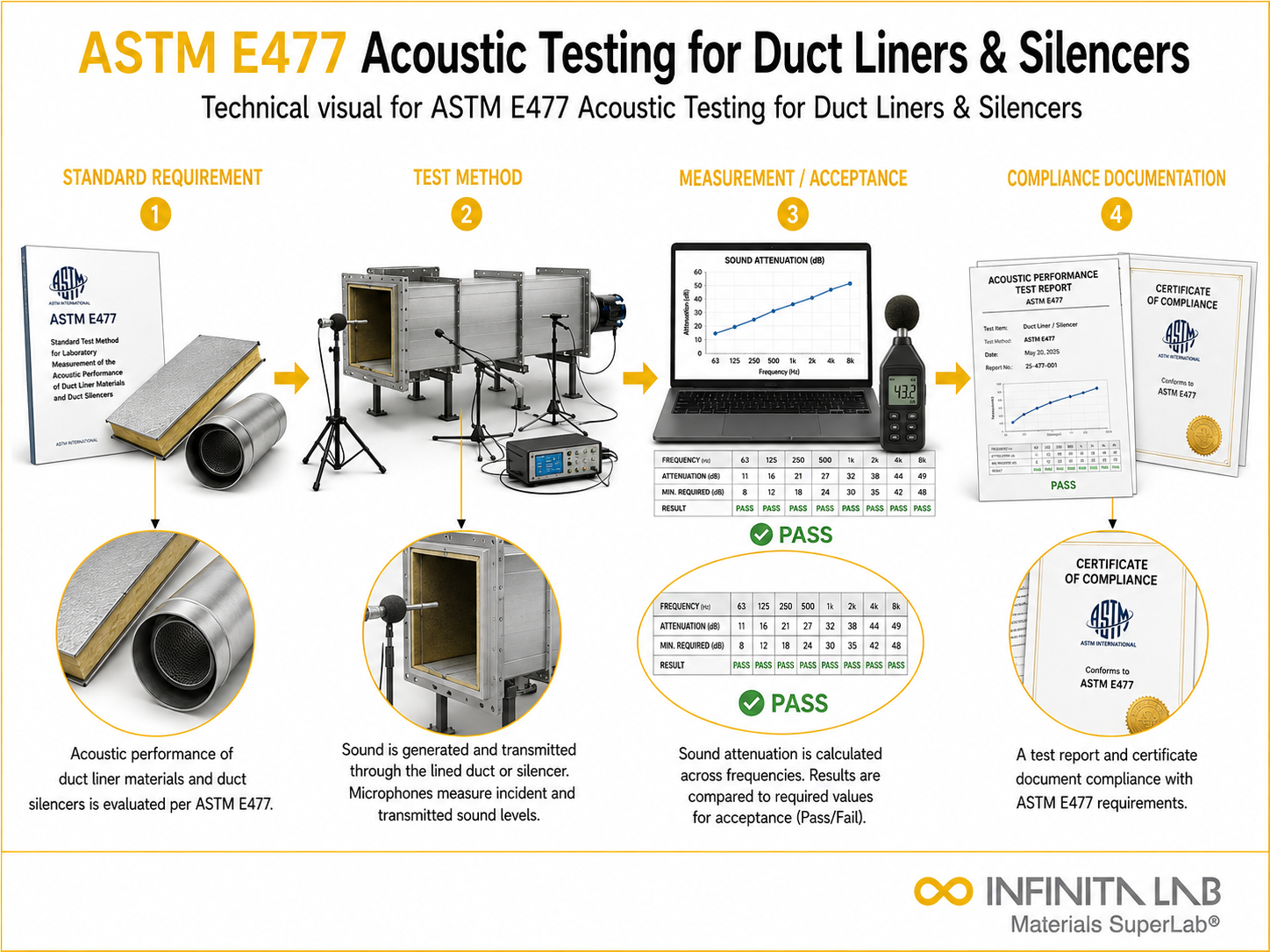
ASTM E477 – 13 defines laboratory methods to evaluate the acoustical and airflow performance of duct liner materials and prefabricated silencers used in air handling systems. The test measures parameters such as sound attenuation, pressure drop, and airflow resistance under controlled conditions to characterize performance.
This standard is critical for assessing materials and components used in HVAC and industrial ventilation systems. By combining acoustic and aerodynamic measurements, it enables accurate evaluation of noise control efficiency alongside airflow performance, ensuring optimized system design without compromising operational efficiency.

Applications and Benefits of ASTM E477 Duct Liner Silencer Acoustic Testing
Scope
ASTM E477 establishes procedures for measuring sound attenuation and airflow characteristics of duct liners and silencers under laboratory-controlled airflow conditions. It ensures reliable and repeatable evaluation of both acoustic and aerodynamic properties.
- Applicable to duct liner materials and prefabricated silencers
- Measures sound attenuation and pressure drop
- Suitable for HVAC and ventilation systems
- Enables combined acoustic and airflow performance assessment
Applications
- HVAC system design and optimization
- Noise control in air handling systems
- Industrial ventilation performance evaluation
- Testing of duct liners and silencers
- Building acoustics engineering
Benefits
- Provides combined acoustic and airflow performance data
- Supports efficient HVAC system design
- Ensures noise reduction without airflow compromise
- Enables comparison of different materials and silencers
- Improves indoor environmental quality
Our ASTM E477 Testing Procedure
Specimen Installation
Install duct liner or silencer in test duct under standardized configuration.
1Airflow Establishment
Generate controlled airflow through the duct system at specified rates.
2Acoustic Measurement
Measure sound attenuation across frequency ranges using microphones.
3Pressure Drop Evaluation
Record pressure differences to determine airflow resistance.
4ASTM E477 Test Parameters and Requirements
| Parameter | Details |
|---|---|
| Standard | ASTM E477 – 13 |
| Method | Laboratory acoustic and airflow performance testing |
| Measurement Parameters | Sound attenuation and pressure drop |
| Frequency Range | Typically across audible frequency bands |
| Airflow Range | Controlled duct airflow conditions |
| Applicable Materials | Duct liners and prefabricated silencers |
| Units | dB (sound), Pa (pressure drop), m³/s (airflow) |


- Acoustic measurement system (microphones and analyzers)
- Airflow measurement devices
- Pressure transducers or manometers
- Signal generator and sound source
- Data acquisition system
Equipment and Instrumentation Used for ASTM E477 Testing
What You Receive: Test Report, Data, and Certification
- Sound attenuation values across frequency bands
- Pressure drop across specimen
- Airflow rate and test conditions
- Acoustic performance curves
- Detailed laboratory test report
ASTM E477 Duct Liner Silencer Acoustic FAQs
ASTM E477 simultaneously measures sound attenuation and pressure drop under controlled airflow conditions. This integrated approach ensures materials are evaluated for both noise reduction effectiveness and aerodynamic impact, providing a realistic representation of in-service performance.
Pressure drop indicates airflow resistance introduced by the material. Excessive resistance reduces system efficiency and increases energy consumption, making it essential to balance acoustic performance with minimal airflow obstruction.
Sound attenuation is measured using microphones and analyzers across standardized frequency bands. This provides a frequency-dependent performance profile, helping engineers understand how materials behave under different noise conditions.
Unlike purely acoustic tests, ASTM E477 evaluates performance under actual airflow conditions. This accounts for flow-induced noise and aerodynamic effects, offering a more realistic assessment of material performance in HVAC systems.
Higher airflow velocities can introduce turbulence and flow noise, affecting sound attenuation measurements. Controlled airflow ensures consistent conditions, allowing accurate evaluation of material performance under specified operating scenarios.
Why Choose Infinita Lab for Duct Liner Silencer Acoustic Testing?
When your Duct Liner Silencer Acoustic results have to hold up - for compliance, a customer audit, or an engineering decision - ASTM E477 accuracy and an unbiased third-party report matter more than price. Infinita Lab routes your ASTM E477 duct liner silencer acoustic testing to ISO/IEC 17025-accredited U.S. partner labs with hands-on method experience, so you get defensible data, transparent reporting, and turnaround times built around your project deadline - not ours.

Need ASTM E477 Duct Liner Silencer Acoustic Testing You Can Rely On?
Send query us at hello@infinitalab.com or call us at (888) 878-3090 to learn more about our services and how we can support you.



Request a Quote
Submit your material details and receive testing procedures, pricing, and turnaround time within 24 hours.
 Quick Turnaround and Hasslefree process
 Confidentiality Guarantee
 Free, No-obligation Consultation
 100% Customer Satisfaction
