


ASTM E439: Beryllium Chemical Analysis Testing Services
These ASTM E439 test methods for the chemical analysis of beryllium metal are primarily designed to be referee procedures for testing such materials for compositional conformity. All users of these test methods are presumed to be qualified analysts capable of completing common laboratory operations skillfully and securely. The job is anticipated to be done in a suitably equipped laboratory.
TRUSTED BY


Get ASTM E439 compliant results — request your beryllium chemical analysis testing quote
- Overview
- Scope, Applications, and Benefits
- Test Process
- Specifications
- Instrumentation
- Results and Deliverables
What Is ASTM E439 Beryllium Chemical Analysis?
ASTM E 439 chemical analysis testing is the standardized reference test method for determining the elemental composition of beryllium metal — providing accurate, traceable impurity concentration data for chromium, iron, manganese, nickel, and other trace elements in beryllium metal through defined photometric analytical procedures. ASTM E 439 covers beryllium with purity from 97.50% to 100% and defines specific photometric wavelengths, reagent complexation procedures, and calibration curve methods required to accurately quantify impurity elements — providing metallurgists, beryllium processors, and laboratory analysts with reliable compositional data for material conformity assessment, incoming inspection, and supplier assessment programs.

Applications and Benefits of ASTM E439 Beryllium Chemical Analysis Testing
Scope
ASTM E 439 determines impurity element concentrations in beryllium metal by dissolving the beryllium matrix and applying defined photometric complexation procedures for each target element, measuring absorbance at defined wavelengths against calibrated reference curves to calculate impurity concentrations within the specified analytical ranges for beryllium compositional conformity assessment.
ASTM E 439 chemical analysis testing evaluates:
- Chromium content from 0.004% to 0.04% by diphenylcarbazide photometric analysis at 540 nm
- Iron content from 0.05% to 0.25% by 1,10-phenanthroline photometric analysis at 515 nm
- Manganese content from 0.008% to 0.04% by periodate photometric analysis at 525 nm
- Nickel content from 0.001% to 0.04% by dimethylglyoxime photometric analysis at 465 nm
- Compliance against elemental concentration limits for beryllium metal compositional specifications
Applications
- Beryllium metal and beryllium alloy materials requiring compositional conformity assessment
- Aerospace and defense beryllium component material impurity verification programs
- Nuclear and scientific instrument beryllium component elemental composition assessment
- Beryllium oxide and beryllium metal product incoming inspection programs
- Beryllium producers and processors requiring ASTM E 439 referee chemical analysis data
Benefits
- Provides reliable impurity concentration data for beryllium metal compositional conformity assessment
- Supports beryllium material specification compliance and supplier assessment programs
- Identifies impurity exceedances in beryllium metal before component fabrication
- Delivers traceable photometric analytical records for engineering and regulatory submissions
- Reduces material risk by verifying beryllium impurity content early in the material assessment cycle
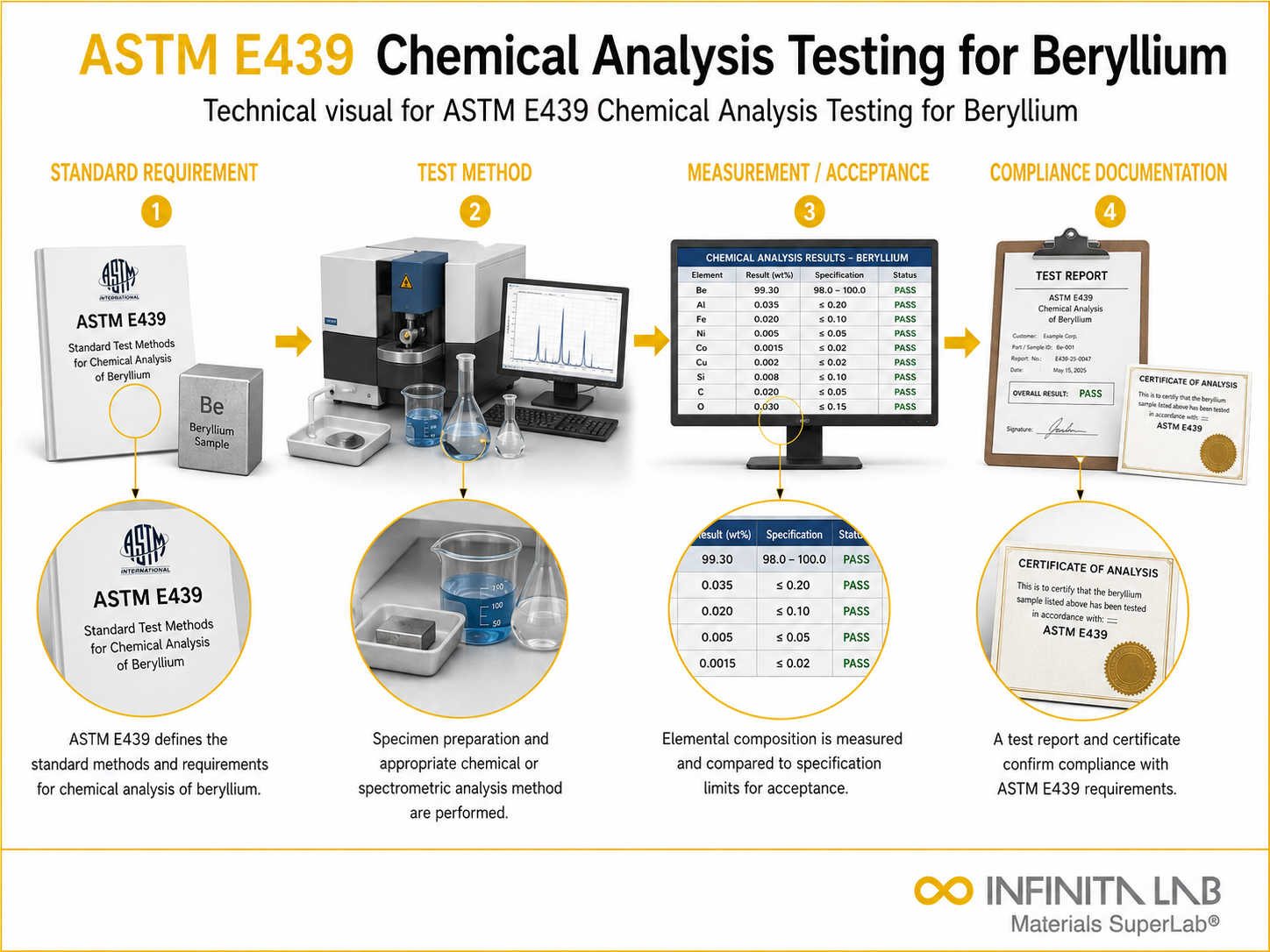
Our ASTM E439 Testing Procedure
Sample Preparation
Beryllium metal specimens dissolved and prepared per ASTM E 439 dissolution procedures.
1Photometric Complexation
Target elements complexed with specific reagents at defined pH and solution conditions per ASTM E 439.
2Absorbance Measurement
Complex absorbance measured at element-specific wavelengths against calibrated reference curves.
3Data Analysis & Reporting
Impurity concentrations calculated from calibration curves and assessed for test compliance result.
4ASTM E439 Test Parameters and Requirements
| Parameter | Details |
|---|---|
| Applicable Materials | Beryllium metal with beryllium content 97.50% to 100% per ASTM E 439 compositional range |
| Chromium Analysis | Diphenylcarbazide photometric method at 540 nm — range 0.004% to 0.04% Cr |
| Iron Analysis | 1,10-phenanthroline photometric method at 515 nm — range 0.05% to 0.25% Fe |
| Manganese Analysis | Periodate photometric method at 525 nm — range 0.008% to 0.04% Mn |
| Nickel Analysis | Dimethylglyoxime photometric method at 465 nm — range 0.001% to 0.04% Ni |
| Measured Outputs | Chromium, iron, manganese, and nickel concentration values and test compliance result |


- UV-Visible spectrophotometer for multi-wavelength photometric absorbance measurement at 465 nm, 515 nm, 525 nm, and 540 nm
- Certified chromium, iron, manganese, and nickel reference standards for calibration curve preparation
- pH measurement and control system for defined solution chemistry conditions
- Acid dissolution and matrix preparation equipment for beryllium specimen digestion
- Precision analytical balance for specimen and reagent mass measurement
- Data acquisition and test reporting system
Equipment and Instrumentation Used for ASTM E439 Testing
What You Receive: Test Report, Data, and Certification
- Photometric absorbance data and calibration curve results for all analyzed beryllium specimens
- Chromium, iron, manganese, and nickel concentration values per ASTM E 439 analytical ranges
- Statistical summary of impurity concentration results across the beryllium specimen set
- Test compliance result assessed against the beryllium metal elemental specification requirements
- ASTM E 439 chemical analysis report for material conformity assessment, incoming inspection, and supplier assessment submissions
ASTM E439 Beryllium Chemical Analysis FAQs
ASTM E 439 also covers aluminum (0.05–0.30%), beryllium oxide (0.30–3.00%), carbon (0.05–0.30%), copper (0.005–0.10%), magnesium (0.02–0.15%), and silicon (0.02–0.15%) — providing a comprehensive elemental impurity profile for beryllium metal compositional conformity assessment.
Each ASTM E 439 complexation reaction produces a colored product with maximum absorbance at a specific wavelength — 540 nm for chromium, 515 nm for iron, 525 nm for manganese, and 465 nm for nickel — where measurement sensitivity is highest and interference from other dissolved species is minimized.
Beryllium and its compounds are classified as toxic and potentially carcinogenic — ASTM E 439 testing must be performed by qualified analysts in properly equipped laboratories with appropriate engineering controls, personal protective equipment, and beryllium-specific safety protocols to prevent inhalation and dermal exposure during dissolution and handling.
ASTM E 439 is a referee procedure — meaning it provides a standardized, authoritative analytical method used to resolve disputes between buyer and seller regarding beryllium compositional conformity, with results from ASTM E 439 procedures taking precedence over routine or non-standardized analytical methods.
Beryllium metal requiring ASTM E 439 compositional analysis is used in aerospace structural components, defense optical systems, nuclear reactor moderators, X-ray windows, scientific instruments, and high-performance electronic heat sinks where precise elemental purity directly affects component performance and reliability.
Why Choose Infinita Lab for Beryllium Chemical Analysis Testing
At the core of this breadth is our network of 2,000+ accredited laboratories across the USA, offering access to over 10,000 testing methods and analytical services. From advanced materials characterization (SEM, TEM, RBS, XPS) to mechanical, chemical, environmental, biological, and standardized ASTM/ISO-compliant testing, we deliver unmatched flexibility, specialization, and scale. You are never limited by geography, facility, or methodology — Infinita Lab connects you to the right expertise and testing solution, every time.

Looking for an Accredited Partner for ASTM E439 Beryllium Chemical Analysis Testing?
Send query us at hello@infinitalab.com or call us at (888) 878-3090 to learn more about our services and how we can support you.



Request a Quote
Submit your material details and receive testing procedures, pricing, and turnaround time within 24 hours.
 Quick Turnaround and Hasslefree process
 Confidentiality Guarantee
 Free, No-obligation Consultation
 100% Customer Satisfaction
