


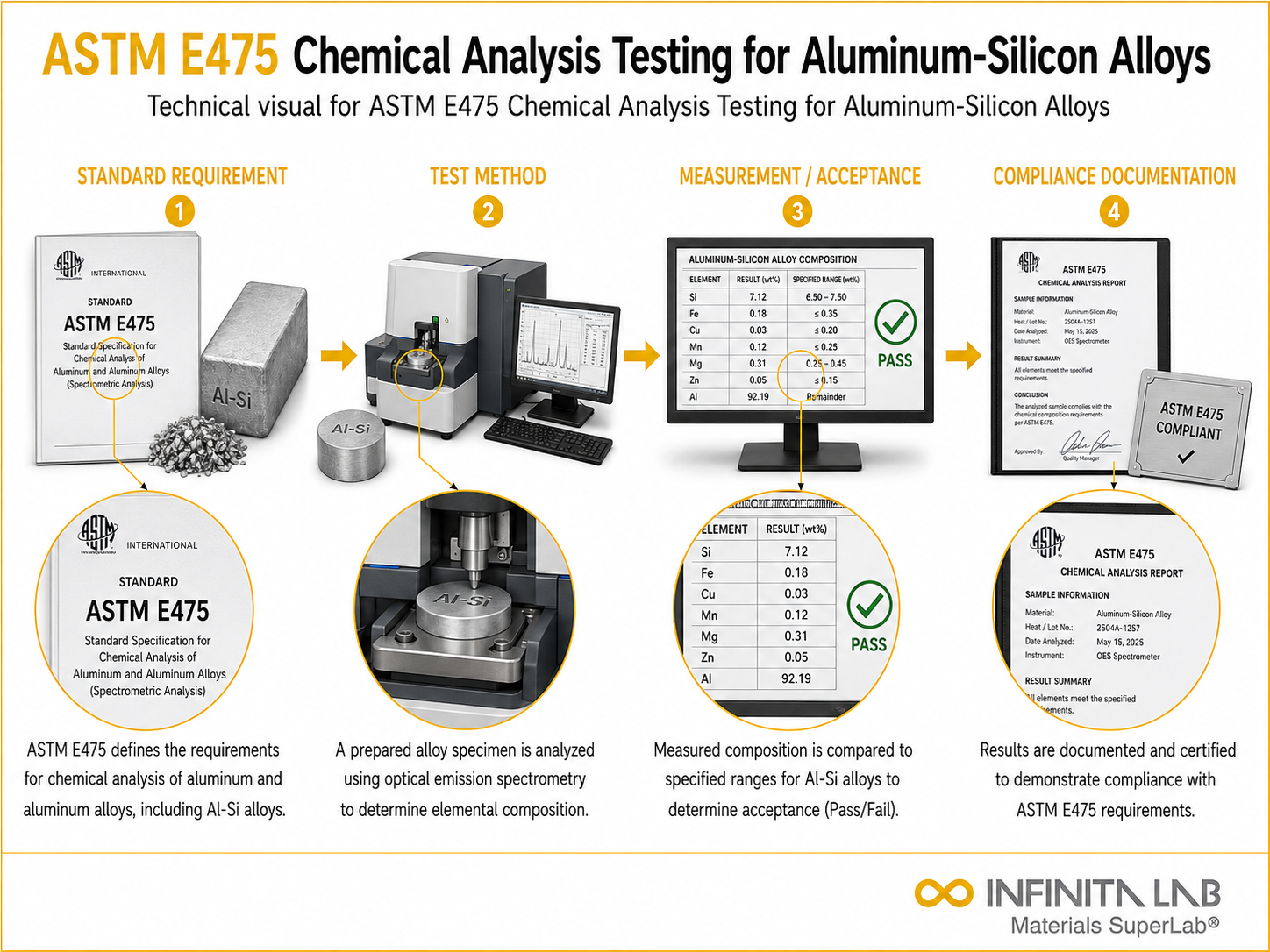
ASTM E475: Aluminum Silicon Alloy Chemical Analysis Testing Services
ASTM E475 – 10 explains the assay of di-tert-butyl peroxide with the help of gas chromatography. It is also applicable to commercial di-tert-butyl peroxide, with contains small impurities. Flame ionization and the Karl fisher method are used to perform this method. Its values are stated in SI units as they are to be regarded as standard.
TRUSTED BY


Get ASTM E475 compliant results — request your aluminum silicon alloy chemical analysis testing quote
- Overview
- Scope, Applications, and Benefits
- Test Process
- Specifications
- Instrumentation
- Results and Deliverables
What Is ASTM E475 Aluminum Silicon Alloy Chemical Analysis?
ASTM E475 – 10 specifies a gas chromatographic method for determining the assay (purity) of di-tert-butyl peroxide (DTBP). The technique separates DTBP from impurities and quantifies it based on detector response, ensuring accurate compositional analysis of this thermally sensitive organic peroxide.
This method is critical for evaluating DTBP quality in applications where controlled decomposition and reactivity are essential. Gas chromatography provides high resolution and sensitivity, enabling precise identification and quantification of DTBP, which is important for maintaining consistency and performance in high-temperature chemical processes.

Applications and Benefits of ASTM E475 Aluminum Silicon Alloy Chemical Analysis Testing
Scope
ASTM E475 outlines a gas chromatographic procedure for determining the purity of di-tert-butyl peroxide. It focuses on accurate separation and quantification under controlled analytical conditions.
- Applicable to di-tert-butyl peroxide samples
- Suitable for purity and impurity profiling
- Based on gas chromatographic separation
- Enables quantitative analysis using detector response
Applications
- Purity assessment of organic peroxides
- Quality control of DTBP production
- Chemical process monitoring
- Research and analytical laboratories
- Stability and decomposition studies
Benefits
- High sensitivity and specificity
- Accurate quantification of DTBP content
- Rapid and reproducible analysis
- Effective impurity separation
- Suitable for routine laboratory testing
Our ASTM E475 Testing Procedure
Sample Preparation
Dilute DTBP sample with suitable solvent for GC compatibility.
1Chromatographic Separation
Inject sample into gas chromatograph for component separation.
2Detection and Recording
Detect DTBP peak using appropriate detector and record chromatogram.
3Quantitative Calculation
Calculate assay based on peak area and calibration standards.
4ASTM E475 Test Parameters and Requirements
| Parameter | Details |
|---|---|
| Standard | ASTM E475 – 10 |
| Method | Gas chromatography (GC) analysis |
| Analyte | Di-tert-butyl peroxide (DTBP) |
| Column Type | Capillary GC column suitable for volatile organics |
| Temperature Program | Controlled oven temperature for separation |
| Applicable Materials | Organic peroxide samples |
| Measurement Basis | Peak area proportional to concentration |
| Units | Percentage (%) purity |


- Gas chromatograph (GC)
- Flame ionization detector (FID)
- Capillary column
- Analytical balance
- Microliter syringe or autosampler
Equipment and Instrumentation Used for ASTM E475 Testing
What You Receive: Test Report, Data, and Certification
- DTBP assay (% purity)
- Chromatogram with peak identification
- Retention time data
- Calibration and quantification details
- Analytical test report
ASTM E475 Aluminum Silicon Alloy Chemical Analysis FAQs
Gas chromatography provides excellent separation of DTBP from volatile impurities and decomposition products. Its high sensitivity and resolution enable precise quantification, making it ideal for analyzing thermally sensitive organic peroxides.
Accuracy is achieved through calibration with known standards and measurement of peak areas corresponding to DTBP. The linear relationship between concentration and detector response ensures reliable quantification.
DTBP is thermally sensitive, so controlled temperature prevents decomposition during analysis. Proper temperature programming ensures effective separation without altering the chemical composition.
Column type, temperature program, carrier gas flow rate, and sample size all influence resolution. Optimizing these parameters ensures clear separation of DTBP from other components.
Retention time helps identify DTBP by comparing it with known standards. Consistent retention times indicate stable chromatographic conditions and reliable identification.
Why Choose Infinita Lab for Aluminum Silicon Alloy Chemical Analysis Testing
At the core of this breadth is our network of 2,000+ accredited laboratories across the USA, offering access to over 10,000 testing methods and analytical services. From advanced materials characterization (SEM, TEM, RBS, XPS) to mechanical, chemical, environmental, biological, and standardized ASTM/ISO-compliant testing, we deliver unmatched flexibility, specialization, and scale. You are never limited by geography, facility, or methodology — Infinita Lab connects you to the right expertise and testing solution, every time.

Looking for an Accredited Partner for ASTM E475 Aluminum Silicon Alloy Chemical Analysis Testing?
Send query us at hello@infinitalab.com or call us at (888) 878-3090 to learn more about our services and how we can support you.



Request a Quote
Submit your material details and receive testing procedures, pricing, and turnaround time within 24 hours.
 Quick Turnaround and Hasslefree process
 Confidentiality Guarantee
 Free, No-obligation Consultation
 100% Customer Satisfaction
