


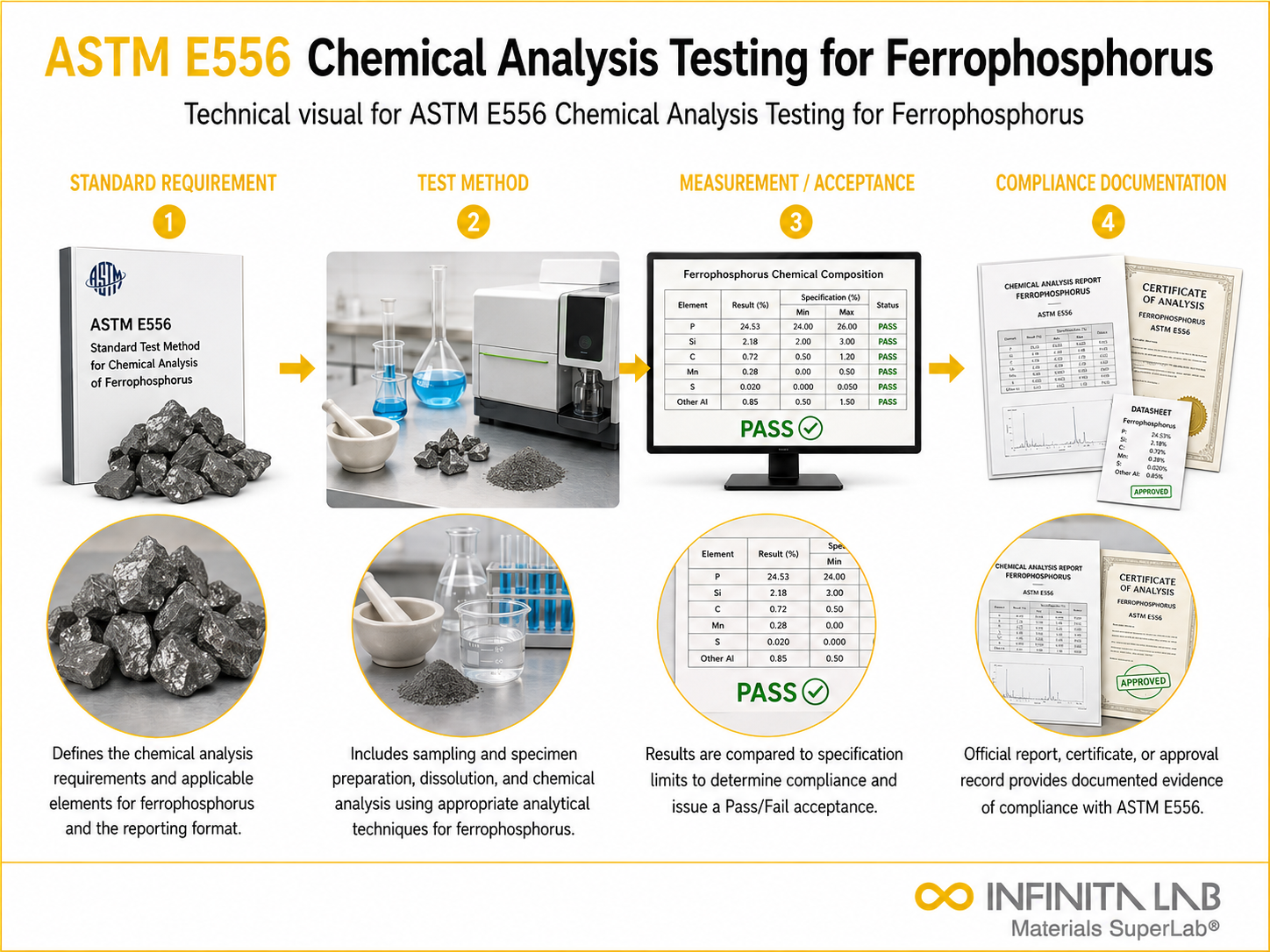
ASTM E556 Chemical Analysis Testing for Ferrophosphorus
ASTM E556-11 involves using a calibration platform which involves the calibration of the force transducer and related instruments of a mounted test wheel. The values stated in SI should be considered as standard.
TRUSTED BY


Precision Testing Solutions for Accurate, Reliable, and Standards-Compliant Results
- Overview
- Scope, Applications, and Benefits
- Test Process
- Specifications
- Instrumentation
- Results and Deliverables
ASTM E556 Wheel Force Calibration – Overview
ASTM E556 – 11 provides procedures for calibrating wheel force measurement systems using a calibration platform. The method ensures that forces applied by wheels are accurately measured by comparing system output against known reference loads.
This standard is essential for validating force measurement accuracy in applications such as vehicle testing and load evaluation systems. By ensuring traceable and repeatable calibration, ASTM E556 supports reliable data acquisition, improves measurement confidence, and maintains compliance with testing requirements.

Scope, Applications, and Benefits
Scope
ASTM E556 outlines procedures for calibrating wheel force measuring devices using a controlled calibration platform. It ensures accurate and repeatable force measurement verification.
- Applicable to wheel force measurement systems
- Uses calibration platforms with known load application
- Ensures traceable and standardized calibration
- Suitable for laboratory and field calibration
Applications
- Vehicle testing and performance evaluation
- Load measurement system calibration
- Automotive research and development
- Structural load testing
- Quality assurance of force measurement systems
Benefits
- Ensures high accuracy in force measurements
- Improves reliability of test data
- Supports traceability to standard loads
- Reduces measurement uncertainty
- Enhances system performance validation
ASTM E556 Wheel Force Calibration – Test Process
System Setup
Install wheel force measurement system on the calibration platform under controlled conditions.
1Load Application
Apply known reference loads incrementally using the calibration platform.
2Signal Recording
Measure and record system output corresponding to each applied load.
3Calibration Adjustment
Compare measured values with reference loads and adjust calibration factors accordingly.
4ASTM E556 Wheel Force Calibration – Technical Specification
| Parameter | Details |
|---|---|
| Standard | ASTM E556 – 11 |
| Method | Calibration using controlled load platform |
| Measurement Type | Wheel force measurement verification |
| Load Range | Application-dependent force levels |
| Calibration Basis | Comparison with known reference loads |
| Sample Type | Wheel force measurement systems |
| Units | Newton (N) or kilonewton (kN) |


- Calibration platform
- Load cells (reference standard)
- Data acquisition system
- Force measurement sensors
- Alignment and positioning tools
Instrumentation Used for Testing
Results and Deliverables
- Calibration curve (force vs output)
- Measurement deviation and correction factors
- Calibration uncertainty estimation
- Test conditions and setup details
- Final calibration certificate/report
Frequently Asked Question
ASTM E556 uses reference load cells with known traceability to national standards. By comparing system output with these calibrated loads, it ensures that force measurements are accurate, repeatable, and traceable to recognized measurement standards.
Misalignment introduces additional forces and moments that distort measurements. Proper alignment ensures that applied loads are transferred directly and accurately to the measurement system without unintended mechanical influences.
The method calibrates each axis independently by applying controlled loads in specific directions, ensuring accurate measurement of vertical, lateral, and longitudinal forces.
Uncertainty arises from load cell accuracy, alignment errors, environmental conditions, and data acquisition precision. ASTM E556 minimizes these through controlled procedures and standardized equipment.
Standardized procedures, controlled environments, and traceable reference equipment ensure comparable results across different laboratories.
Why Choose Infinita Lab for Advanced Materials Testing and Characterization?
At the core of this breadth is our network of 2,000+ accredited laboratories across the USA, offering access to over 10,000 testing methods and analytical services. From advanced materials characterization (SEM, TEM, RBS, XPS) to mechanical, chemical, environmental, biological, and standardized ASTM/ISO-compliant testing, we deliver unmatched flexibility, specialization, and scale. You are never limited by geography, facility, or methodology — Infinita Lab connects you to the right expertise and testing solution, every time.

Looking for a Trusted Partner for Accurate and Reliable Testing Services?
Send query us at hello@infinitalab.com or call us at (888) 878-3090 to learn more about our services and how we can support you.



Request a Quote
Submit your material details and receive testing procedures, pricing, and turnaround time within 24 hours.
 Quick Turnaround and Hasslefree process
 Confidentiality Guarantee
 Free, No-obligation Consultation
 100% Customer Satisfaction
