


ASTM E579: Ferrocolumbium Niobium Analysis Testing Services
ASTM E579-04 test method is used to measure the sensitivity of a fluorescence measuring system in testing for the limit of detection (LOD) of quinine sulfate dihydrate in solution. The excitation and fluorescence bands are kept broader than 10 nm for performance evaluation. The SI units are considered to be the standard of measurement.
TRUSTED BY


Get ASTM E579 compliant results — request your ferrocolumbium niobium analysis testing quote
- Overview
- Scope, Applications, and Benefits
- Test Process
- Specifications
- Instrumentation
- Results and Deliverables
What Is ASTM E579 Ferrocolumbium Niobium Analysis?
ASTM E579 – 04 defines a method for determining the limit of detection (LOD) of fluorescence measuring systems using quinine sulfate in solution as a reference standard. The method evaluates the minimum detectable fluorescence signal distinguishable from background noise.
This standard is essential for assessing sensitivity performance of fluorescence instruments. By establishing detection limits under controlled conditions, ASTM E579 supports method validation, instrument comparison, and ensures reliable detection of low-level analytes in analytical applications.

Applications and Benefits of ASTM E579 Ferrocolumbium Niobium Analysis Testing
Scope
ASTM E579 outlines procedures to determine the fluorescence detection limit using quinine sulfate solutions. It ensures accurate assessment of instrument sensitivity under standardized conditions.
- Applicable to fluorescence spectrometers and detectors
- Uses quinine sulfate as a reference fluorophore
- Evaluates minimum detectable signal above noise
- Suitable for instrument performance validation
Applications
- Sensitivity evaluation of fluorescence instruments
- Analytical method validation
- Trace-level detection studies
- Instrument comparison and benchmarking
- Laboratory quality assurance
Benefits
- Determines true detection capability
- Enhances analytical reliability
- Supports low-level quantification
- Standardized evaluation method
- Improves instrument performance assessment
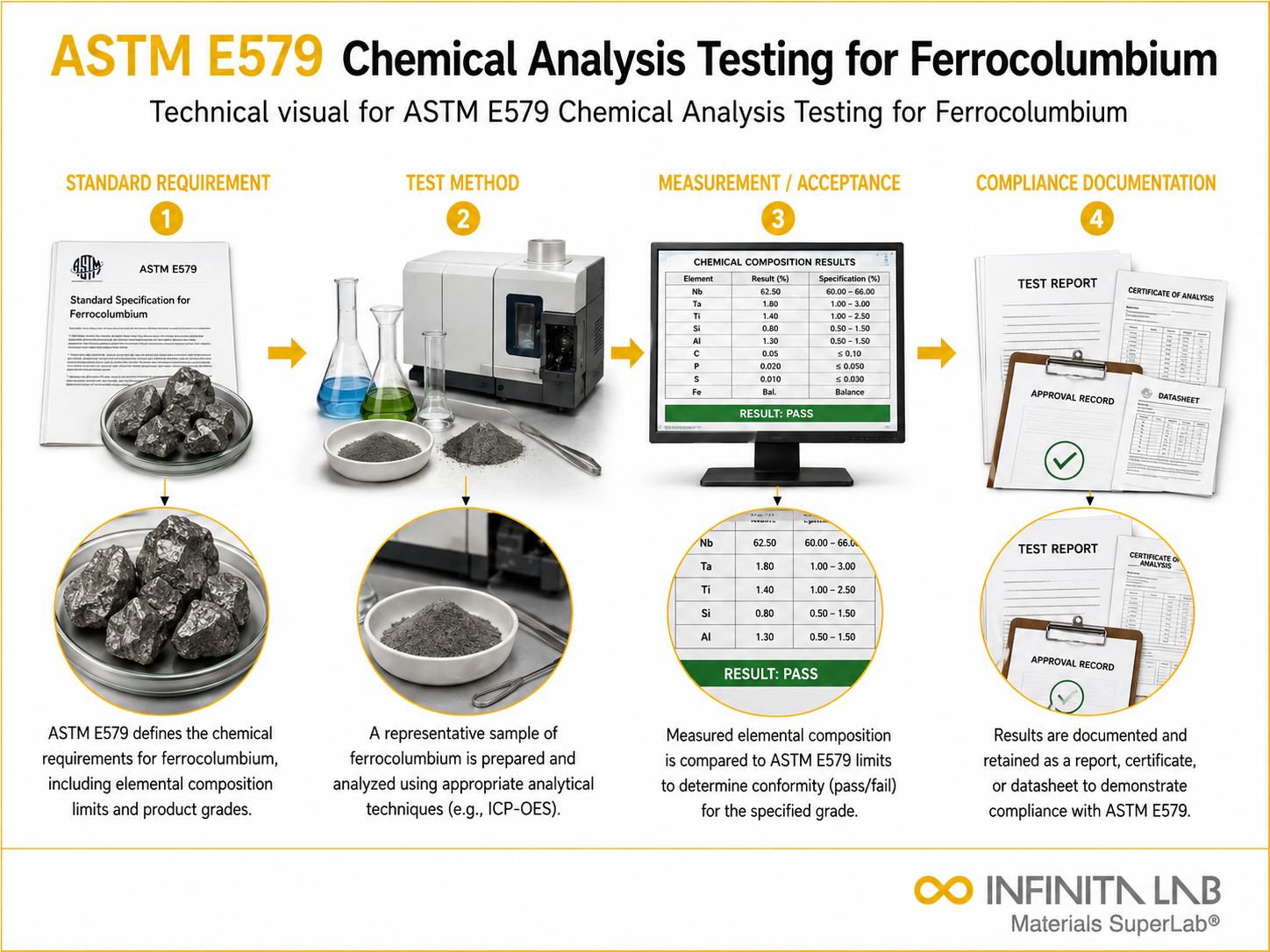
Our ASTM E579 Testing Procedure
Standard Solution Preparation
Prepare dilute quinine sulfate solutions at varying low concentrations under controlled conditions.
1Instrument Stabilization
Set and stabilize fluorescence system with fixed excitation and emission parameters.
2Signal Measurement
Measure fluorescence intensity and background noise for each concentration level.
3LOD Determination
Identify the lowest concentration producing a signal statistically distinguishable from noise.
4ASTM E579 Test Parameters and Requirements
| Parameter | Details |
|---|---|
| Standard | ASTM E579 – 04 |
| Method | Fluorescence detection limit evaluation |
| Reference Material | Quinine sulfate solution |
| Measurement Type | Signal-to-noise based detection |
| Sample Type | Dilute aqueous solutions |
| Units | Concentration (ppm or ppb) |


- Fluorescence spectrometer
- UV excitation source
- Photodetector (PMT or equivalent)
- Volumetric glassware
- Calibration standards
Equipment and Instrumentation Used for ASTM E579 Testing
What You Receive: Test Report, Data, and Certification
- Limit of detection (LOD) value
- Signal-to-noise ratio data
- Calibration and sensitivity curves
- Instrument performance evaluation
- Final validation report
ASTM E579 Ferrocolumbium Niobium Analysis FAQs
LOD is defined statistically as the lowest concentration producing a signal distinguishable from background noise, typically using signal-to-noise criteria or standard deviation of blank measurements, ensuring objective and reproducible sensitivity determination.
Quinine sulfate exhibits stable, well-characterized fluorescence with high quantum yield, making it ideal for reproducible sensitivity benchmarking across different fluorescence instruments and laboratories.
Noise from electronic, optical, and environmental sources masks weak fluorescence signals. LOD is reached when signal magnitude becomes comparable to noise variability, preventing reliable discrimination of analyte presence.
Single measurements are insufficient due to noise variability. Statistical analysis of repeated blank and low-level measurements ensures confidence that detected signals are not due to random fluctuations.
LOD indicates detectability, while LOQ defines the lowest concentration that can be quantified with acceptable accuracy and precision.
Why Choose Infinita Lab for Ferrocolumbium Niobium Analysis Testing
At the core of this breadth is our network of 2,000+ accredited laboratories across the USA, offering access to over 10,000 testing methods and analytical services. From advanced materials characterization (SEM, TEM, RBS, XPS) to mechanical, chemical, environmental, biological, and standardized ASTM/ISO-compliant testing, we deliver unmatched flexibility, specialization, and scale. You are never limited by geography, facility, or methodology — Infinita Lab connects you to the right expertise and testing solution, every time.

Looking for an Accredited Partner for ASTM E579 Ferrocolumbium Niobium Analysis Testing?
Send query us at hello@infinitalab.com or call us at (888) 878-3090 to learn more about our services and how we can support you.



Request a Quote
Submit your material details and receive testing procedures, pricing, and turnaround time within 24 hours.
 Quick Turnaround and Hasslefree process
 Confidentiality Guarantee
 Free, No-obligation Consultation
 100% Customer Satisfaction
