


ASTM E436 Drop Weight Tear Testing (DWTT) for Ferritic Steel Pipe
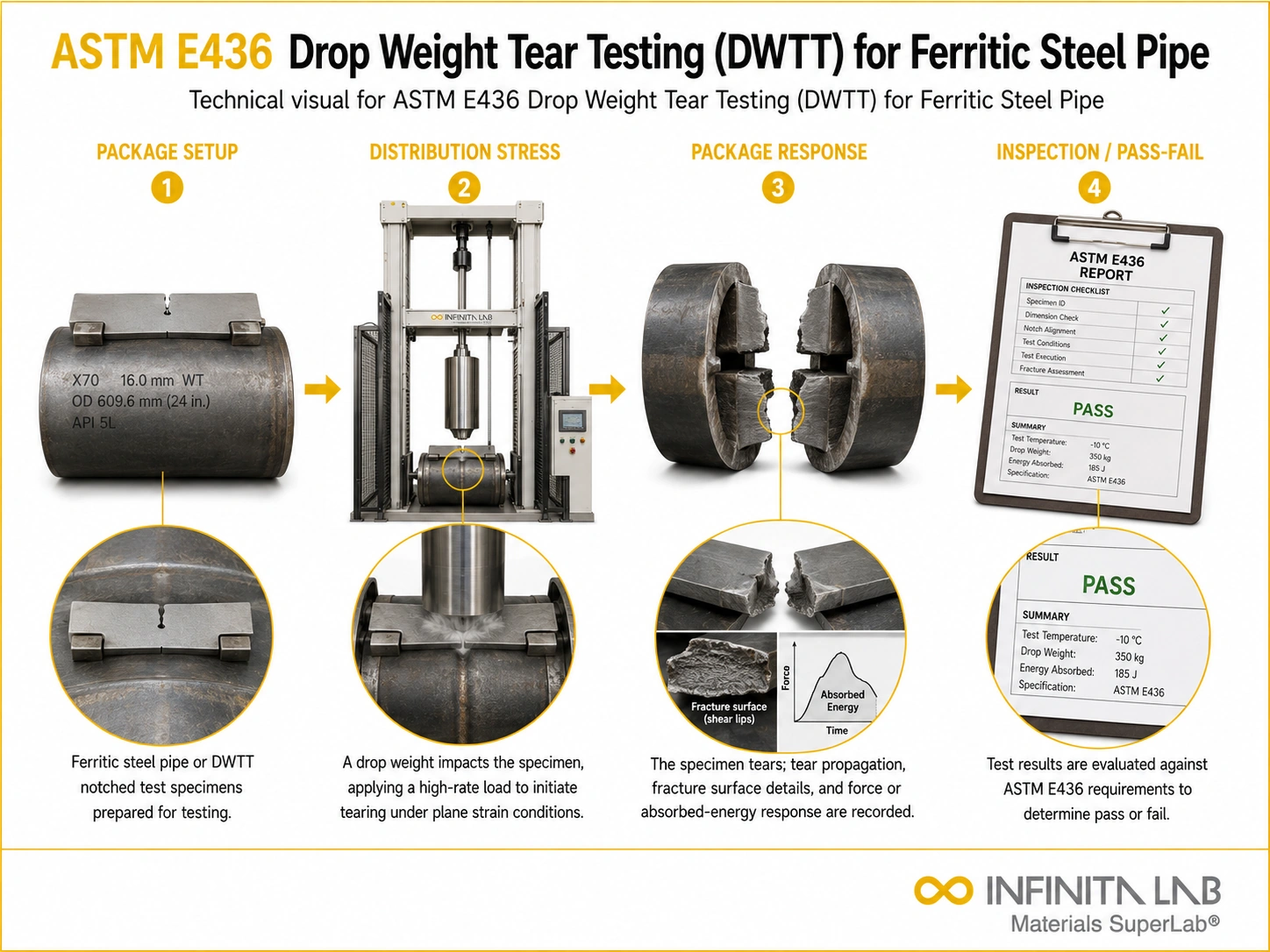
Drop-weight tear tests (DWTT) on ferritic steels with thicknesses ranging from 3.18 mm to 19.1 mm are covered by the standard test method ASTM E436. Drop weight tear testing is a material characterization test for pipelines to prevent brittle fracture and crack arrest (seamless or welded). The values expressed in SI units should be considered standard.
TRUSTED BY


Precision Testing Solutions for Accurate, Reliable, and Standards-Compliant Results
- Overview
- Scope, Applications, and Benefits
- Test Process
- Specifications
- Instrumentation
- Results and Deliverables
ASTM E 436 Drop-Weight Tear Overview
ASTM E 436 drop-weight tear testing is the standardized test method for evaluating the fracture appearance and ductile-to-brittle transition behavior of ferritic pipeline steels across a defined temperature range — determining the percentage shear fracture area of full-thickness specimens subjected to high-velocity impact loading to assess brittle fracture resistance and crack arrest capability. ASTM E 436 covers ferritic steels with thicknesses from 3.18 mm to 19.1 mm and yield strengths below 825 MPa — providing pipeline engineers, steel manufacturers, and structural integrity specialists with reliable DWTT fracture appearance data for pipeline material selection, brittle fracture prevention, and supplier assessment programs.

Scope, Applications, and Benefits
Scope
ASTM E 436 evaluates the fracture appearance transition behavior of plain carbon and low-alloy ferritic pipe steels by breaking 76.2 mm × 305 mm full-plate-thickness pressed-notch specimens within 10 seconds of temperature conditioning, measuring the percentage shear fracture area on the broken specimen surface to characterize the ductile-to-brittle fracture mode transition across the test temperature range.
ASTM E 436 drop-weight tear testing evaluates:
- Percentage shear fracture area of ferritic pipe steel specimens across ductile-to-brittle transition temperatures
- Fracture appearance transition temperature of plain carbon and low-alloy pipeline steel materials
- Brittle fracture resistance and crack arrest capability of seamless and welded pipe steels
- Effect of metallurgical factors, including composition, microstructure, and processing, on DWTT fracture behavior
- Compliance with minimum shear fracture area requirements for pipeline steel specifications
Applications
- Natural gas and oil transmission pipeline steel brittle fracture resistance assessment programs
- Line pipe steel DWTT fracture appearance evaluation for API 5L and pipeline specifications
- Seamless and welded pipe steel ductile-to-brittle transition temperature characterization
- Steel plate and coil material DWTT evaluation for pipeline fabrication approval programs
- Steel mills and pipe manufacturers requiring ASTM E 436 DWTT fracture appearance data
Benefits
- Provides reliable DWTT shear fracture area data for pipeline steel brittle fracture prevention
- Supports API 5L, pipeline specification compliance, and supplier assessment programs
- Identifies insufficient ductile fracture resistance in pipe steels before pipeline fabrication
- Delivers traceable DWTT fracture appearance records for engineering and regulatory submissions
- Reduces pipeline brittle fracture risk by verifying steel DWTT performance early in material approval
ASTM E 436 Drop-Weight Tear Test Process
Sample Preparation
Full-plate-thickness 76.2 mm × 305 mm specimens pressed-notched and temperature conditioned per ASTM E 436.
1Temperature Conditioning
Specimens completely immersed in conditioning liquid at target test temperature for thermal equilibration.
2Drop-Weight Impact
Specimens broken within 10 seconds of removal from conditioning bath with notch within 1.59 mm of tup centerline.
3Fracture Appearance Evaluation
Percentage shear fracture area measured on broken specimen surface and assessed for test compliance result.
4Technical Specifications
| Parameter | Details |
|---|---|
| Applicable Materials | Plain carbon and low-alloy ferritic pipe steels with yield strength below 825 MPa |
| Specimen Dimensions | 76.2 mm × 305 mm full-plate-thickness edge-notch bend specimen per ASTM E 436 |
| Steel Thickness Range | 3.18 mm to 19.1 mm full plate thickness per ASTM E 436 applicability requirements |
| Notch Type | Pressed notch positioned within 1.59 mm of tup centerline per ASTM E 436 |
| Transfer Time | Specimen broken within 10 seconds of removal from temperature conditioning bath |
| Measured Outputs | Percentage shear fracture area, fracture appearance classification, and test compliance result |


- Drop-weight tear test machine with defined hammer and tup geometry per ASTM E 436
- Temperature conditioning bath with defined liquid medium and precision temperature control
- Calibrated thermometer for conditioning bath temperature measurement and verification
- Pressed notch preparation apparatus for specimen notch geometry per ASTM E 436
- Fracture surface measurement tools for shear fracture area percentage determination
- Data acquisition and test reporting system
Instrumentation Used for Testing
Results and Deliverables
- Percentage shear fracture area measurements for all tested ferritic steel specimens
- Fracture appearance classification and ductile-to-brittle transition temperature data per ASTM E 436
- Temperature versus shear fracture area transition curve data, where multiple temperatures were tested
- Test compliance result assessed against the minimum shear fracture area specification requirements
- ASTM E 436 DWTT test report for pipeline steel approval, fracture assessment, and supplier assessment submissions
Frequently Asked Question
ASTM E 436 evaluates brittle fracture resistance of ferritic pipe steels by breaking 76.2 mm × 305 mm full-thickness pressed-notch specimens within 10 seconds of temperature conditioning and measuring percentage shear fracture area across ductile-to-brittle transition temperatures.
ASTM E 436 covers ferritic pipe steels with plate thickness from 3.18 mm to 19.1 mm and yield strengths below 825 MPa — applicable to seamless and welded line pipe grades used in natural gas and oil transmission pipeline systems.
ASTM E 436 uses full-plate-thickness specimens representing actual pipe wall geometry and measures fracture appearance transition — while Charpy testing uses small standardized sub-size specimens measuring absorbed energy, making DWTT more representative of real pipeline brittle fracture propagation behavior.
ASTM E 436 testing is conducted across the ductile-to-brittle transition temperature range of the specific pipeline steel grade — typically from −40°C to +20°C for carbon steel line pipe grades, with test temperatures selected to define the fracture appearance transition curve.
API 5L line pipe specification and related pipeline fracture control standards commonly reference ASTM E 436 DWTT testing — requiring minimum shear fracture area percentages at specified test temperatures for pipeline steel grades used in high-pressure natural gas and liquid transmission systems.
Why Choose Infinita Lab for Advanced Materials Testing and Characterization?
At the core of this breadth is our network of 2,000+ accredited laboratories across the USA, offering access to over 10,000 testing methods and analytical services. From advanced materials characterization (SEM, TEM, RBS, XPS) to mechanical, chemical, environmental, biological, and standardized ASTM/ISO-compliant testing, we deliver unmatched flexibility, specialization, and scale. You are never limited by geography, facility, or methodology — Infinita Lab connects you to the right expertise and testing solution, every time.

Looking for a Trusted Partner for Accurate and Reliable Testing Services?
Send query us at hello@infinitalab.com or call us at (888) 878-3090 to learn more about our services and how we can support you.



Request a Quote
Submit your material details and receive testing procedures, pricing, and turnaround time within 24 hours.
 Quick Turnaround and Hasslefree process
 Confidentiality Guarantee
 Free, No-obligation Consultation
 100% Customer Satisfaction
