


Elmendorf Tear Testing Services
Plastic films and sheets are widely used in many industries, including packaging, construction, and electronics. It is important to ensure that these materials are strong and durable enough to withstand the stresses of their intended use. One way to measure the strength of these materials is through the Elmendorf Tear Test.
TRUSTED BY


Get compliant results — request your elmendorf tear testing quote
- Overview
- Scope, Applications, and Benefits
- Test Process
- Specifications
- Instrumentation
- Results and Deliverables
What Is Elmendorf Tear?
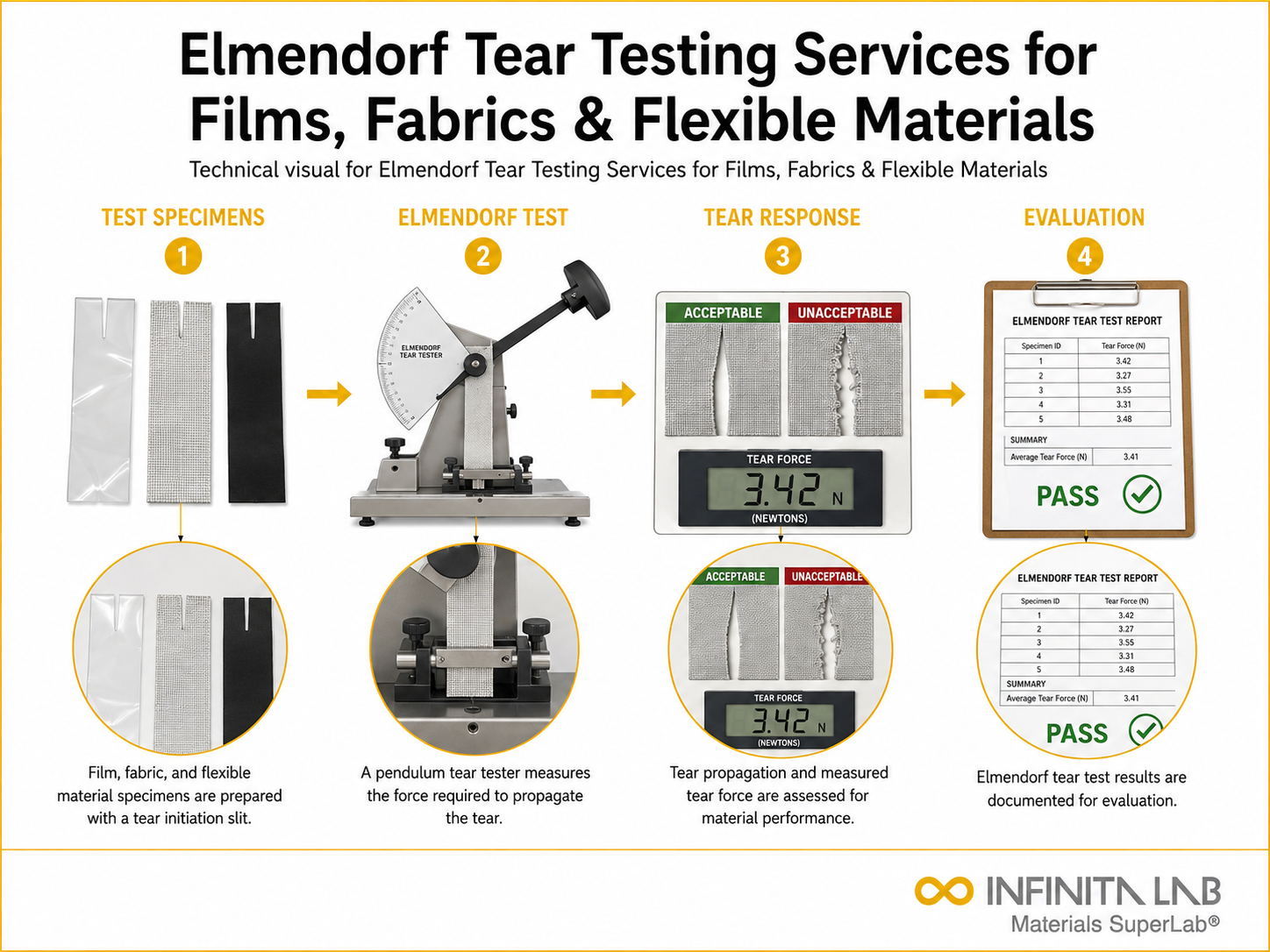
The Elmendorf Tear Test measures the force required to propagate a pre-initiated tear through a flexible material, primarily films, paper, textiles, and nonwovens. It quantifies tear resistance, a critical mechanical property for packaging, protective materials, and flexible substrates.
The test simulates real-world tearing conditions and provides manufacturers with data needed to optimise material formulations, ensure product durability, and meet packaging industry specifications.

Applications and Benefits of Elmendorf Tear Testing
Scope
The Elmendorf Tear Test evaluates:
- Tear propagation force (mN or gf)
- Machine direction (MD) and cross direction (CD) tear resistance
- Single-ply and multi-ply configurations
- Thin films, paper, woven and nonwoven fabrics
Applications
- Flexible packaging film quality control
- Paper and paperboard grading
- Textile and nonwoven durability assessment
- Agricultural films and geotextile testing
- Biomedical and hygiene product evaluation
Benefits
- Simple, rapid, and reproducible test method
- Differentiates MD and CD tear resistance
- Applicable to a wide range of flexible materials
- Supports packaging design and material selection
- Complies with major international standards
Our Testing Procedure
Specimen Preparation
Specimens are cut to standard dimensions (63 × 75 mm) with a precise slit initiation notch using a die cutter.
1Instrument Setup
The Elmendorf pendulum tester is raised to its starting position and the specimen is clamped between fixed and swinging clamps.
2Tear Initiation
The pendulum is released, and the stored energy propagates the pre-slit tear across the specimen width.
3Force Measurement
The residual pendulum energy is used to calculate the mean tear force, recorded in mN or gf, and reported for both MD and CD.
4Test parameters and requirements
| Parameter | Details |
|---|---|
| Test Principle | Pendulum impact tear propagation |
| Applicable Materials | Films, paper, fabrics, nonwovens |
| Pendulum Capacity | 200 mN to 6400 mN (multiple ranges) |
| Specimen Size | 63 × 75 mm (standard) |
| Measured Output | Tear force (mN or gf), directional tear resistance |


- Elmendorf pendulum tear tester
- Precision die cutter for specimen preparation
- Calibration weights
- Data recording and reporting software
Equipment and Instrumentation Used for Testing
What You Receive: Test Report, Data, and Certification
- Tear force values in MD and CD
- Mean tear strength with standard deviation
- Comparison against specification or reference materials
- Pass/fail determinations
- Full test report
Elmendorf Tear FAQs
The Elmendorf Tear Test is a standard test for determining the tear resistance of plastic films and sheets.
Tear testing helps select the suitable material with the required tear resistance for manufacturing a product that can withstand tearing forces.
Elmendorf tear test can test paper, cardboard, textiles, non-woven fabrics, and thin plastic films.
A minimum of 10 specimens per direction (MD and CD) is generally recommended for statistically reliable results per ASTM D1922.
Tear resistance is often anisotropic — significantly different in MD vs. CD — due to polymer orientation or fibre alignment during manufacturing. Both directions provide a complete picture of tear behaviour.
Why Choose Infinita Lab for Elmendorf Tear Testing
At the core of this breadth is our network of 2,000+ accredited laboratories across the USA, offering access to over 10,000 testing methods and analytical services. From advanced materials characterization (SEM, TEM, RBS, XPS) to mechanical, chemical, environmental, biological, and standardized ASTM/ISO-compliant testing, we deliver unmatched flexibility, specialization, and scale. You are never limited by geography, facility, or methodology — Infinita Lab connects you to the right expertise and testing solution, every time.

Looking for an Accredited Partner for Elmendorf Tear Testing?
Send query us at hello@infinitalab.com or call us at (888) 878-3090 to learn more about our services and how we can support you.



Request a Quote
Submit your material details and receive testing procedures, pricing, and turnaround time within 24 hours.
 Quick Turnaround and Hasslefree process
 Confidentiality Guarantee
 Free, No-obligation Consultation
 100% Customer Satisfaction
