


Geotextile Trapezoidal Tear Strength Testing Services
ASTM D4533 measures the force required to propagate a tear through a geotextile specimen cut into a trapezoidal shape with an initial slit. The test simulates how a geotextile behaves when a small damage or cut grows under installation stress or in-service loading. Both machine direction (MD) and cross-machine direction (CMD) specimens for woven, nonwoven, and knitted geotextiles per ASTM D4533, reporting maximum tearing force in Newtons at a controlled crosshead speed of 300 mm/min. Results are used for material selection, quality control, and geotechnical specification compliance.
TRUSTED BY


Get compliant results — request your geotextile trapezoidal tear strength testing quote
- Overview
- Scope, Applications, and Benefits
- Test Process
- Specifications
- Instrumentation
- Results and Deliverables
What Is Geotextile Trapezoidal Tear Strength?
ASTM D4533 is a standard test method for determining the tearing strength of geotextiles using the trapezoid tear procedure. It measures the force required to continue or propagate a tear in woven and nonwoven geotextiles under controlled conditions.
The method simulates real-world conditions where an initiated tear grows under applied load. It is widely used for comparative evaluation of geotextile materials in civil engineering applications, helping assess durability and resistance to mechanical damage

Applications and Benefits of Geotextile Trapezoidal Tear Strength Testing
Scope
ASTM D4533 evaluates:
- Tear propagation resistance of geotextiles
- The maximum force required to continue a tear
- Directional strength (machine and cross direction)
- Structural integrity of woven and nonwoven fabrics
- Comparative tear performance
Applications
- Road construction and pavement systems
- Drainage and filtration geotextiles
- Soil stabilization and reinforcement
- Landfills and environmental protection systems
- Coastal and erosion control applications
Benefits
- Provides standardized tear strength measurement
- Simulates real-life tear propagation behavior
- Enables comparison across materials and directions
- Supports material selection for durability
- Improves performance reliability in field conditions
Our Testing Procedure
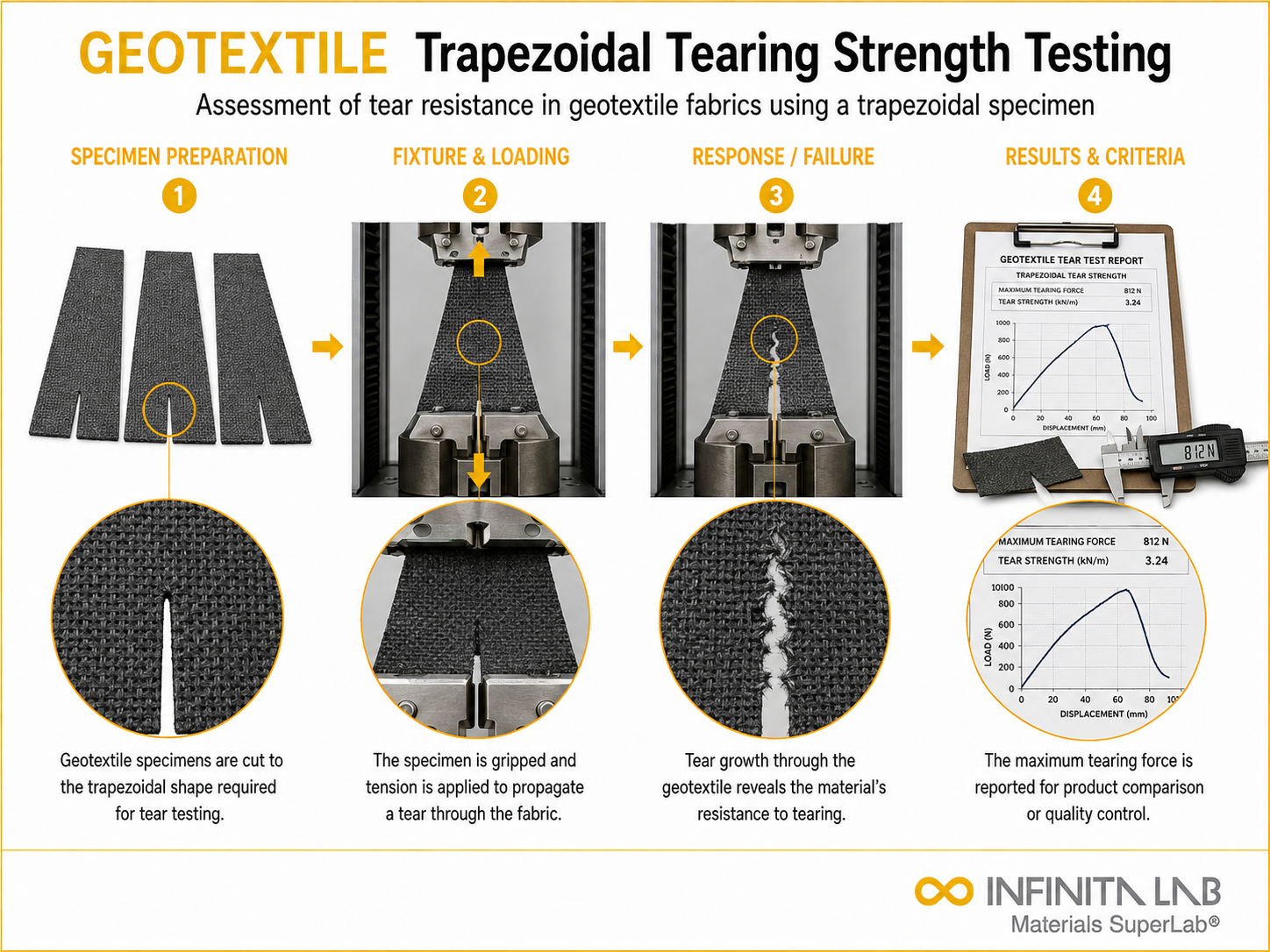
Sample Preparation
Rectangular specimen is cut and marked into a trapezoid shape with a small initial slit.
1Mounting
Non-parallel sides of the trapezoid are clamped in a tensile testing machine.
2Tensile Loading
Specimen is pulled at constant rate (~300 mm/min) causing tear propagation.
3Data Analysis
Maximum force recorded during tearing is reported as tear strength.
4Test parameters and requirements
| Parameter | Details |
|---|---|
| Test Type | Index test for tear propagation |
| Specimen Size | ~200 mm × 75 mm (typical) |
| Crosshead Speed | ~300 ± 10 mm/min |
| Clamp Distance | ~25 ± 1 mm |
| Sample Type | Woven, nonwoven, knitted geotextiles |
| Measured Output | Maximum tearing force |


- Universal tensile testing machine (CRE type)
- Flat-faced grips (pneumatic or mechanical)
- Specimen cutting die (trapezoid shape)
- Load cell and displacement sensors
- Measurement scale or calipers
- Data acquisition and analysis software
Equipment and Instrumentation Used for Testing
What You Receive: Test Report, Data, and Certification
- Maximum tearing strength value
- Force vs displacement curve
- Tear propagation behavior
- Directional strength comparison
- Material performance evaluation report
Geotextile Trapezoidal Tear Strength FAQs
ASTM D4533 testing measures the force required to propagate a tear in geotextiles using a trapezoid-shaped specimen, helping evaluate tear resistance and durability under simulated loading conditions.
It indicates the ability of a geotextile to resist tear propagation once a cut or damage has occurred, which is critical for maintaining structural integrity in field applications.
Woven, nonwoven, knitted, and felt-type geotextiles used in construction, drainage, and environmental engineering applications are commonly tested using this method.
It provides comparative data for material evaluation and quality control but does not fully represent all field performance conditions, so additional tests may be required for design purposes.
Tear strength ensures that geotextiles can withstand damage during installation and service, preventing failure in applications such as soil reinforcement, filtration, and erosion control.
Why Choose Infinita Lab for Plastic Lumber Bulk Density Specific Gravity Testing?
At the core of this breadth is our network of 2,000+ accredited laboratories across the USA, offering access to over 10,000 testing methods and analytical services. From advanced materials characterization (SEM, TEM, RBS, XPS) to mechanical, chemical, environmental, biological, and standardized ASTM/ISO-compliant testing, we deliver unmatched flexibility, specialization, and scale. You are never limited by geography, facility, or methodology — Infinita Lab connects you to the right expertise and testing solution, every time.

Looking for an Accredited Partner for Geotextile Trapezoidal Tear Strength Testing?
Send query us at hello@infinitalab.com or call us at (888) 878-3090 to learn more about our services and how we can support you.



Request a Quote
Submit your material details and receive testing procedures, pricing, and turnaround time within 24 hours.
 Quick Turnaround and Hasslefree process
 Confidentiality Guarantee
 Free, No-obligation Consultation
 100% Customer Satisfaction
