


ASTM E1106: Acoustic Emission Sensor Calibration Testing Services
The criteria for absolute calibration of acoustic emission (AE) sensors are covered in the ASTM E1106 test method. The frequency response of a transducer to waves at acoustic emission operations surfaces is obtained in this test method.
TRUSTED BY


ASTM E1106: Acoustic Emission Sensor Calibration Testing Services
- Overview
- Scope, Applications, and Benefits
- Test Process
- Specifications
- Instrumentation
- Results and Deliverables
Get ASTM E1106 compliant results — request your acoustic emission sensor calibration testing quote
ASTM E1106 defines a standardized method for the primary calibration of acoustic emission (AE) sensors, ensuring accurate measurement of transient elastic waves generated by material deformation or failure. The method establishes traceability by comparing sensor response to a known, reproducible mechanical source, typically using a displacement-controlled input.
This standard is essential for maintaining consistency in AE testing across industries where structural integrity monitoring is critical. It focuses on determining the absolute sensitivity of AE sensors over a defined frequency range, enabling reliable signal interpretation. By ensuring calibration accuracy, ASTM E1106 enhances data comparability, supports quality assurance programs, and improves confidence in AE-based diagnostics and structural health monitoring systems.

What Is ASTM E1106 Acoustic Emission Sensor Calibration?
Scope
ASTM E1106 defines laboratory-based procedures for establishing the absolute sensitivity of AE sensors using a traceable reference source. It ensures repeatable and accurate calibration by controlling signal generation, coupling conditions, and measurement parameters across a defined frequency range.
- Establishes absolute calibration methodology for AE sensors
- Defines use of displacement-based reference signal source
- Covers sensitivity and frequency response determination
- Ensures traceability to mechanical displacement standards
- Applicable to controlled laboratory calibration environments
Applications
- Monitoring structural integrity of bridges and civil infrastructure
- Inspection of pressure vessels and storage tanks
- Aerospace component testing and validation
- Composite material damage and delamination detection
- Crack initiation and propagation studies
- Nuclear and power plant equipment monitoring
- Quality control in acoustic emission testing systems
Benefits
- Ensures high accuracy and repeatability of AE measurements
- Provides traceable and standardized calibration results
- Improves comparability across different sensors and systems
- Enhances defect detection reliability and sensitivity
- Supports compliance with international testing standards
- Reduces uncertainty in acoustic emission data interpretation
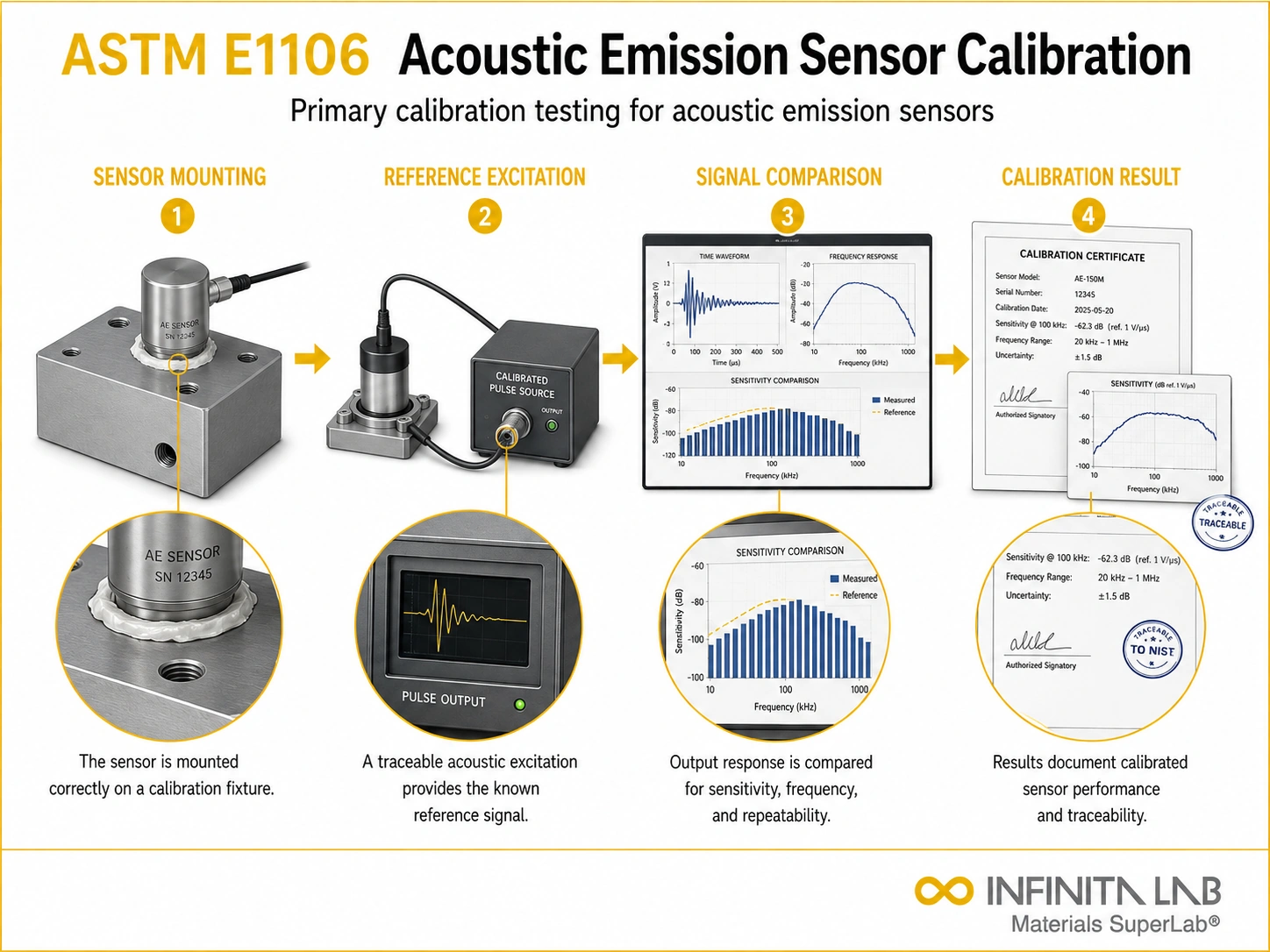
Our ASTM E1106 Testing Procedure
Sensor Mounting
The AE sensor is firmly attached to a calibration block using a consistent coupling medium to ensure effective acoustic transmission.
1Reference Signal Application
A controlled displacement source generates a reproducible acoustic signal input for calibration.
2Signal Measurement
The sensor output is captured using data acquisition systems across the required frequency range.
3Sensitivity Calculation
The recorded output is compared with the known input to determine absolute sensor sensitivity.
4ASTM E1106 Test Parameters and Requirements
| Parameter | Details |
|---|---|
| Frequency Range | Typically 20 kHz to 1 MHz depending on AE sensor design and application range |
| Reference Input Type | Displacement-controlled mechanical source ensuring traceable and repeatable excitation |
| Sensitivity Measurement | Expressed as voltage per unit displacement or velocity for accurate response quantification |
| Calibration Environment | Performed under controlled laboratory conditions to minimize external interference |
| Coupling Condition | Requires uniform coupling medium (gel/grease) to ensure consistent acoustic transmission |
| Signal-to-Noise Ratio | High SNR required to accurately distinguish sensor response from background noise |
| Sensor Positioning | Precise alignment required to maintain repeatability and reduce signal variation |
| Temperature Stability | Environmental temperature must be controlled to avoid sensitivity drift |


- Acoustic emission sensors
- Mechanical displacement reference source
- Calibration block or medium
- Data acquisition system (DAQ)
- Oscilloscope or frequency analyzer
- Coupling agents (gel, grease, or adhesive)
- Pre-amplifiers
- Signal filters
Equipment and Instrumentation Used for ASTM E1106 Testing
What You Receive: Test Report, Data, and Certification
- Absolute sensitivity values of AE sensors
- Frequency response characteristics
- Calibration certificates with traceability
- Signal amplitude versus frequency data
- Measurement uncertainty evaluation
- Compliance confirmation with ASTM E1106
ASTM E1106 Acoustic Emission Sensor Calibration FAQs
ASTM E1106 ensures absolute calibration with traceability to physical standards, enabling accurate and repeatable AE measurements. It eliminates inconsistencies across systems, improves defect detection reliability, and provides a standardized basis for comparing sensor performance in critical applications.
Primary calibration directly relates sensor output to a known physical input, ensuring traceability and high accuracy. Other methods rely on reference sensors, making them dependent on prior calibration quality and potentially introducing cumulative errors.
Proper coupling ensures efficient transmission of acoustic waves from the calibration source to the sensor. Poor coupling introduces signal loss and distortion, leading to inaccurate sensitivity measurements and reduced repeatability across calibration trials.
Frequency response determines how well a sensor detects signals across different frequencies. Accurate characterization ensures detection of relevant acoustic events, improving the ability to identify defects such as cracks, leaks, or material degradation.
Incorrect positioning can alter wave propagation paths and reduce signal consistency. Precise alignment ensures uniform acoustic input, improving repeatability and accuracy in sensitivity measurements.
Why Choose Infinita Lab for Acoustic Emission Sensor Calibration Testing
At the core of this breadth is our network of 2,000+ accredited laboratories across the USA, offering access to over 10,000 testing methods and analytical services. From advanced materials characterization (SEM, TEM, RBS, XPS) to mechanical, chemical, environmental, biological, and standardized ASTM/ISO-compliant testing, we deliver unmatched flexibility, specialization, and scale. You are never limited by geography, facility, or methodology — Infinita Lab connects you to the right expertise and testing solution, every time.

Looking for an Accredited Partner for ASTM E1106 Acoustic Emission Sensor Calibration Testing?
Send query us at hello@infinitalab.com or call us at (888) 878-3090 to learn more about our services and how we can support you.



Request a Quote
Submit your material details and receive testing procedures, pricing, and turnaround time within 24 hours.
 Quick Turnaround and Hasslefree process
 Confidentiality Guarantee
 Free, No-obligation Consultation
 100% Customer Satisfaction
