


ASTM D7645 Insecticide Determination in Water by Liquid Chromatography
The measurement of aldicarb, aldicarb sulfone, aldicarb sulfoxide, carbofuran, methomyl, oxamyl, and thiofanox in water by liquid chromatography (LC) and tandem mass spectrometry (MS/MS) is covered by ASTM D7645. The values are considered as a standard when expressed in SI units.
TRUSTED BY


Precision-driven testing for dimensional accuracy and compliance
- Overview
- Scope, Applications, and Benefits
- Test Process
- Specifications
- Instrumentation
- Results and Deliverables
Overview
ASTM D7645 describes a standard test method for the determination of insecticide concentrations in water samples by liquid chromatography with tandem mass spectrometry (LC-MS/MS) or equivalent LC detection methods. This method provides sensitive, selective analysis of multiple insecticide residues in surface water, groundwater, and wastewater samples.
As insecticide contamination of water sources is a critical environmental concern, this standard provides a validated analytical framework supporting regulatory compliance, ecological risk assessment, and watershed monitoring programs.

Scope, Applications, and Benefits
Scope
ASTM D7645 covers the determination of:
- Target insecticide compounds in water matrices
- Trace-level insecticide residues in surface and groundwater
- Multiple insecticide classes in a single analytical run
- Method performance including detection limits, precision, and accuracy
Applications
- Regulatory compliance monitoring of insecticides in drinking water sources
- Agricultural runoff and watershed monitoring
- Industrial effluent discharge compliance testing
- Ecological risk assessment studies
- Groundwater contamination investigations
Benefits
- Sensitive detection at regulatory-relevant concentration levels
- Multi-compound analysis in a single run
- High selectivity using MS/MS detection
- Validated methodology for defensible regulatory data
- Applicable to diverse insecticide chemical classes
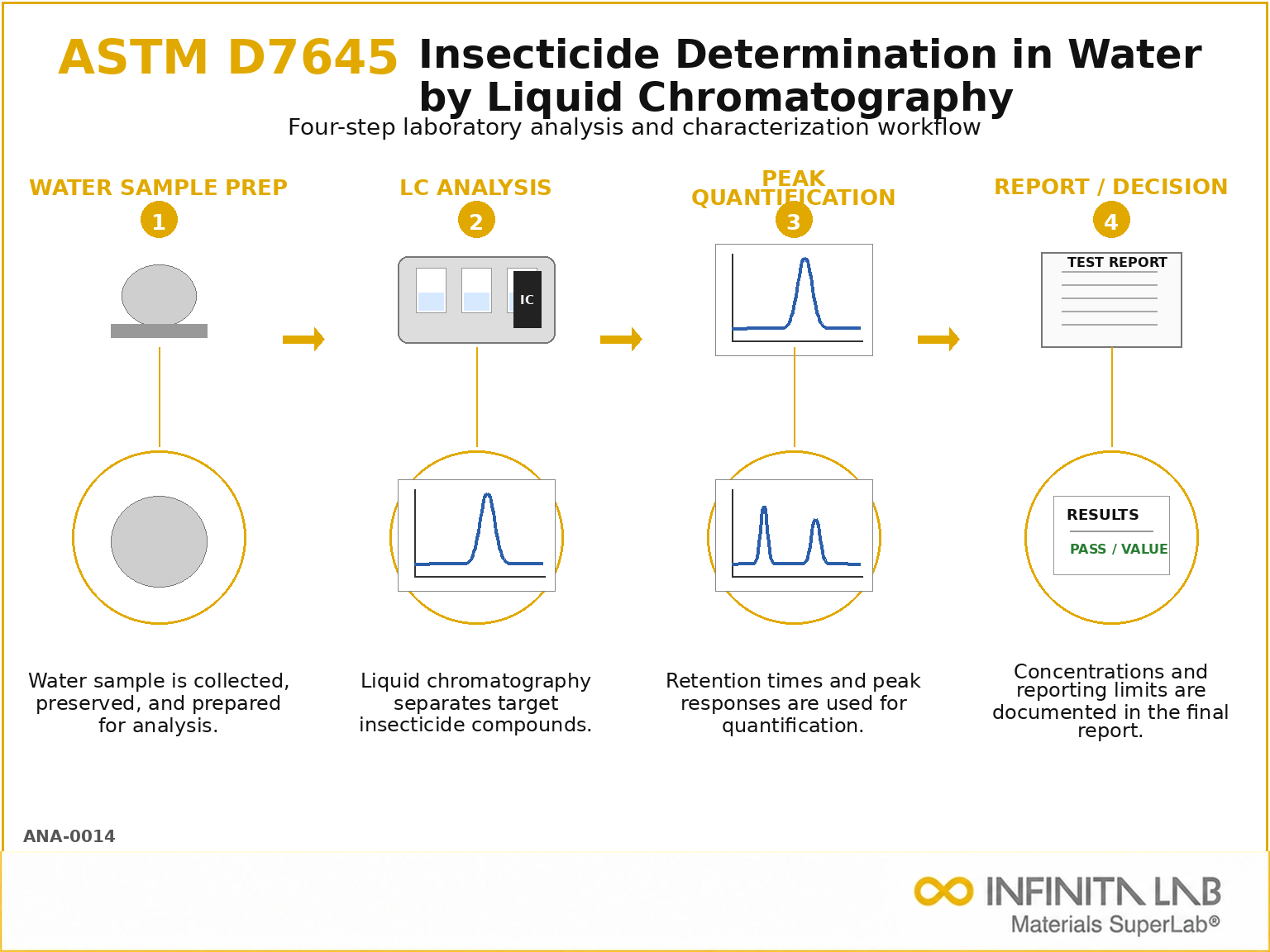
Test Process
Sample Collection & Preservation
Collect water samples in amber glass containers with appropriate preservatives; store at 4°C until analysis.
1Sample Extraction & Cleanup
Extract insecticides using SPE or LLE and remove matrix interferences.
2LC-MS/MS Analysis
Inject the extract into LC and separate insecticides, detecting them by MS/MS.
3Quantification & Reporting
Quantify insecticides using calibration curves with isotope-labeled standards and report in µg/L or ng/L.
4Technical Specifications
| Parameter | Details |
|---|---|
| Standard | ASTM D7645-14 |
| Test Principle | Liquid chromatography with mass spectrometry detection |
| Applicable Matrix | Surface water, groundwater, wastewater |
| Detection Method | LC-MS/MS (preferred) or equivalent |
| Measured Output | Individual insecticide concentrations (µg/L or ng/L) |
| Extraction Method | SPE or liquid-liquid extraction |


- High-performance liquid chromatograph (HPLC)
- LC detectors (UV, fluorescence, or MS)
- Sample filtration apparatus
- Solid-phase extraction (SPE) system
- Analytical balance and volumetric glassware
Instrumentation Used for Testing
Results and Deliverables
- Individual insecticide concentrations in µg/L or ng/L
- Multi-compound chromatographic data with identified peaks
- Method detection limits (MDLs) for each compound
- QC sample recoveries and surrogate spike results
- Compliance assessment against drinking water standards
- Environmental monitoring reports for watershed management
Frequently Asked Question
The method can be applied to a range of insecticide classes including organophosphates, carbamates, neonicotinoids, pyrethroids, and others, depending on the specific method compounds list and LC-MS/MS optimization.
LC-MS/MS provides much greater selectivity and sensitivity than UV detection. It can differentiate target insecticides from co-eluting matrix interferences and detect compounds at sub-ppb levels required for environmental monitoring.
Samples are typically collected in amber glass bottles to prevent photodegradation, preserved with sodium thiosulfate (to quench residual chlorine), and stored at 4°C. Analysis should be performed within the defined holding time to prevent degradation.
Isotope-labeled (deuterium or ¹³C) analogs of target insecticides are added to samples before extraction. They track extraction recovery and matrix effects, correcting for variability and improving quantitative accuracy.
Reporting limits vary by compound and matrix but are typically in the range of 0.01–0.1 µg/L (10–100 ng/L) in water, sufficient to evaluate compliance with drinking water maximum contaminant levels (MCLs).
Why Choose Infinita Lab for Advanced Materials Testing and Characterization?
At the core of this breadth is our network of 2,000+ accredited laboratories across the USA, offering access to over 10,000 testing methods and analytical services. From advanced materials characterization (SEM, TEM, RBS, XPS) to mechanical, chemical, environmental, biological, and standardized ASTM/ISO-compliant testing, we deliver unmatched flexibility, specialization, and scale. You are never limited by geography, facility, or methodology — Infinita Lab connects you to the right expertise and testing solution, every time.

Looking for a Trusted Partner for Accurate and Reliable Testing Services?
Send query us at hello@infinitalab.com or call us at (888) 878-3090 to learn more about our services and how we can support you.



Request a Quote
Submit your material details and receive testing procedures, pricing, and turnaround time within 24 hours.
 Quick Turnaround and Hasslefree process
 Confidentiality Guarantee
 Free, No-obligation Consultation
 100% Customer Satisfaction
