


ASTM D6735: Gaseous Chlorides Fluorides Calcining Exhaust Testing Services
The concentration of gaseous hydrochloric, hydrofluoric acids, other gaseous chlorides, and fluorides that pass through a particulate matter filter kept at 177°C (350°F) is measured using ASTM D6735. The values are considered as a standard when expressed in SI units.
TRUSTED BY


Get ASTM D6735 compliant results — request your gaseous chlorides fluorides calcining exhaust testing quote
- Overview
- Scope, Applications, and Benefits
- Test Process
- Specifications
- Instrumentation
- Results and Deliverables
What Is ASTM D6735 Gaseous Chlorides Fluorides Calcining Exhaust?
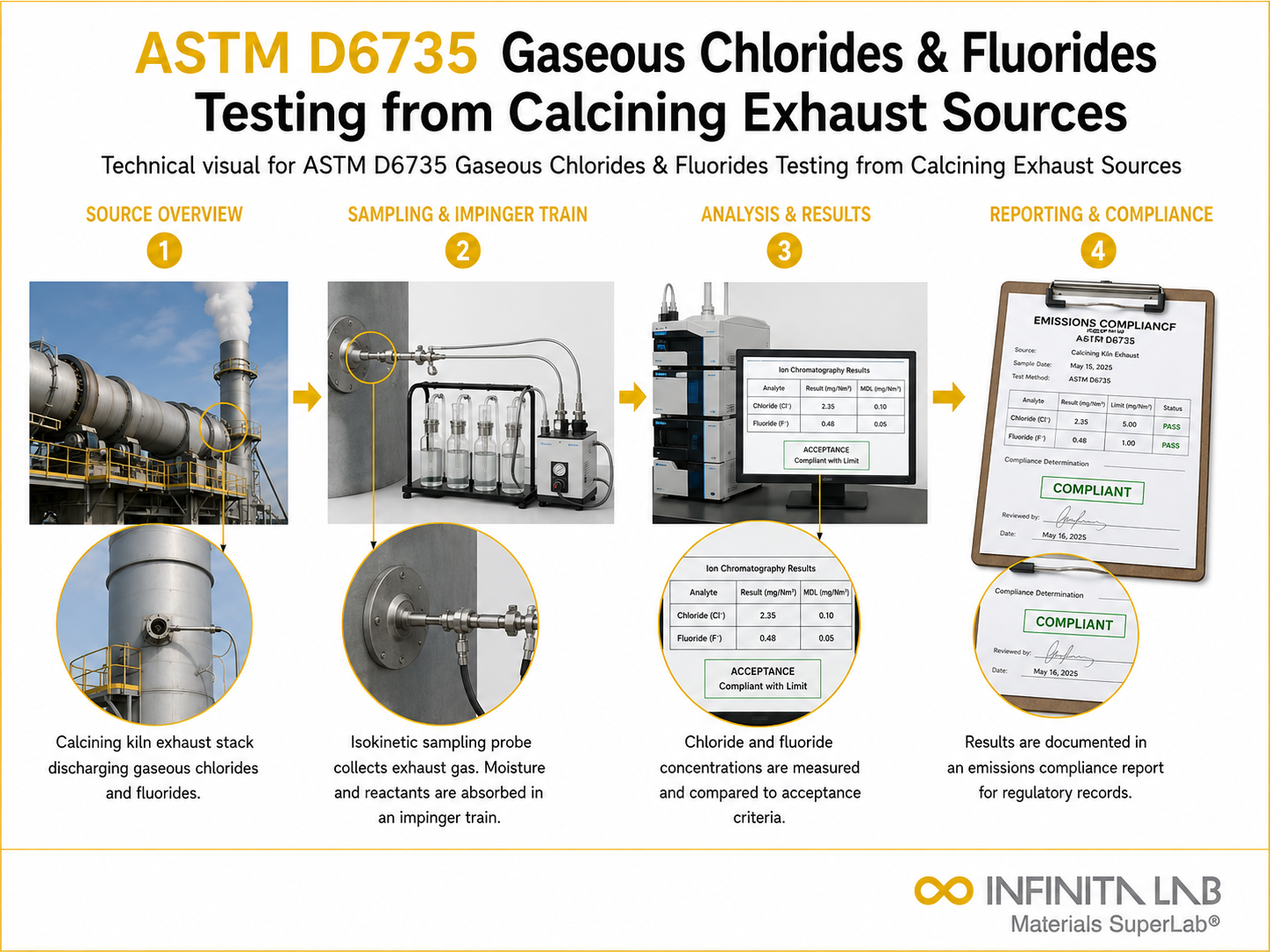
ASTM D6735 is a standard test method for measuring gaseous chlorides and fluorides in exhaust emissions from mineral calcining operations. These operations—used in the production of lime, cement, ceramics, and other mineral products—can release hydrogen chloride (HCl) and hydrogen fluoride (HF) as byproducts of thermal processing.
HCl and HF are acid gases regulated under the Clean Air Act and similar environmental legislation due to their corrosive and toxic nature. ASTM D6735 provides a standardized isokinetic stack sampling and analytical procedure to measure these emissions for compliance reporting, process control, and environmental assessment.

Applications and Benefits of ASTM D6735 Gaseous Chlorides Fluorides Calcining Exhaust Testing
Scope
ASTM D6735 covers:
- Gaseous HCl and HF measurement in mineral calcining stack emissions
- Isokinetic stack gas sampling with impinger train collection
- Separation and analysis of chloride and fluoride fractions
- Applicability to cement, lime, clay, and ceramic calcining exhaust
Applications
- Cement kiln and lime kiln emission compliance monitoring
- Ceramic and glass manufacturing exhaust characterization
- Regulatory compliance with EPA and state air quality rules
- Emission factor development for mineral processing industries
- Environmental permitting and performance testing
Benefits
- Provides accurate quantitative measurement of HCl and HF emissions
- Meets EPA Method equivalency requirements for acid gas stack testing
- Supports air permit compliance and emission reduction program monitoring
- Enables process optimization to minimize acid gas emissions
- Generates defensible data for regulatory submissions
Our ASTM D6735 Testing Procedure
Isokinetic Sampling Setup
A calibrated probe and impinger train are installed, and isokinetic flow is set based on stack gas conditions.
1Sample Collection
Stack gas is drawn isokinetically through an impinger train with absorbing solutions to capture HCl and HF.
2Sample Recovery & Preservation
Impinger solutions and rinses are carefully recovered, labeled, and preserved for laboratory analysis.
3Ion Analysis
Recovered solutions are analyzed by IC or ISE to quantify chloride and fluoride, and emission rates are calculated.
4ASTM D6735 Test Parameters and Requirements
| Parameter | Details |
|---|---|
| Standard | ASTM D6735 |
| Test Principle | Isokinetic stack sampling + ion chromatography/ISE analysis |
| Applicable Emissions | Gaseous HCl and HF from mineral calcining exhaust |
| Measured Outputs | HCl and HF emission concentration (mg/m³) and emission rate (g/hr) |
| Sampling Method | Isokinetic probe with impinger train |
| Analytical Method | Ion chromatography (IC) or ion-selective electrode |


- Isokinetic stack sampling train with calibrated probe and pitot tube
- Impinger train with appropriate absorbing solutions
- Ion chromatograph (IC) with anion columns
- Ion-selective electrodes for chloride and fluoride
- Stack gas analyzers (temperature, velocity, moisture)
- Data recording and emission calculation system
Equipment and Instrumentation Used for ASTM D6735 Testing
What You Receive: Test Report, Data, and Certification
- HCl and HF stack concentrations (mg/m³ or ppm)
- Mass emission rates (g/hr or kg/hr)
- Isokinetic sampling run data sheets
- Emission factor calculations per unit production
- Regulatory compliance and permit reporting documentation
ASTM D6735 Gaseous Chlorides Fluorides Calcining Exhaust FAQs
Many minerals and raw materials contain trace chlorides and fluorides that volatilize during high-temperature calcination. HCl and HF are corrosive acid gases regulated due to their impacts on human health, vegetation, and infrastructure.
Isokinetic sampling means the gas is extracted from the stack at the same velocity as the stack gas, ensuring representative sampling without particle over- or under-collection. It is the EPA-accepted standard for stationary source emissions testing.
The sampling train typically includes a filter or cyclone upstream of the absorbing impingers to remove particulate matter, so only gaseous species are captured in the impinger solutions.
Under EPA's National Emission Standards for Hazardous Air Pollutants (NESHAP) for Portland cement, HCl limits apply at the facility level. Specific limits vary by permit and state regulation.
ASTM D6735 is specifically designed for chlorides and fluorides. Other acid gases such as SO₂ and HNO₃ require separate EPA reference methods or ASTM methods tailored to those analytes.
Why Choose Infinita Lab for Gaseous Chlorides Fluorides Calcining Exhaust Testing?
At the core of this breadth is our network of 2,000+ accredited laboratories across the USA, offering access to over 10,000 testing methods and analytical services. From advanced materials characterization (SEM, TEM, RBS, XPS) to mechanical, chemical, environmental, biological, and standardized ASTM/ISO-compliant testing, we deliver unmatched flexibility, specialization, and scale. You are never limited by geography, facility, or methodology — Infinita Lab connects you to the right expertise and testing solution, every time.

Looking for an Accredited Partner for ASTM D6735 Gaseous Chlorides Fluorides Calcining Exhaust Testing?
Send query us at hello@infinitalab.com or call us at (888) 878-3090 to learn more about our services and how we can support you.



Request a Quote
Submit your material details and receive testing procedures, pricing, and turnaround time within 24 hours.
 Quick Turnaround and Hasslefree process
 Confidentiality Guarantee
 Free, No-obligation Consultation
 100% Customer Satisfaction
