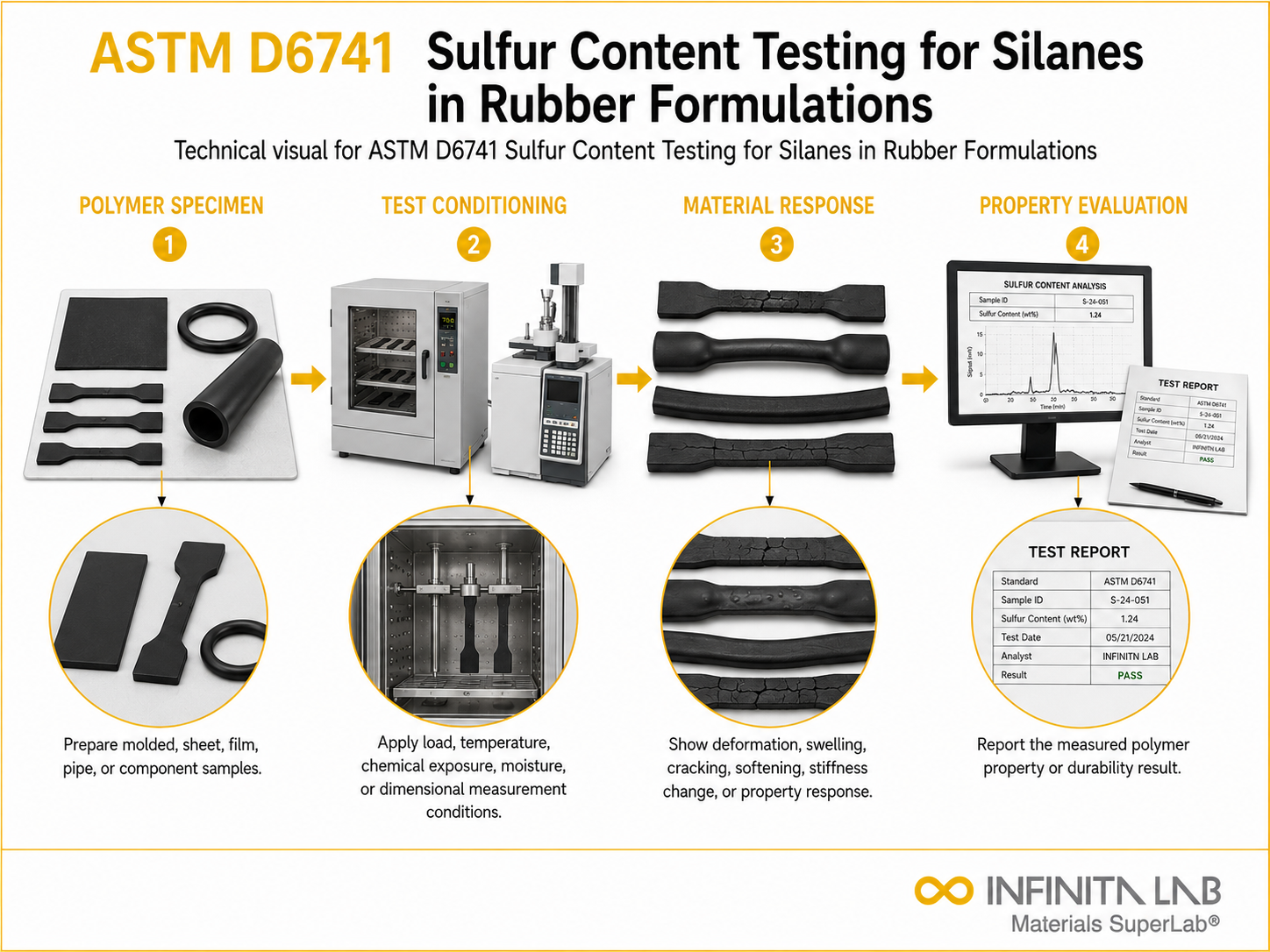


What Is ASTM D6741 Rubber Silane Sulfur Content?
ASTM D6741 is a standard test method for determining the sulfur content of silane coupling agents used in rubber formulations. Many silane coupling agents—particularly bis(triethoxysilylpropyl) tetrasulfide (TESPT) and disulfide (TESPD) silanes—contain sulfur as a functional component that reacts with the rubber matrix during vulcanization to form covalent bonds between silica and polymer chains.
Accurate sulfur content determination is essential for ensuring correct silane functionality, verifying product purity, and predicting cure behavior in silica-filled rubber compounds. ASTM D6741 provides a standardized analytical procedure for this measurement using combustion and detection techniques.

Applications and Benefits of ASTM D6741 Rubber Silane Sulfur Content Testing
Scope
ASTM D6741 evaluates:
- Total sulfur content of silane coupling agents
- Purity verification relative to theoretical sulfur content
- Batch-to-batch consistency in sulfur-containing silane products
- Detection of off-grade or adulterated silane materials
Applications
- Silane coupling agent quality control in rubber and tire manufacturing
- Bis-silane (TESPT/TESPD) product specification compliance
- Supplier qualification and incoming silane material inspection
- Silica/silane system optimization in tire tread compounds
- Research and development of new sulfur-functional silanes
Benefits
- Confirms silane functionality and chemical composition
- Detects adulteration or batch deviations rapidly
- Supports consistent rubber compound cure and property control
- Enables precise silane dosage calculation based on active sulfur content
- Complements residue on ignition and other silane QC methods
Our ASTM D6741 Testing Procedure
Sample Combustion
A weighed silane sample is combusted in an oxygen atmosphere in a combustion analyzer, converting all sulfur to SO₂ or SO₃.
1SO₂ Detection
Combustion gases are carried to a sulfur detector (infrared, coulometric, or titration-based) that quantifies the evolved SO₂.
2Sulfur Content Calculation
Total sulfur content is calculated from the detector signal and sample mass, and reported as percent sulfur by mass.
3Reporting
Sulfur content is compared to specification limits and reported with measurement uncertainty and replicates.
4ASTM D6741 Test Parameters and Requirements
| Parameter | Details |
|---|---|
| Standard | ASTM D6741 |
| Applicable Materials | Sulfur-containing silane coupling agents |
| Test Principle | High-temperature combustion with SO₂ detection |
| Measured Output | Total sulfur content (% by mass) |
| Detection Method | IR absorption, coulometry, or titration |
| Analytical Balance | 0.1 mg precision |


- Combustion sulfur analyzer (LECO, Eltra, or equivalent)
- Oxygen supply for combustion atmosphere
- IR or coulometric sulfur detection cell
- Analytical balance (0.1 mg precision)
- Certified sulfur reference standards
- Data acquisition and reporting software
Equipment and Instrumentation Used for ASTM D6741 Testing
What You Receive: Test Report, Data, and Certification
- Total sulfur content (% by mass)
- Comparison to theoretical sulfur content for the silane type
- Triplicate measurement data and mean value
- Specification compliance assessment
- Incoming material inspection and batch certification records
ASTM D6741 Rubber Silane Sulfur Content FAQs
Sulfur-functional silanes like TESPT and TESPD are bifunctional: one end bonds to the silica surface via silanol groups, while the sulfur polysulfide groups at the other end bond covalently to the rubber polymer during vulcanization, creating an effective silica–rubber interface.
Bis(triethoxysilylpropyl) tetrasulfide (TESPT, Si69) has a theoretical sulfur content of approximately 22.5% by mass, based on its molecular formula. TESPD (disulfide) contains approximately 13% sulfur.
Lower sulfur content than specified means fewer reactive sulfide groups, reducing silica–rubber coupling efficiency, which degrades dynamic mechanical properties, rolling resistance, and wet traction in tire treads.
No, ASTM D6741 measures only total sulfur content. Characterization of polysulfide rank distribution requires additional analytical techniques such as GC, NMR, or mass spectrometry.
Non-sulfur silanes (e.g., aminosilanes, epoxysilanes, vinylsilanes) will show near-zero sulfur content by this method. It is most relevant for quality control of sulfur-functional silanes used in silica-reinforced rubber systems.
Why Choose Infinita Lab for Rubber Silane Sulfur Content Testing
At the core of this breadth is our network of 2,000+ accredited laboratories across the USA, offering access to over 10,000 testing methods and analytical services. From advanced materials characterization (SEM, TEM, RBS, XPS) to mechanical, chemical, environmental, biological, and standardized ASTM/ISO-compliant testing, we deliver unmatched flexibility, specialization, and scale. You are never limited by geography, facility, or methodology — Infinita Lab connects you to the right expertise and testing solution, every time.

Looking for an Accredited Partner for ASTM D6741 Rubber Silane Sulfur Content Testing?
Send query us at hello@infinitalab.com or call us at (888) 878-3090 to learn more about our services and how we can support you.





