


ASTM D6936: Soil Water Characteristic Curve Testing Services
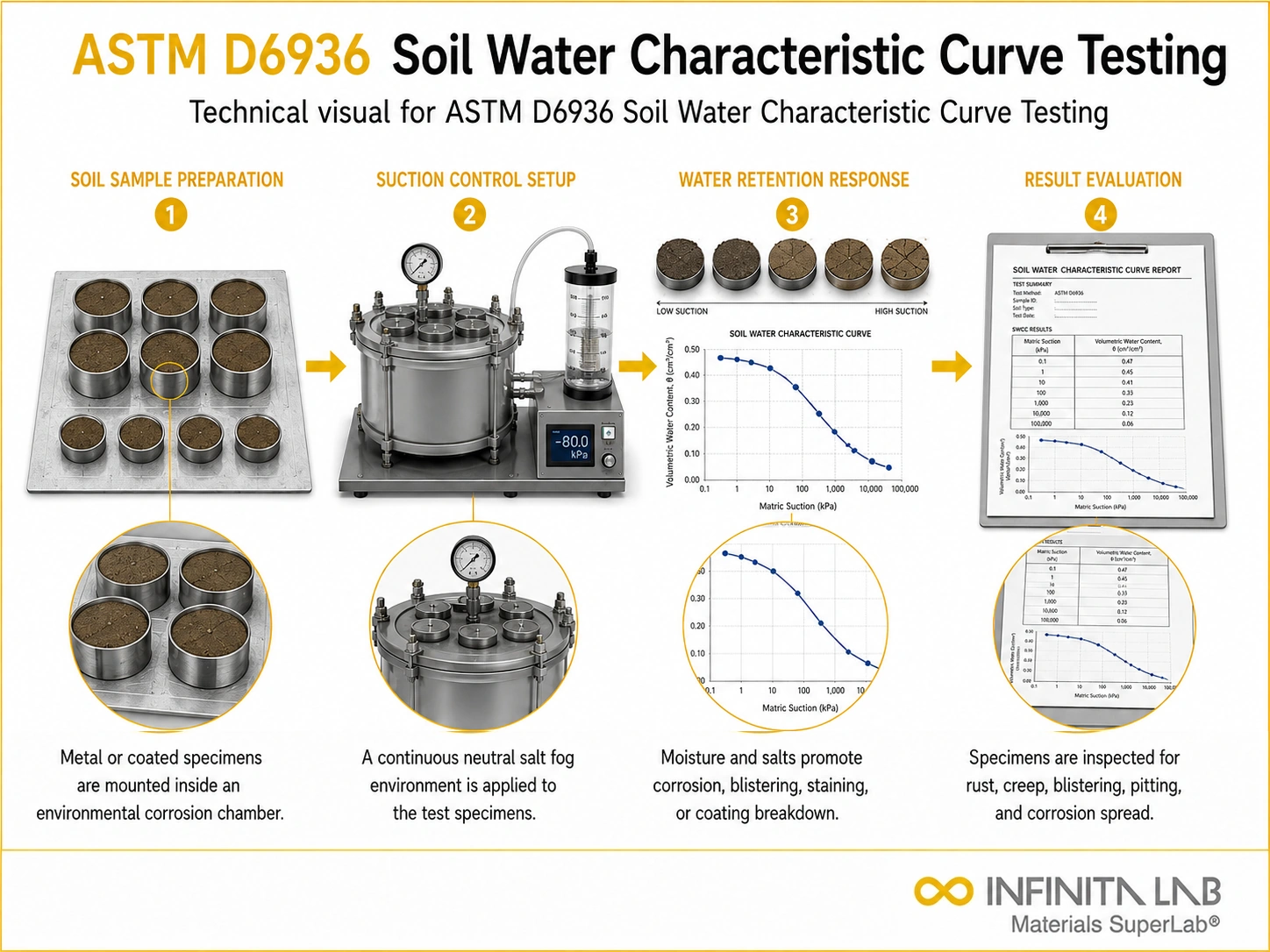
The determination of soil water characteristic curves (SWCCs) for desorption (drying) is covered by ASTM D 6836 test techniques. SWCCs outline the correlation between suction and water saturation levels, volumetric water content, or gravimetric water content. SWCCs are also known as capillary pressure curves, soil water retention curves, and soil water release curves.
TRUSTED BY


Get ASTM D6936 compliant results — request your soil water characteristic curve testing quote
- Overview
- Scope, Applications, and Benefits
- Test Process
- Specifications
- Instrumentation
- Results and Deliverables
What Is ASTM D6936 Soil Water Characteristic Curve?
ASTM D6936 covers standard methods for determining the soil-water characteristic curve (SWCC), also known as the soil moisture retention curve, which describes the relationship between soil water content (or degree of saturation) and matric suction. This relationship is fundamental to understanding unsaturated soil behavior in geotechnical, agricultural, and environmental engineering.
The SWCC is essential for predicting water infiltration, drainage, slope stability, and contaminant transport in unsaturated soils, as well as for designing engineered covers, retaining walls, and foundation systems in arid regions.

Applications and Benefits of ASTM D6936 Soil Water Characteristic Curve Testing
Scope
ASTM D6936 covers procedures for measuring the SWCC using pressure plate and axis translation techniques and includes:
- Wetting and drying paths of the characteristic curve
- Suction ranges from near-zero to approximately 1500 kPa
- Volumetric water content and degree of saturation as output parameters
- Hysteresis effects between drying and wetting curves
Applications
- Geotechnical design in unsaturated soils
- Slope stability and landslide risk assessment
- Agricultural soil water management
- Landfill cover and liner design
- Environmental remediation of contaminated vadose zones
Benefits
- Provides foundational data for unsaturated soil mechanics analysis
- Enables prediction of hydraulic conductivity functions
- Supports numerical modeling of water flow and transport
- Essential for the design of evapotranspirative covers
- Applicable to natural soils, fill materials, and mine tailings
Our ASTM D6936 Testing Procedure
Specimen Preparation
Soil specimens are prepared at desired density and initial water content, then saturated.
1Pressure Application
Specimens are placed on pressure plates in a sealed chamber; air pressure (representing matric suction) is applied in increments.
2Equilibration & Measurement
At each suction step, water is allowed to drain until equilibrium; the gravimetric water content is measured.
3Curve Plotting
Water content versus matric suction data are plotted to construct the SWCC, with curve fitting applied as needed.
4ASTM D6936 Test Parameters and Requirements
| Parameter | Details |
|---|---|
| Test Principle | Axis translation using pressure plate extractor |
| Suction Range | 0 to ~1500 kPa (pressure plate); higher range requires other methods |
| Measured Output | Water content or degree of saturation vs. matric suction |
| Soil Types | Fine-grained, coarse-grained, and mixed soils |
| Test Duration | Days to weeks depending on soil permeability |


- Pressure plate extractor with ceramic plate
- Air pressure regulator and control system
- Vacuum-sealed extraction chamber
- Analytical balance for water content measurement
- Drying oven for gravimetric water content
Equipment and Instrumentation Used for ASTM D6936 Testing
What You Receive: Test Report, Data, and Certification
- SWCC data table (suction vs. water content)
- Plotted soil-water characteristic curve
- Curve fit parameters (e.g., van Genuchten, Fredlund & Xing)
- Air entry value and residual water content
- Full geotechnical test report
ASTM D6936 Soil Water Characteristic Curve FAQs
ASTM D6936 is a standard test method used to determine compressive properties of rigid cellular plastics, evaluating their behavior under compressive loads for insulation and structural applications.
ASTM D6936 is important because compressive strength and deformation characteristics affect load-bearing capacity, durability, and performance of materials used in insulation, packaging, and construction applications.
Equilibration at each suction step can take days to weeks for fine-grained or low-permeability soils, making the total test duration several weeks.
Yes, though the shape of the curve differs significantly; coarse soils desaturate rapidly at low suctions, while fine-grained soils retain water over a wider suction range.
Hysteresis refers to the difference between the drying path (starting saturated) and the wetting path (starting dry); soils typically hold more water at a given suction during drying than during wetting.
Why Choose Infinita Lab for Soil Water Characteristic Curve Testing?
At the core of this breadth is our network of 2,000+ accredited laboratories across the USA, offering access to over 10,000 testing methods and analytical services. From advanced materials characterization (SEM, TEM, RBS, XPS) to mechanical, chemical, environmental, biological, and standardized ASTM/ISO-compliant testing, we deliver unmatched flexibility, specialization, and scale. You are never limited by geography, facility, or methodology — Infinita Lab connects you to the right expertise and testing solution, every time.

Looking for an Accredited Partner for ASTM D6936 Soil Water Characteristic Curve Testing?
Send query us at hello@infinitalab.com or call us at (888) 878-3090 to learn more about our services and how we can support you.



Request a Quote
Submit your material details and receive testing procedures, pricing, and turnaround time within 24 hours.
 Quick Turnaround and Hasslefree process
 Confidentiality Guarantee
 Free, No-obligation Consultation
 100% Customer Satisfaction
