


ASTM D7605: Tpe Rheological Dynamic Properties Testing Services
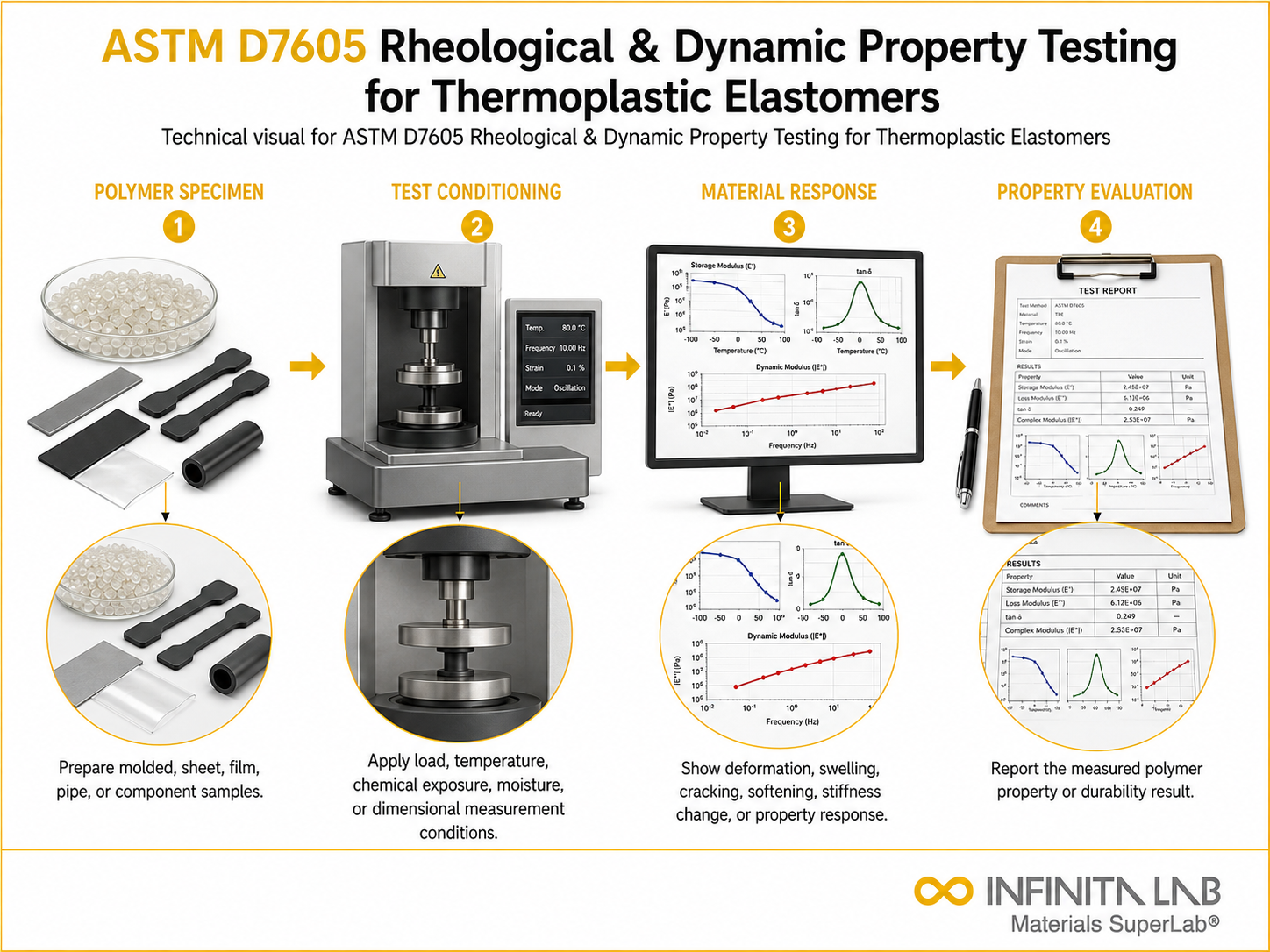
ASTM D7605 test method determines the flow properties and dynamic properties of polymer melts and thermoplastic elastomers, respectively, by employing a rotorless oscillating shear rheometer. These properties are essential for product processing and performance evaluation. The final results of this test method are expressed in SI units.
TRUSTED BY


Get ASTM D7605 compliant results — request your tpe rheological dynamic properties testing quote
- Overview
- Scope, Applications, and Benefits
- Test Process
- Specifications
- Instrumentation
- Results and Deliverables
What Is ASTM D7605 Tpe Rheological Dynamic Properties?
ASTM D7605 describes a standard test method for measuring the rheological and dynamic mechanical properties of thermoplastic elastomers (TPEs) using a dynamic mechanical analyzer (DMA) or similar rheometric instrumentation. These properties define how TPEs behave under oscillatory deformation and are critical for processing and end-use performance prediction.
This test method supports TPE formulation development, quality control, and material selection for applications in automotive, medical, consumer goods, and industrial sectors where the balance between thermoplastic processability and elastomeric performance is essential.

Applications and Benefits of ASTM D7605 Tpe Rheological Dynamic Properties Testing
Scope
ASTM D7605 covers the measurement of:
- Storage modulus (E’ or G’) of thermoplastic elastomers
- Loss modulus (E” or G”) under dynamic loading
- Loss tangent (tan δ) vs. temperature or frequency
- Viscoelastic behavior in the solid and melt states
Applications
- Thermoplastic elastomer formulation development
- Automotive seals, grips, and flexible components
- Medical device TPE material qualification
- Consumer product material selection
- Processing parameter optimization for TPE extrusion and injection molding
Benefits
- Provides comprehensive viscoelastic property data
- Enables direct comparison of different TPE grades
- Supports performance prediction under dynamic service conditions
- Identifies thermal transitions (Tg, softening) relevant to processing
- Applicable across a wide temperature and frequency range
Our ASTM D7605 Testing Procedure
Specimen Preparation
Prepare molded or cut specimens to required dimensions (rectangular bar or disc geometry depending on the test mode).
1DMA Setup & Conditioning
Mount the specimen in the DMA fixture; equilibrate to the starting temperature under controlled conditions.
2Dynamic Sweep
Apply sinusoidal deformation over the set sweep and record stress–strain continuously.
3Data Analysis
Calculate storage and loss moduli and tan δ from phase angle, and identify thermal transitions.
4ASTM D7605 Test Parameters and Requirements
| Parameter | Details |
|---|---|
| Standard | ASTM D7605 |
| Test Principle | Dynamic Mechanical Analysis (DMA) or rheometry |
| Applicable Materials | Thermoplastic elastomers (TPEs) |
| Measured Outputs | E' (or G'), E'' (or G''), tan δ |
| Test Modes | Tension, flexure, shear, compression |
| Temperature Range | Typically -100°C to 200°C |


- Rotational rheometer
- Dynamic mechanical analyzer (DMA)
- Temperature control system
- Parallel plate or cone-and-plate fixtures
- Frequency control unit
- Data acquisition software
- Sample preparation tools
Equipment and Instrumentation Used for ASTM D7605 Testing
What You Receive: Test Report, Data, and Certification
- Storage modulus (E’/G’) and loss modulus (E”/G”) vs. temperature/frequency
- Tan δ (loss tangent) spectra and peak identification
- Glass transition temperature (Tg) and other thermal transition data
- Comparative viscoelastic profiles between TPE formulations
- Processing behavior predictions based on melt-state rheology
- Material characterization reports for TPE qualification
ASTM D7605 Tpe Rheological Dynamic Properties FAQs
TPEs exhibit both thermoplastic (melt-processable) and elastomeric (flexible, recoverable) properties. Unlike vulcanized rubbers, they soften and flow at elevated temperatures, requiring dynamic testing across both the solid and melt states for full characterization.
Tan δ is the ratio of energy dissipated to energy stored per cycle. High tan δ indicates damping-dominated behavior, which is desirable in vibration isolation applications. The temperature at the tan δ peak is often used to identify Tg.
Yes, melt-state dynamic rheology measurements (G' and G'' in the melt) provide information on melt viscosity, elasticity, and processability that can be correlated to extruder pressure requirements and die flow behavior.
In strain-controlled tests, the instrument applies a defined oscillatory strain and measures the resulting stress. In stress-controlled tests, the applied stress is defined and strain is measured. The choice affects instrument accuracy depending on material stiffness.
Higher test frequencies generally shift modulus transitions to higher temperatures due to the time-temperature superposition principle. This means results measured at 1 Hz correspond to different effective temperatures than those at 10 Hz, and frequency should always be reported with results.
Why Choose Infinita Lab for Tpe Rheological Dynamic Properties Testing?
At the core of this breadth is our network of 2,000+ accredited laboratories across the USA, offering access to over 10,000 testing methods and analytical services. From advanced materials characterization (SEM, TEM, RBS, XPS) to mechanical, chemical, environmental, biological, and standardized ASTM/ISO-compliant testing, we deliver unmatched flexibility, specialization, and scale. You are never limited by geography, facility, or methodology — Infinita Lab connects you to the right expertise and testing solution, every time.

Looking for an Accredited Partner for ASTM D7605 Tpe Rheological Dynamic Properties Testing?
Send query us at hello@infinitalab.com or call us at (888) 878-3090 to learn more about our services and how we can support you.



Request a Quote
Submit your material details and receive testing procedures, pricing, and turnaround time within 24 hours.
 Quick Turnaround and Hasslefree process
 Confidentiality Guarantee
 Free, No-obligation Consultation
 100% Customer Satisfaction
