


ASTM D2000: Rubber Classification System Testing Services
ASTM D2000-18 test method determines the qualities of vulcanized rubber materials such as natural rubber, recovered rubber, and synthetic rubbers intended for, but not limited to, usage in rubber products for automotive applications. The final results of this method are displayed in SI units keeping in view the international standards.
TRUSTED BY


Get ASTM D2000 compliant results — request your rubber classification system testing quote
- Overview
- Scope, Applications, and Benefits
- Test Process
- Specifications
- Instrumentation
- Results and Deliverables
What Is ASTM D2000 Rubber Classification System?
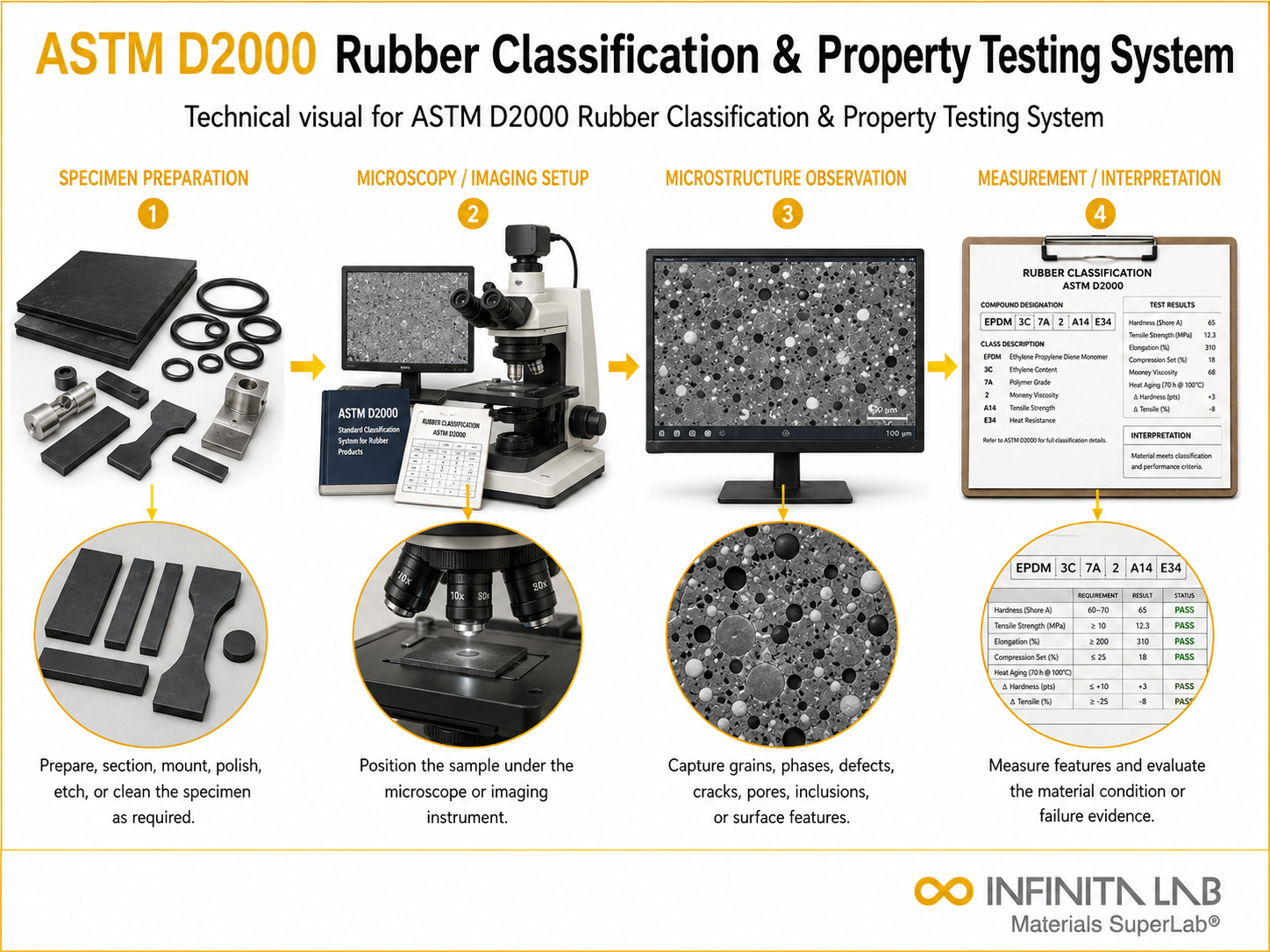
ASTM D2000 provides a standardized classification and specification system for rubber materials (elastomers) used in automotive applications and beyond. Rather than defining a specific test, this standard offers a comprehensive framework for specifying rubber compounds based on their resistance to heat aging and oil swelling, combined with additional performance requirements.
The classification uses a line call-out system that encodes the rubber type, hardness, tensile strength, and required suffix requirements (such as resistance to compression set, ozone, fluids, and low-temperature flexibility). This system allows engineers to communicate precise material requirements without naming a specific compound, enabling flexibility in supplier selection while ensuring consistent performance.

Applications and Benefits of ASTM D2000 Rubber Classification System Testing
Scope
ASTM D2000 covers:
- Classification of vulcanised rubber compounds
- Heat resistance categories (temperature grades)
- Volume swell in ASTM Reference Oil No. 3
- Hardness (Shore A durometer)
- Tensile strength requirements
- Suffix test requirements (compression set, ozone, fluid resistance, low temperature, etc.)
Applications
- Automotive seals and gaskets
- O-rings and engineered seals
- Hose and tubing specifications
- Automotive procurement and sourcing
- Vibration-damping components
- Electrical cable insulation
- Rubber molded parts across industries
Benefits
- Provides a universal language for rubber specification
- Reduces variability in supplier-sourced materials
- Simplifies procurement through line call-out notation
- Ensures performance consistency across production batches
- Supports failure analysis and root cause investigations
- Enables comparison of rubber compounds across manufacturers
Our ASTM D2000 Testing Procedure
Material Classification
The rubber type and grade are identified using the ASTM D2000 type/class system.
1Basic Requirements Testing
Hardness, tensile strength, elongation, and heat aging tests are conducted.
2Suffix Tests
Additional tests specified in the line call-out (e.g., oil swell, compression set, ozone) are performed.
3Conformance Evaluation
Results are compared against the D2000 requirements for the specified line call-out.
4ASTM D2000 Test Parameters and Requirements
| Parameter | Details |
|---|---|
| Test Principle | Classification and conformance testing |
| Hardness Range | 20–90 Shore A |
| Temperature Grades | A (70°C) through K (275°C) |
| Volume Swell Reference | ASTM Reference Oil No. 3 |
| Measured Outputs | Hardness, tensile strength, elongation, heat aging, swell, compression set |


- Shore A durometer
- Universal testing machine (UTM)
- Aging oven with temperature control
- Fluid immersion apparatus
- Compression set fixtures
- Ozone chamber
Equipment and Instrumentation Used for ASTM D2000 Testing
What You Receive: Test Report, Data, and Certification
- Classification line call-out compliance report
- Hardness and tensile test data
- Heat aging and fluid swell results
- Suffix test results (as applicable)
- Conformance certificate
- Quality assurance documentation
ASTM D2000 Rubber Classification System FAQs
ASTM D2000-18 is a standard classification system for rubber products, primarily used in automotive and industrial applications. It classifies vulcanized rubber materials based on key physical properties such as heat aging resistance, oil resistance, hardness, and tensile strength.
ASTM D2000 is a classification and specification standard, not a single test method. It defines a system for material callouts and performance requirements, while the actual testing is performed using referenced ASTM rubber test methods.
A line callout is a coded material designation used to specify the required rubber properties. It includes the standard designation, grade, type, class, hardness, tensile strength, and suffix requirements. This enables easy communication between buyers, suppliers, and manufacturers.
The standard ensures consistent material quality and performance specifications across suppliers, making it easier to select suitable rubber compounds for specific service conditions such as heat, oil exposure, and environmental aging.
Although originally developed for automotive applications, the standard is also commonly used in industrial, aerospace, electrical, and general engineering applications wherever rubber material classification is required.
Why Choose Infinita Lab for Rubber Classification System Testing
At the core of this breadth is our network of 2,000+ accredited laboratories across the USA, offering access to over 10,000 testing methods and analytical services. From advanced materials characterization (SEM, TEM, RBS, XPS) to mechanical, chemical, environmental, biological, and standardized ASTM/ISO-compliant testing, we deliver unmatched flexibility, specialization, and scale. You are never limited by geography, facility, or methodology — Infinita Lab connects you to the right expertise and testing solution, every time.

Need ASTM D2000 Rubber Classification System Testing You Can Rely On?
Send query us at hello@infinitalab.com or call us at (888) 878-3090 to learn more about our services and how we can support you.



Request a Quote
Submit your material details and receive testing procedures, pricing, and turnaround time within 24 hours.
 Quick Turnaround and Hasslefree process
 Confidentiality Guarantee
 Free, No-obligation Consultation
 100% Customer Satisfaction
