


ASTM D7427: Natural Rubber Latex Allergen Protein Testing Services
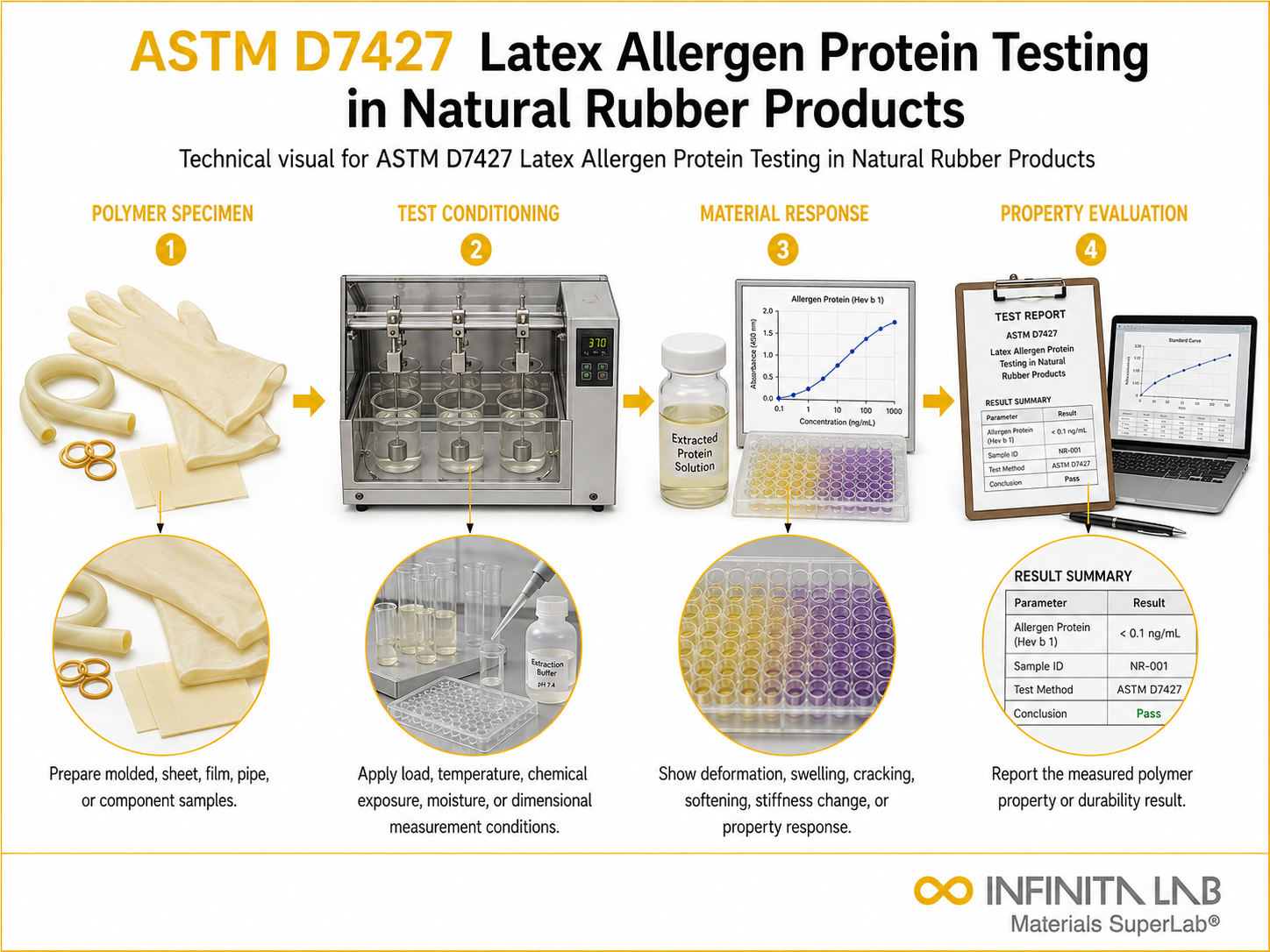
ASTM D7427 The Immunological Measurement of Four Principal Allergenic Proteins (Hev b 1, 3, 5, and 6.02) in Natural Rubber and its products derived from Latex can be determined using the standard test method ASTM D7427. This test method is based on an Immunoenzymetric assay (IEMA), which is a two-site non-isotopic immunological test method that employs two antibodies, a primary antibody to capture and a secondary enzyme-conjugated antibody to detect the analyte of interest.
TRUSTED BY


Get ASTM D7427 compliant results — request your natural rubber latex allergen protein testing quote
- Overview
- Scope, Applications, and Benefits
- Test Process
- Specifications
- Instrumentation
- Results and Deliverables
What Is ASTM D7427 Natural Rubber Latex Allergen Protein?
ASTM D7427 describes a standard test method for the immunological measurement of four principal allergenic proteins—Hev b 1, Hev b 3, Hev b 5, and Hev b 6.02—in natural rubber latex and products derived from it. These proteins are the primary allergens responsible for latex hypersensitivity reactions in sensitive individuals.
This test method is critical for manufacturers of latex-based medical devices, gloves, and consumer products who must monitor allergen levels to ensure product safety and regulatory compliance. It enables quantitative measurement of individual allergens using validated immunoassay techniques.

Applications and Benefits of ASTM D7427 Natural Rubber Latex Allergen Protein Testing
Scope
ASTM D7427 covers the quantitative measurement of:
- Hev b 1 (rubber elongation factor)
- Hev b 3 (small rubber particle protein)
- Hev b 5 (acidic latex protein)
- Hev b 6.02 (hevein, the major allergen in gloves)
- Total and individual allergen content in latex products
Applications
- Medical glove and device manufacturing quality control
- Latex condom and catheter allergen testing
- Healthcare product compliance with allergen limits
- Research on latex sensitization mechanisms
- Consumer product safety assessment
Benefits
- Identifies specific allergens rather than total protein content
- Enables targeted risk assessment for sensitized patients
- Supports regulatory compliance for latex medical devices
- Highly sensitive immunoassay-based detection
- Reproducible quantitative results across laboratories
Our ASTM D7427 Testing Procedure
Sample Extraction
Extract allergen proteins from the latex product using a standardized aqueous buffer extraction procedure.
1Immunoassay Setup
Set up ELISA or equivalent immunoassay using antibodies specific to Hev b 1, 3, 5, and 6.02 allergens.
2Detection & Quantification
Incubate, wash, and develop the immunoassay; measure absorbance or signal intensity against calibration standards.
3Data Reporting
Allergen concentrations are calculated from calibration curves and reported individually for each Hev b protein.
4ASTM D7427 Test Parameters and Requirements
| Parameter | Details |
|---|---|
| Standard | ASTM D7427 |
| Test Principle | Immunological assay (ELISA or equivalent) |
| Applicable Materials | Natural rubber latex and latex-derived products |
| Target Allergens | Hev b 1, Hev b 3, Hev b 5, Hev b 6.02 |
| Detection Limit | Sub-microgram per gram levels |
| Measured Output | Individual allergen concentrations |
| Units | µg/g or µg/dm² |


- Microplate ELISA reader
- Allergen-specific monoclonal antibodies
- Calibration standards for each Hev b protein
- Aqueous extraction buffer and centrifuge
- Microplate washer
- Data analysis software for concentration calculation
Equipment and Instrumentation Used for ASTM D7427 Testing
What You Receive: Test Report, Data, and Certification
- Quantitative concentrations of Hev b 1, 3, 5, and 6.02 allergens
- Allergen profile comparison across product lots
- Pass/fail assessment against allergen thresholds
- Calibration curves and assay validation data
- Regulatory compliance documentation for latex medical products
- Recommendations for allergen reduction strategies
ASTM D7427 Natural Rubber Latex Allergen Protein FAQs
These four proteins are the most clinically significant allergens in natural rubber latex, responsible for the majority of IgE-mediated hypersensitivity reactions in sensitized individuals, particularly healthcare workers and surgical patients.
Total protein tests (such as the modified Lowry method) measure all proteins extracted from latex without distinguishing allergens. ASTM D7427 specifically quantifies the four clinically relevant allergens individually, providing more actionable safety data.
The method is applicable to examination gloves, surgical gloves, condoms, catheters, and other latex products from which allergens can be extracted in aqueous buffer.
Hev b 6.02 (hevein) is the dominant allergen in latex gloves and is the most common sensitizer among healthcare workers. Its quantification is especially important for products with high skin contact.
Several regulatory bodies and standards organizations have proposed or established allergen threshold limits for latex medical devices. ASTM D7427 provides the measurement framework for assessing compliance with such limits.
Why Choose Infinita Lab for Natural Rubber Latex Allergen Protein Testing?
At the core of this breadth is our network of 2,000+ accredited laboratories across the USA, offering access to over 10,000 testing methods and analytical services. From advanced materials characterization (SEM, TEM, RBS, XPS) to mechanical, chemical, environmental, biological, and standardized ASTM/ISO-compliant testing, we deliver unmatched flexibility, specialization, and scale. You are never limited by geography, facility, or methodology — Infinita Lab connects you to the right expertise and testing solution, every time.

Looking for an Accredited Partner for ASTM D7427 Natural Rubber Latex Allergen Protein Testing?
Send query us at hello@infinitalab.com or call us at (888) 878-3090 to learn more about our services and how we can support you.



Request a Quote
Submit your material details and receive testing procedures, pricing, and turnaround time within 24 hours.
 Quick Turnaround and Hasslefree process
 Confidentiality Guarantee
 Free, No-obligation Consultation
 100% Customer Satisfaction
