


ASTM D7389: Mah Grafted Wax Acid Number Testing Services
The free acid content of MAH-grafted waxes is determined using test technique covered by ASTM D1386. Free acid content is an important quality control test that determines the wax's utility. The content reflects the amount of free acid present and is derived by direct titration of the substance.
TRUSTED BY


Get ASTM D7389 compliant results — request your mah grafted wax acid number testing quote
- Overview
- Scope, Applications, and Benefits
- Test Process
- Specifications
- Instrumentation
- Results and Deliverables
What Is ASTM D7389 Mah Grafted Wax Acid Number?
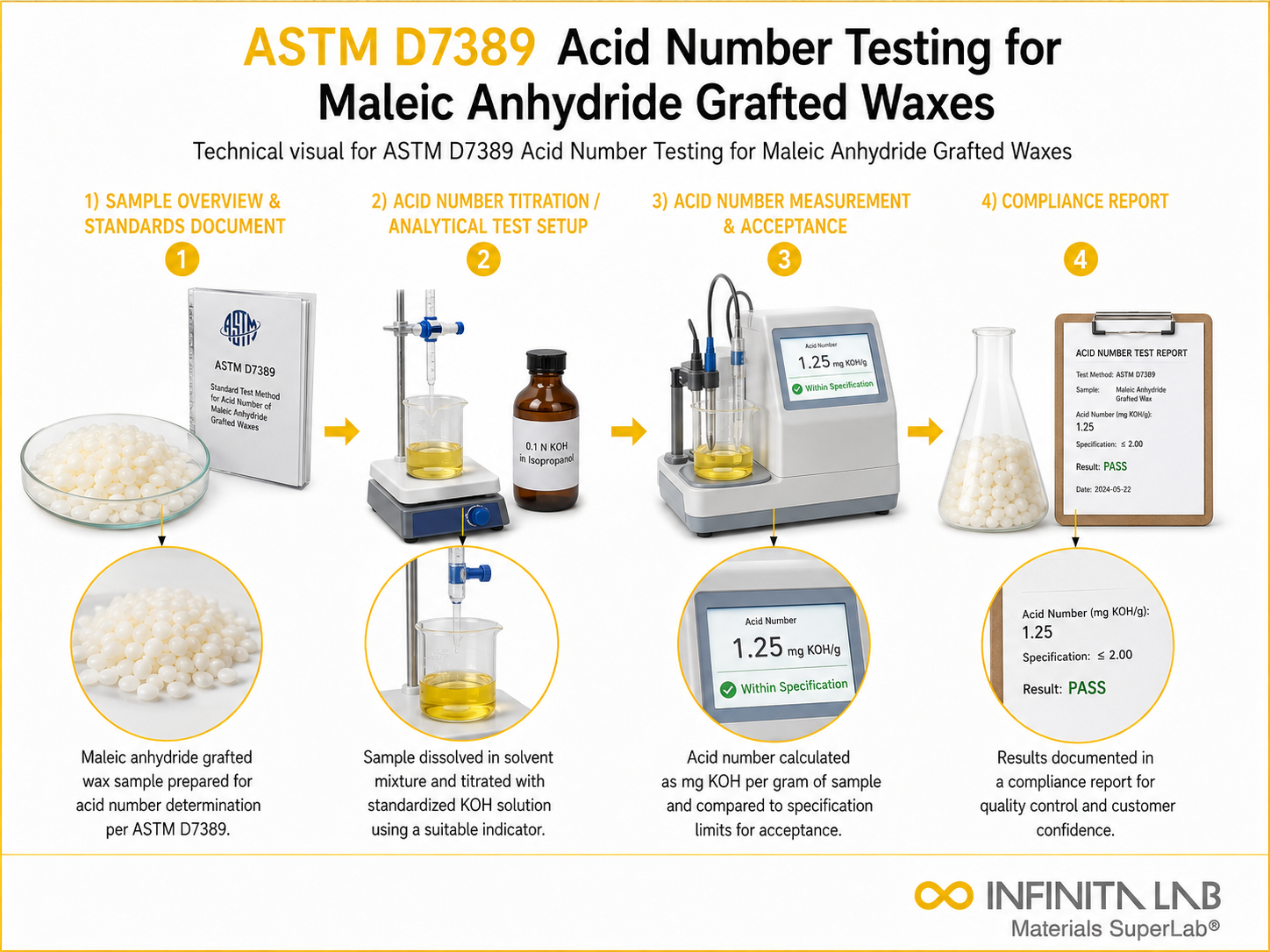
ASTM D7389 describes a test method for determining the acid number of maleic anhydride (MAH) grafted waxes by an empirical titration procedure. MAH grafted waxes and polyolefins are widely used as compatibilizers, coupling agents, and dispersing agents in polymer composites, adhesives, and coatings. The acid number directly reflects the degree of MAH grafting and determines the reactivity available for adhesion promotion and compatibilization.
This empirical method provides a practical, reproducible measure of the functional group content in MAH-grafted materials that complements more complex spectroscopic analyses.

Applications and Benefits of ASTM D7389 Mah Grafted Wax Acid Number Testing
Scope
ASTM D7389 applies to maleic anhydride-grafted waxes and polyolefins and determines:
- Acid number as mg KOH per gram of sample
- Total acid and anhydride functional group content
- Degree of grafting relative to the ungrafted base wax
- Batch-to-batch consistency of MAH graft level
Applications
- Compatibilizer and coupling agent quality control
- Wood-plastic composite (WPC) coupling agent specification
- Polyolefin blend and compounding additive characterization
- Hot melt adhesive formulation and quality verification
- Polymer surface treatment agent functional group analysis
Benefits
- Simple, rapid titration method applicable in routine quality labs
- Provides direct measurement of reactive functional group content
- Enables batch release testing without requiring FTIR quantification
- Empirical acid number correlates to industrial performance benchmarks
- Applicable to a wide range of MAH-grafted wax viscosities and molecular weights
Our ASTM D7389 Testing Procedure
Sample Dissolution
A weighed wax sample is dissolved in hot toluene or xylene to ensure complete dissolution of the grafted material.
1Hydrolysis
The dissolved sample is refluxed with water to convert anhydride groups to dicarboxylic acid groups, making them titratable.
2Titration
The hydrolyzed solution is titrated with standardized KOH solution using a suitable indicator or potentiometric endpoint.
3Acid Number Calculation
Acid number is calculated as milligrams of KOH consumed per gram of sample; results are reported and compared to specification.
4ASTM D7389 Test Parameters and Requirements
| Parameter | Details |
|---|---|
| Standard | ASTM D7389 |
| Test Principle | Empirical potassium hydroxide back titration of MAH-grafted wax |
| Applicable Materials | MAH-grafted waxes and polyolefin copolymers |
| Reagent | Standardized KOH solution in isopropanol |
| Measured Output | Acid number (mg KOH/g) |
| Endpoint | Visual indicator (phenolphthalein) or potentiometric |


- Hot plate with reflux condenser for dissolution and hydrolysis
- Burette or automated titration system
- Analytical balance (0.1 mg resolution)
- Potentiometric titrator (optional for improved endpoint accuracy)
- Standardized KOH solution and reference acid standard
- Heating mantle and appropriate glassware
Equipment and Instrumentation Used for ASTM D7389 Testing
What You Receive: Test Report, Data, and Certification
- Acid number (mg KOH/g) with replicate values
- Standard deviation and comparison to specification
- Graft level estimation based on acid number data
- Batch release pass/fail determination
- Certificate of analysis for MAH-grafted wax lot
ASTM D7389 Mah Grafted Wax Acid Number FAQs
Commercial MAH-grafted waxes used as coupling agents typically have acid numbers in the range of 20–60 mg KOH/g; very highly grafted grades may exceed 80 mg KOH/g.
MAH exists as a cyclic anhydride that hydrolyzes to maleic acid (a dicarboxylic acid) in the presence of water; titration without prior hydrolysis would undercount the actual functional group content.
Yes — FTIR using the carbonyl absorption at ~1780 cm⁻¹ (anhydride C=O) provides direct graft level data; however, acid number titration is more accessible for routine quality control.
Higher acid number (more MAH groups) generally provides better coupling to hydroxyl-rich wood fibers; however, excessive graft levels can also cause processing issues, so an optimal range is typically specified.
D7389 is an empirical method adapted specifically for MAH-grafted waxes and may differ in procedure and results from the conventional D974 acid number — both should be referenced to the applicable specification.
Why Choose Infinita Lab for Mah Grafted Wax Acid Number Testing?
At the core of this breadth is our network of 2,000+ accredited laboratories across the USA, offering access to over 10,000 testing methods and analytical services. From advanced materials characterization (SEM, TEM, RBS, XPS) to mechanical, chemical, environmental, biological, and standardized ASTM/ISO-compliant testing, we deliver unmatched flexibility, specialization, and scale. You are never limited by geography, facility, or methodology — Infinita Lab connects you to the right expertise and testing solution, every time.

Looking for an Accredited Partner for ASTM D7389 Mah Grafted Wax Acid Number Testing?
Send query us at hello@infinitalab.com or call us at (888) 878-3090 to learn more about our services and how we can support you.



Request a Quote
Submit your material details and receive testing procedures, pricing, and turnaround time within 24 hours.
 Quick Turnaround and Hasslefree process
 Confidentiality Guarantee
 Free, No-obligation Consultation
 100% Customer Satisfaction
