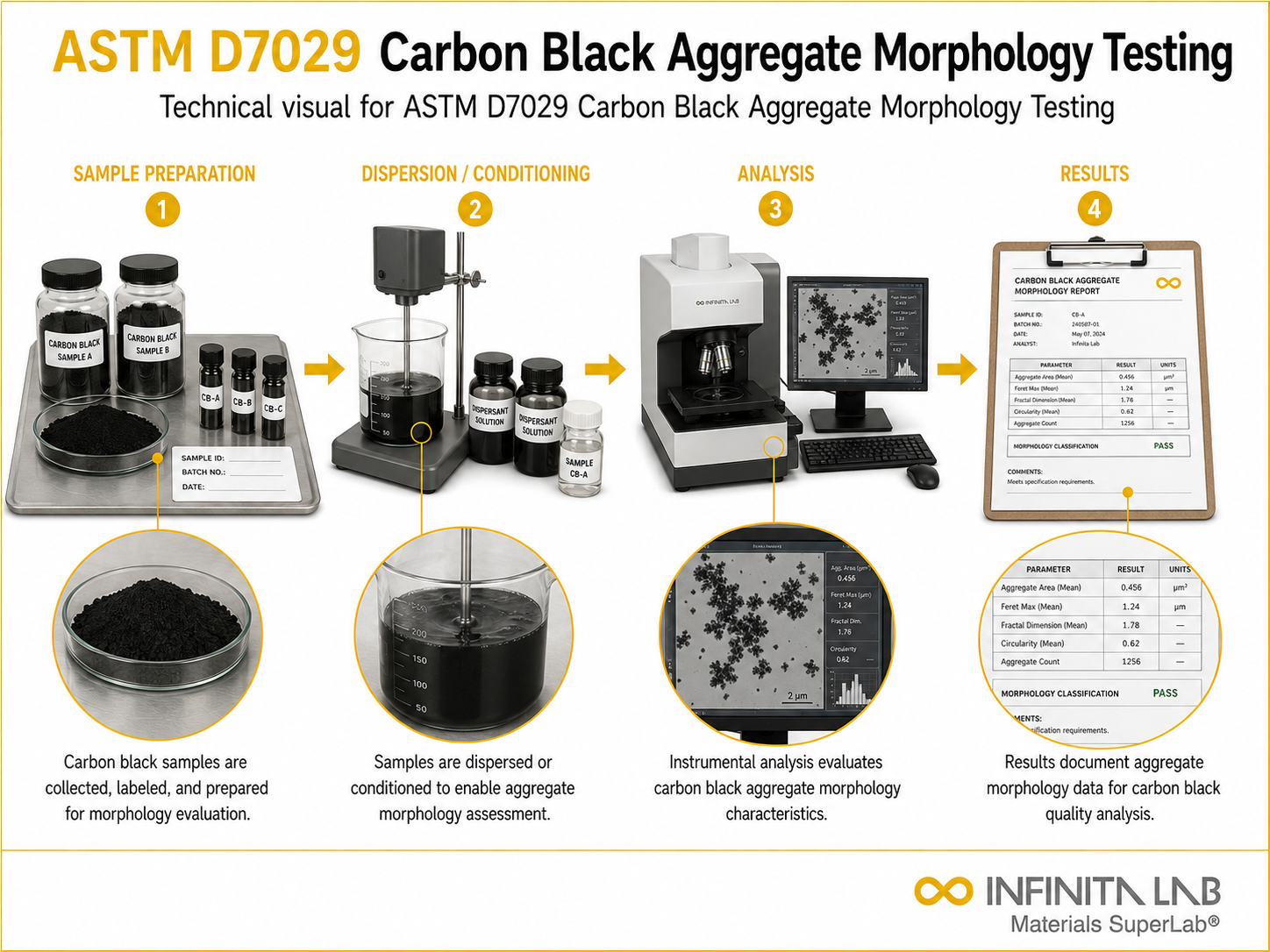


What Is ASTM D7029 Carbon Black Aggregate Morphology?
ASTM D7029-09 provides standard test methods for evaluating the mechanical properties of thermoplastic honeycomb core materials used in structural sandwich panel construction. As thermoplastic honeycombs gain traction in lightweight construction, standardized characterization of their core properties is essential for design and quality assurance.
The standard covers key property measurements needed to characterize core performance in composite sandwich panels for use in transportation, construction, and industrial applications.

Applications and Benefits of ASTM D7029 Carbon Black Aggregate Morphology Testing
Scope
ASTM D7029-09 covers the mechanical testing of thermoplastic honeycomb cores, including:
- Flatwise compressive strength and modulus
- Shear strength and modulus in L and W directions
- Tensile strength (flatwise)
- Core density and cell geometry characterization
Applications
- Automotive floor, roof, and trunk structural panels
- Railway and bus interior partition panels
- Building and construction lightweight wall panels
- Marine and recreational vehicle composite panels
- Industrial equipment enclosures and covers
Benefits
- Provides comprehensive mechanical data for thermoplastic honeycomb core
- Enables direct material qualification for sandwich panel design
- Supports weight reduction initiatives in transportation
- Facilitates comparison between thermoplastic and aluminum honeycomb cores
- Ensures consistency in panel production quality control
Our ASTM D7029 Testing Procedure
Specimen Preparation
Core specimens are cut to defined size from production panels or bulk core material in L, W, and T orientations.
1Property Testing
Specimens are individually tested for flatwise compression, shear, and tensile properties per the applicable sub-method of D7029.
2Data Recording
Load-displacement data are recorded; strength and modulus are calculated from the linear elastic portion of the response.
3Reporting
Results are reported by direction and compared to material data sheet or design allowable values.
4ASTM D7029 Test Parameters and Requirements
| Parameter | Details |
|---|---|
| Applicable Materials | Thermoplastic honeycomb core (PP, PET, PC, etc.) |
| Key Tests | Flatwise compression, shear (L and W), flatwise tension |
| Loading Rate | Typically 0.5–2.0 mm/min |
| Measured Outputs | Strength (MPa), modulus (MPa), failure mode |


- Universal testing machine with an appropriate load cell
- Flatwise compression fixtures (rigid platens)
- Sandwich beam shear test fixture
- Extensometer or crosshead displacement data
- Calipers and a balance for dimension and density measurement
Equipment and Instrumentation Used for ASTM D7029 Testing
What You Receive: Test Report, Data, and Certification
- Flatwise compressive strength and modulus
- Shear strength and modulus (L and W)
- Core density (kg/m³ or lb/ft³)
- Failure mode description per specimen
- Comprehensive mechanical property report
ASTM D7029 Carbon Black Aggregate Morphology FAQs
Common thermoplastic honeycomb materials include polypropylene (PP), polyethylene terephthalate (PET), and polycarbonate (PC), chosen for their balance of stiffness, weight, and recyclability.
Thermoplastic honeycomb is lighter and corrosion-resistant, with lower strength and stiffness per unit weight than aluminum; it is preferred when recyclability and cost are priorities over maximum structural performance.
The L-direction is parallel to the honeycomb ribbon direction (stronger), and the W-direction is perpendicular (weaker); both are measured because panels may be loaded in either orientation.
Yes — elevated temperature exposure can significantly reduce thermoplastic honeycomb stiffness and strength; testing at service temperatures is recommended for elevated-temperature applications.
ASTM D7029 covers thermoplastic honeycomb core material regardless of facing material; the core properties are independent of whether facings are carbon fiber, glass fiber, or metal.
Why Choose Infinita Lab for Carbon Black Aggregate Morphology Testing?
When your Carbon Black Aggregate Morphology results have to hold up - for compliance, a customer audit, or an engineering decision - ASTM D7029 accuracy and an unbiased third-party report matter more than price. Infinita Lab routes your ASTM D7029 carbon black aggregate morphology testing to ISO/IEC 17025-accredited U.S. partner labs with hands-on method experience, so you get defensible data, transparent reporting, and turnaround times built around your project deadline - not ours.

Looking for an Accredited Partner for ASTM D7029 Carbon Black Aggregate Morphology Testing?x
Send query us at hello@infinitalab.com or call us at (888) 878-3090 to learn more about our services and how we can support you.





