


ASTM D6188: Cellulose Viscosity Cuprammonium Ball Fall Testing Services
ASTM D6188 is used to estimate the molecular weight of cellulose by determining the viscosity of cuprammonium (CuAm) solutions of cellulosic materials, such as wood pulp, cotton, and cotton linters.
TRUSTED BY


Get ASTM D6188 compliant results — request your cellulose viscosity cuprammonium ball fall testing quote
- Overview
- Scope, Applications, and Benefits
- Test Process
- Specifications
- Instrumentation
- Results and Deliverables
What Is ASTM D6188 Cellulose Viscosity Cuprammonium Ball Fall?
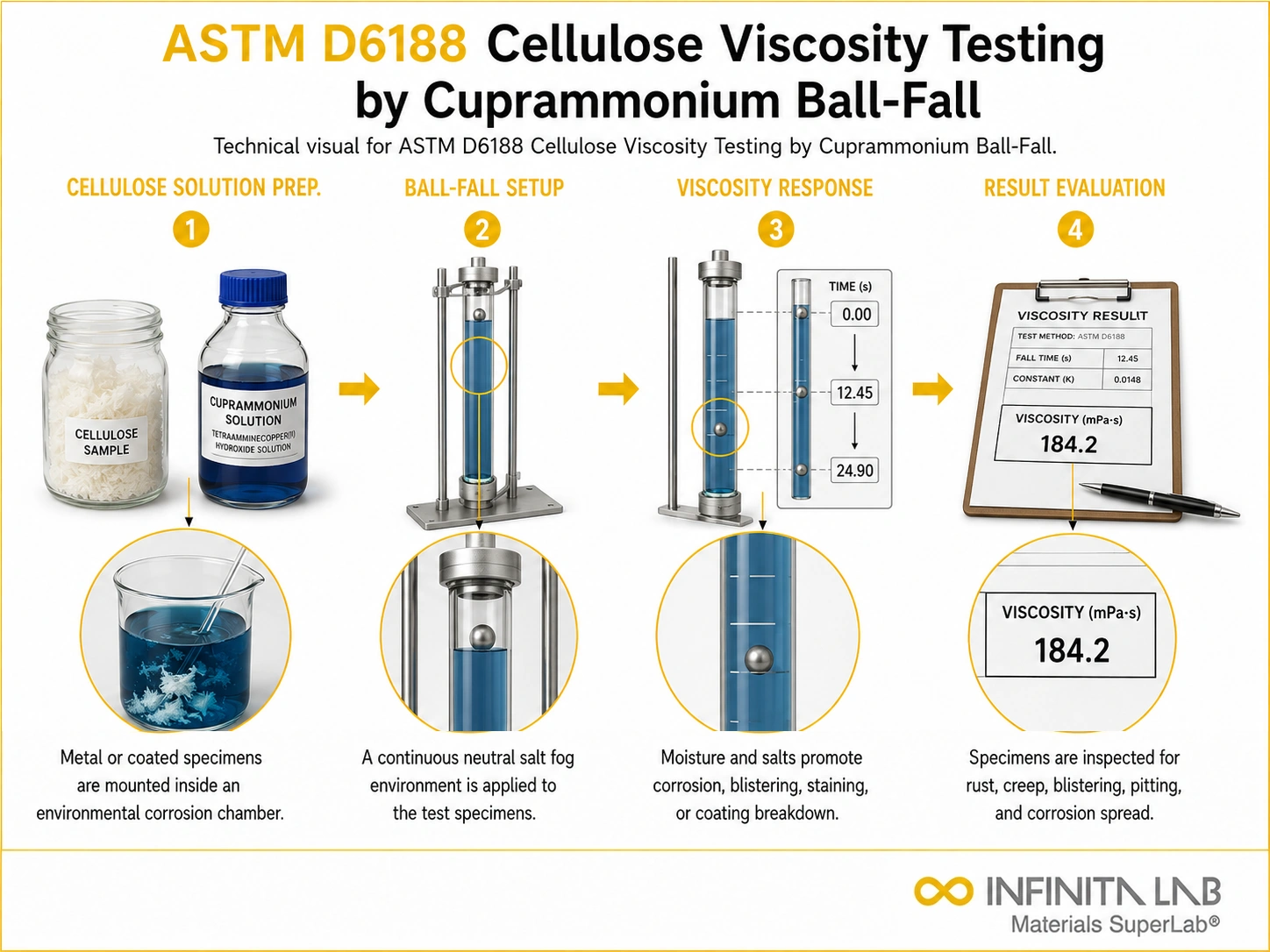
ASTM D6188 is a standardized method used to determine the viscosity of cellulose solutions using the cuprammonium ball fall technique. This method evaluates the resistance to flow of cellulose dissolved in cuprammonium solvent, which reflects molecular weight and polymer chain characteristics.
The test measures the time required for a ball to fall through the cellulose solution under controlled conditions. It provides reliable and reproducible viscosity data, making it essential for quality control, material characterization, and ensuring consistent performance in cellulose-based products and industrial applications.

Applications and Benefits of ASTM D6188 Cellulose Viscosity Cuprammonium Ball Fall Testing
Scope
This test method determines the viscosity of cellulose solutions using the ball fall method in a cuprammonium solvent system.
Includes:
- Measurement of solution viscosity
- Applicability to cellulose materials
- Use of cuprammonium solvent system
- Evaluation of polymer molecular characteristics
- Support for quality control and material analysis
Applications
- Cellulose fiber production
- Textile and paper industries
- Polymer and chemical manufacturing
- Raw material quality assessment
- Research and development laboratories
- Viscosity characterization of cellulose solutions
Benefits
- Provides accurate viscosity measurement
- Reflects molecular weight characteristics
- Ensures consistent material quality
- Supports process control and optimization
- Enables comparison between cellulose grades
- Improves product performance reliability
Our ASTM D6188 Testing Procedure
Sample Preparation
Cellulose is dissolved in cuprammonium solution under controlled conditions to form a homogeneous solution.
1Temperature Conditioning
The solution is maintained at a specified temperature to ensure consistent viscosity measurement.
2Ball Drop Measurement
A calibrated ball is allowed to fall through the solution, and the time taken is recorded.
3Viscosity Calculation
Viscosity is calculated based on fall time, ball dimensions, and solution properties.
4ASTM D6188 Test Parameters and Requirements
| Parameter | Details |
|---|---|
| Property Measured | Viscosity of cellulose solution |
| Method | Ball fall viscometry |
| Solvent | Cuprammonium solution |
| Material Type | Cellulose |
| Measurement Unit | Viscosity (mPa·s or equivalent) |
| Output | Flow resistance value |
| Temperature | Controlled test condition |


- Ball fall viscometer
- Temperature-controlled bath
- Calibrated falling ball
- Stopwatch or timing system
- Sample tubes or viscometer columns
- Analytical balance
Equipment and Instrumentation Used for ASTM D6188 Testing
What You Receive: Test Report, Data, and Certification
- Viscosity values of cellulose solution
- Ball fall time measurements
- Test conditions and parameters
- Material quality assessment
- Comparative analysis data
- Detailed analytical report
ASTM D6188 Cellulose Viscosity Cuprammonium Ball Fall FAQs
Viscosity reflects the molecular weight and chain length of cellulose, which directly impacts processing behavior and final product properties. Accurate measurement ensures consistent quality and performance in applications such as fibers, films, and coatings.
ASTM D6188 provides reliable viscosity data that correlates with polymer characteristics. This helps manufacturers assess raw material consistency and ensure that cellulose meets required specifications for processing and performance.
The method measures the time taken for a ball to fall through a cellulose solution. The resistance encountered by the ball is directly related to the viscosity of the solution.
Higher viscosity generally indicates higher molecular weight and longer polymer chains, which can influence strength, flexibility, and processing characteristics of cellulose-based products.
Factors include temperature variation, improper sample preparation, air bubbles, and timing inaccuracies, all of which must be controlled for reliable measurements.
Why Choose Infinita Lab for Cellulose Viscosity Cuprammonium Ball Fall Testing?
At the core of this breadth is our network of 2,000+ accredited laboratories across the USA, offering access to over 10,000 testing methods and analytical services. From advanced materials characterization (SEM, TEM, RBS, XPS) to mechanical, chemical, environmental, biological, and standardized ASTM/ISO-compliant testing, we deliver unmatched flexibility, specialization, and scale. You are never limited by geography, facility, or methodology — Infinita Lab connects you to the right expertise and testing solution, every time.

Looking for an Accredited Partner for ASTM D6188 Cellulose Viscosity Cuprammonium Ball Fall Testing?
Send query us at hello@infinitalab.com or call us at (888) 878-3090 to learn more about our services and how we can support you.



Request a Quote
Submit your material details and receive testing procedures, pricing, and turnaround time within 24 hours.
 Quick Turnaround and Hasslefree process
 Confidentiality Guarantee
 Free, No-obligation Consultation
 100% Customer Satisfaction
