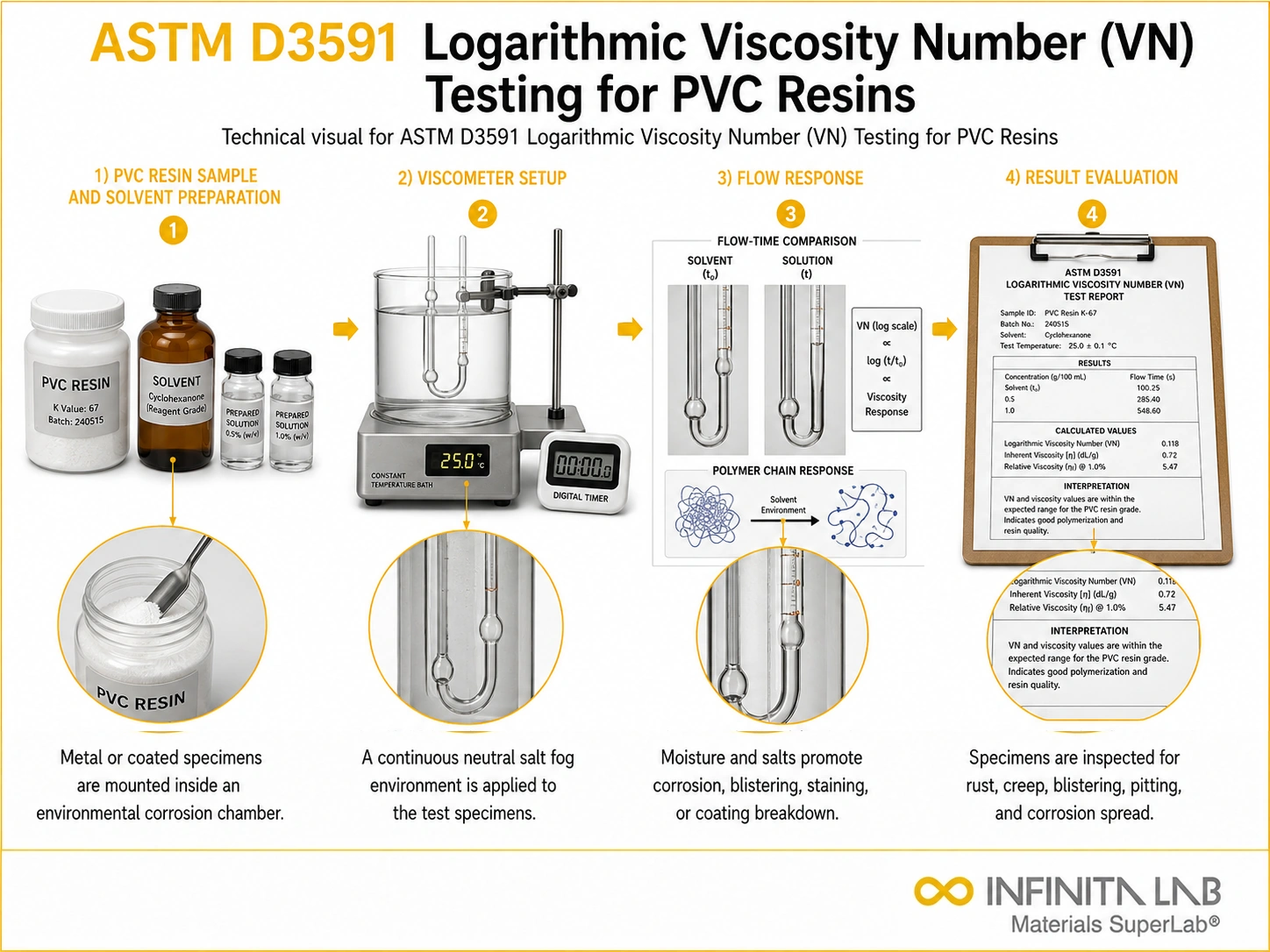


What Is ASTM D3591 PVC Logarithmic Viscosity Number?
ASTM D3591 is the standard method of testing the logarithmic viscosity number (intrinsic viscosity) of a solution of polyvinyl chloride (PVC) resins. Intrinsic viscosity is a measure of the polymer’s average molecular weight and is directly related to its mechanical properties, processing behavior, and consistency.
This method applies to all types of PVC resins, including suspension, emulsion, and bulk-polymerized grades, whether plasticized or unplasticized. Generally speaking, higher viscosity values indicate higher molecular weight, which provides improved strength and impact resistance; lower viscosity values indicate easier processability.

Applications and Benefits of ASTM D3591 PVC Logarithmic Viscosity Number Testing
Scope
ASTM D3591 evaluates the molecular characteristics of PVC by measuring the flow behavior of dilute polymer solutions through a capillary viscometer.
It evaluates:
- Logarithmic viscosity number (intrinsic viscosity)
- Relative molecular weight trends
- Polymer chain length characteristics
- Resin uniformity and consistency
- Processability indicators
The method applies to suspension, emulsion, and bulk-polymerized PVC grades.
Applications
- PVC pipe and profile manufacturing
- Flexible flooring and coatings
- Synthetic leather production
- Film and sheet extrusion
- Cable insulation materials
- Quality control laboratories
- PVC resin research and development
Benefits
- Provides standardized molecular weight indicators
- Supports resin grade selection
- Improves processing control
- Assists in product development
- Ensures batch-to-batch consistency
- Enhances quality assurance programs
Our ASTM D3591 Testing Procedure
Sample Preparation
PVC resin is dried, dissolved in cyclohexanone or THF, and conditioned at 30°C to ensure uniformity and remove air bubbles.
1Flow Measurement
Flow times of the pure solvent and the prepared solution are measured using a capillary viscometer.
2Data Calculation
Intrinsic viscosity is calculated from the flow-time ratios using standard equations.
3Result Reporting
The logarithmic viscosity number is reported in mL/g.
4ASTM D3591 Test Parameters and Requirements
| Parameter | Details |
|---|---|
| Applicable Materials | PVC resins |
| Resin Forms | Powder or granules |
| Solvent | Cyclohexanone or THF |
| Typical Concentration | 0.4 g PVC / 100 mL solvent |
| Test Temperature | 30°C ± 0.1°C |
| Viscometer Type | Ubbelohde or Ostwald |


- Ubbelohde or Ostwald viscometer
- Constant temperature bath
- Analytical balance
- Drying oven
- Stopwatch or digital timer
- Data analysis tools
Equipment and Instrumentation Used for ASTM D3591 Testing
What You Receive: Test Report, Data, and Certification
- Logarithmic viscosity number (mL/g)
- Molecular weight trend assessment
- Batch consistency reports
- Comparative resin performance data
- Documentation for quality control
- Material qualification records
ASTM D3591 PVC Logarithmic Viscosity Number FAQs
The test measures the plasticizer content and logarithmic viscosity number of PVC after compounding or processing.
Soxhlet extraction removes plasticizers, ensuring accurate resin concentration for viscosity determination.
Handle diethyl ether with care due to its flammability and potential for peroxide formation. Use a ventilated workspace.
Key equipment includes a hydraulic press, Soxhlet extraction apparatus, infrared spectrophotometer, and viscometers.
Why Choose Infinita Lab for PVC Logarithmic Viscosity Number Testing?
When your PVC Logarithmic Viscosity Number results have to hold up - for compliance, a customer audit, or an engineering decision - ASTM D3591 accuracy and an unbiased third-party report matter more than price. Infinita Lab routes your ASTM D3591 PVC logarithmic viscosity number testing to ISO/IEC 17025-accredited U.S. partner labs with hands-on method experience, so you get defensible data, transparent reporting, and turnaround times built around your project deadline - not ours.

Need ASTM D3591 PVC Logarithmic Viscosity Number Testing You Can Rely On?
Send query us at hello@infinitalab.com or call us at (888) 878-3090 to learn more about our services and how we can support you.