


ASTM D4878: Polyurethane Raw Material Polyol Testing Services
ASTM D4878 is used to determine polyol viscosity. At 25°C, this test technique determines polyol viscosity in the range of 10 to 100 000 mPa.s (cP).The values are considered as a standard when expressed in SI units.
TRUSTED BY


Get ASTM D4878 compliant results — request your polyurethane raw material polyol testing quote
- Overview
- Scope, Applications, and Benefits
- Test Process
- Specifications
- Instrumentation
- Results and Deliverables
What Is ASTM D4878 Polyurethane Raw Material Polyol?
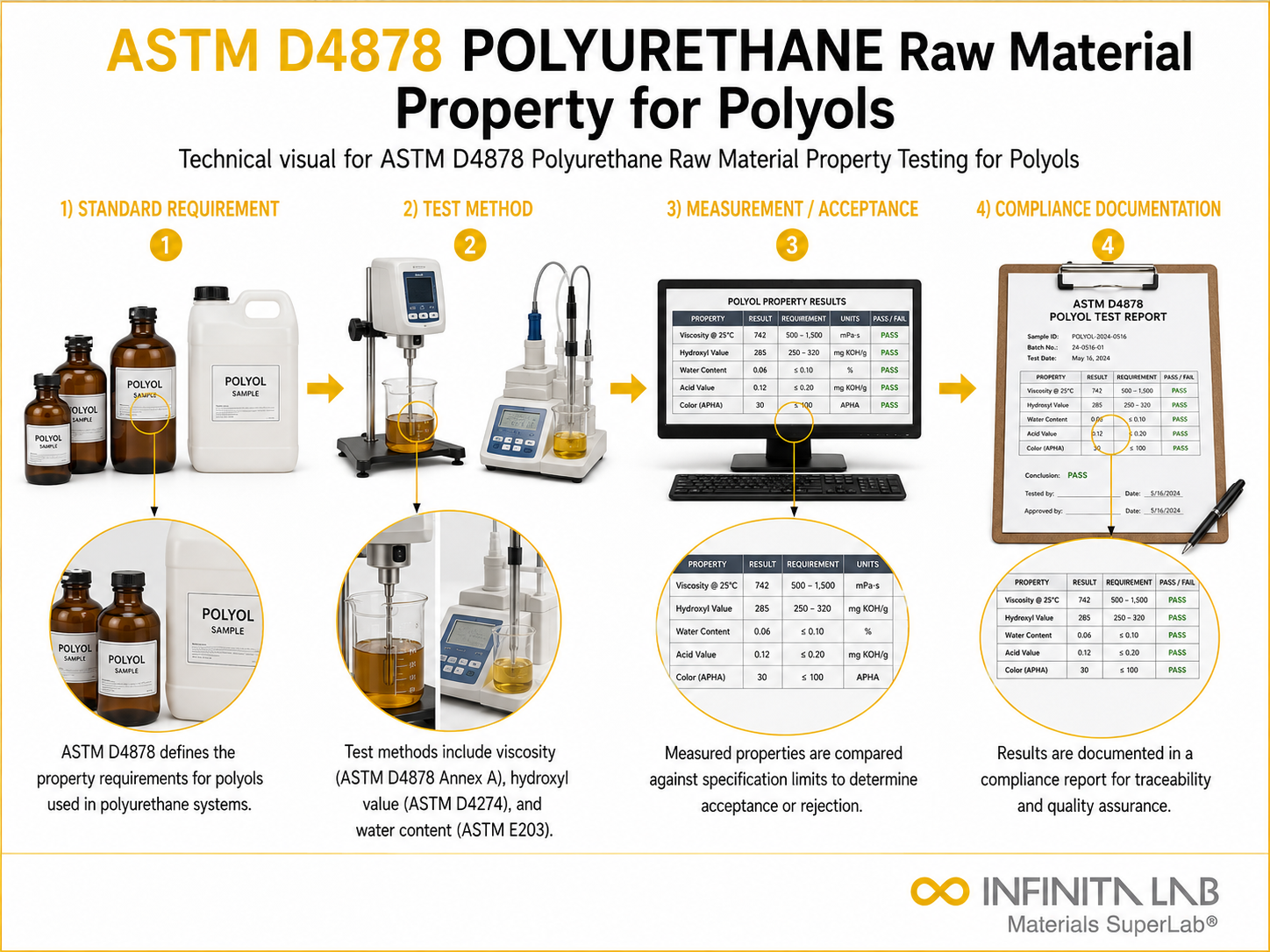
ASTM D4878 defines standardized methods for measuring the viscosity of polyol raw materials used in polyurethane production. Viscosity is among the most practically important physical properties of polyols because it directly governs pumpability through metering equipment, mixability with isocyanates in mixing heads, flow behavior during foam rise, and the ability to wet and impregnate reinforcing materials in composite and binder applications. Polyols range widely in viscosity from thin, water-like liquids to thick, honey-like materials, requiring different measurement approaches.
The standard covers both rotational viscometry using Brookfield-type instruments (suitable for moderate- to high-viscosity polyols) and capillary viscometry (suitable for lower-viscosity systems). Viscosity is measured at a precisely controlled temperature, typically 25°C, and the result is reported in millipascal-seconds (mPa·s, equivalent to centipoise, cP). ASTM D4878 specifies spindle selection criteria, rotational speed selection, temperature control requirements, and measurement timing to ensure accurate, reproducible viscosity values that are comparable across laboratories and production facilities.

Applications and Benefits of ASTM D4878 Polyurethane Raw Material Polyol Testing
Scope
ASTM D4878 evaluates:
- Dynamic viscosity of polyether polyols at specified temperatures
- Dynamic viscosity of polyester polyols at specified temperatures
- Viscosity of blended polyol systems and polyol premix formulations
- Effect of temperature on polyol viscosity (temperature-viscosity relationship)
- Batch-to-batch viscosity consistency of polyol production
- Compliance with polyol viscosity specification limits for processing and formulation
Applications
- Flexible and rigid polyurethane foam polyol incoming inspection
- Polyurethane elastomer and reaction injection molding (RIM) polyol qualification
- CASE application polyols (Coatings, Adhesives, Sealants, Elastomers)
- Polyol manufacturer production quality control and batch release
- Blended polyol system and premix formulation characterization
- Polyol storage stability viscosity monitoring
- Research and development in polyurethane raw material formulation
Benefits
- Ensures polyol processability and pumpability in foam machinery and dispensing equipment
- Detects viscosity deviations caused by contamination, moisture absorption, or off-spec composition
- Supports appropriate pump, hose, and mixing head selection for processing equipment
- Enables consistent mixing ratios and stoichiometry in high-pressure impingement mixing systems
- Provides compliance data for polyol specification and batch release decisions
- Facilitates polyol blend viscosity optimization for the target processing window
Our ASTM D4878 Testing Procedure
Temperature Equilibration
Polyol sample is equilibrated to the specified test temperature (typically 25°C ± 0.1°C) in a controlled bath.
1Viscometer Setup
Appropriate spindle (rotational method) or capillary (low-viscosity method) is selected based on the expected viscosity range.
2Viscosity Measurement
Viscometer is operated at the specified rotational speed or flow rate; steady-state viscosity reading is recorded when stable.
3Reporting
Viscosity is reported in mPa·s at the specified temperature, with the spindle type and speed documented for rotational method results.
4ASTM D4878 Test Parameters and Requirements
| Parameter | Details |
|---|---|
| Test Principle | Rotational viscometry or glass capillary viscometry |
| Instrument Type | Brookfield rotational viscometer or equivalent; Ubbelohde/Cannon-Fenske capillary |
| Test Temperature | 25°C ± 0.1°C (standard); other temperatures as specified |
| Applicable Materials | Polyether polyols, polyester polyols, blended polyol systems |
| Output Units | mPa·s (cP) |
| Measured Outputs | Dynamic viscosity at specified temperature and shear conditions |


- Rotational viscometer (Brookfield LV, RV, HA, or HB series, or equivalent)
- Precision constant-temperature bath (±0.1°C)
- Appropriate viscometer spindles (selected by viscosity range)
- Glass capillary viscometer (for low-viscosity polyols, <500 mPa·s)
- Analytical balance for solution preparation (if applicable)
- Data recording and reporting system
Equipment and Instrumentation Used for ASTM D4878 Testing
What You Receive: Test Report, Data, and Certification
- Viscosity values (mPa·s) at the specified test temperature
- Spindle type, rotational speed, and torque reading records (rotational method)
- Temperature records throughout the measurement
- Batch compliance evaluation against polyol viscosity specification
- Compliance reports
ASTM D4878 Polyurethane Raw Material Polyol FAQs?
ASTM D4878 determines viscosity of polyols. It evaluates flow behavior and processing characteristics, helping ensure consistent mixing, handling, and performance of polyols used in polyurethane manufacturing applications.
Key parameters include temperature control, viscometer type, sample preparation, shear rate, and calibration. Controlled conditions ensure accurate measurement of viscosity in polyol samples.
The test measures viscosity, typically expressed in centipoise or millipascal-seconds. Results indicate flow properties and influence processing and performance of polyurethane systems.
ASTM D4878 applies to polyols used in polyurethane foams, coatings, adhesives, sealants, and elastomers where viscosity affects processing and final product quality.
ASTM D4878 results depend on temperature control and instrument accuracy. Variations in sample handling or contamination may affect results, requiring careful calibration and consistent testing conditions.
Why Choose Infinita Lab for Polyurethane Raw Material Polyol Testing?
At the core of this breadth is our network of 2,000+ accredited laboratories across the USA, offering access to over 10,000 testing methods and analytical services. From advanced materials characterization (SEM, TEM, RBS, XPS) to mechanical, chemical, environmental, biological, and standardized ASTM/ISO-compliant testing, we deliver unmatched flexibility, specialization, and scale. You are never limited by geography, facility, or methodology — Infinita Lab connects you to the right expertise and testing solution, every time.

Need ASTM D4878 Polyurethane Raw Material Polyol Testing You Can Rely On?
Send query us at hello@infinitalab.com or call us at (888) 878-3090 to learn more about our services and how we can support you.



Request a Quote
Submit your material details and receive testing procedures, pricing, and turnaround time within 24 hours.
 Quick Turnaround and Hasslefree process
 Confidentiality Guarantee
 Free, No-obligation Consultation
 100% Customer Satisfaction
