


Glass Viscosity Beam Bending Testing Services
ASTM C1350M measures the viscosity of glass from approximately 108 Pa·s to approximately 1013 Pa·s by determining the rate of viscous bending of a purely loaded glass beam. The values stated in SI units are considered standard.
TRUSTED BY


Get compliant results — request your glass viscosity beam bending testing quote
- Overview
- Scope, Applications, and Benefits
- Test Process
- Specifications
- Instrumentation
- Results and Deliverables
What Is Glass Viscosity Beam Bending?
ASTM C1350M specifies a test method for determining the viscosity of glass using the beam bending technique under controlled temperature conditions. The method evaluates the resistance of glass to deformation when subjected to a constant load at elevated temperatures.
This standard is widely used in glass manufacturing and research where viscosity plays a critical role in forming, shaping, and processing operations. ASTM C1350M ensures accurate and repeatable viscosity measurement, supporting process optimization, quality control, and material characterization.

Applications and Benefits of Glass Viscosity Beam Bending Testing
Scope
ASTM C1350M covers the determination of glass viscosity by measuring the deflection of a beam-shaped specimen under load at elevated temperatures. It includes procedures for specimen preparation, temperature control, and data analysis.
Includes:
- Measurement of viscosity using beam bending method
- Evaluation of deformation under constant load
- Controlled high-temperature testing conditions
- Specimen preparation and dimensional control
- Standardized calculation and reporting
Applications
- Glass manufacturing processes
- Furnace and forming operations
- Research and development of glass materials
- Quality control in glass production
- Thermal processing analysis
- Material property evaluation
Benefits
- Accurate viscosity measurement at high temperatures
- Supports process optimization in glass forming
- Non-complex and reliable testing method
- Provides critical thermal behavior data
- Standardized and repeatable procedure
- Useful for quality assurance and research
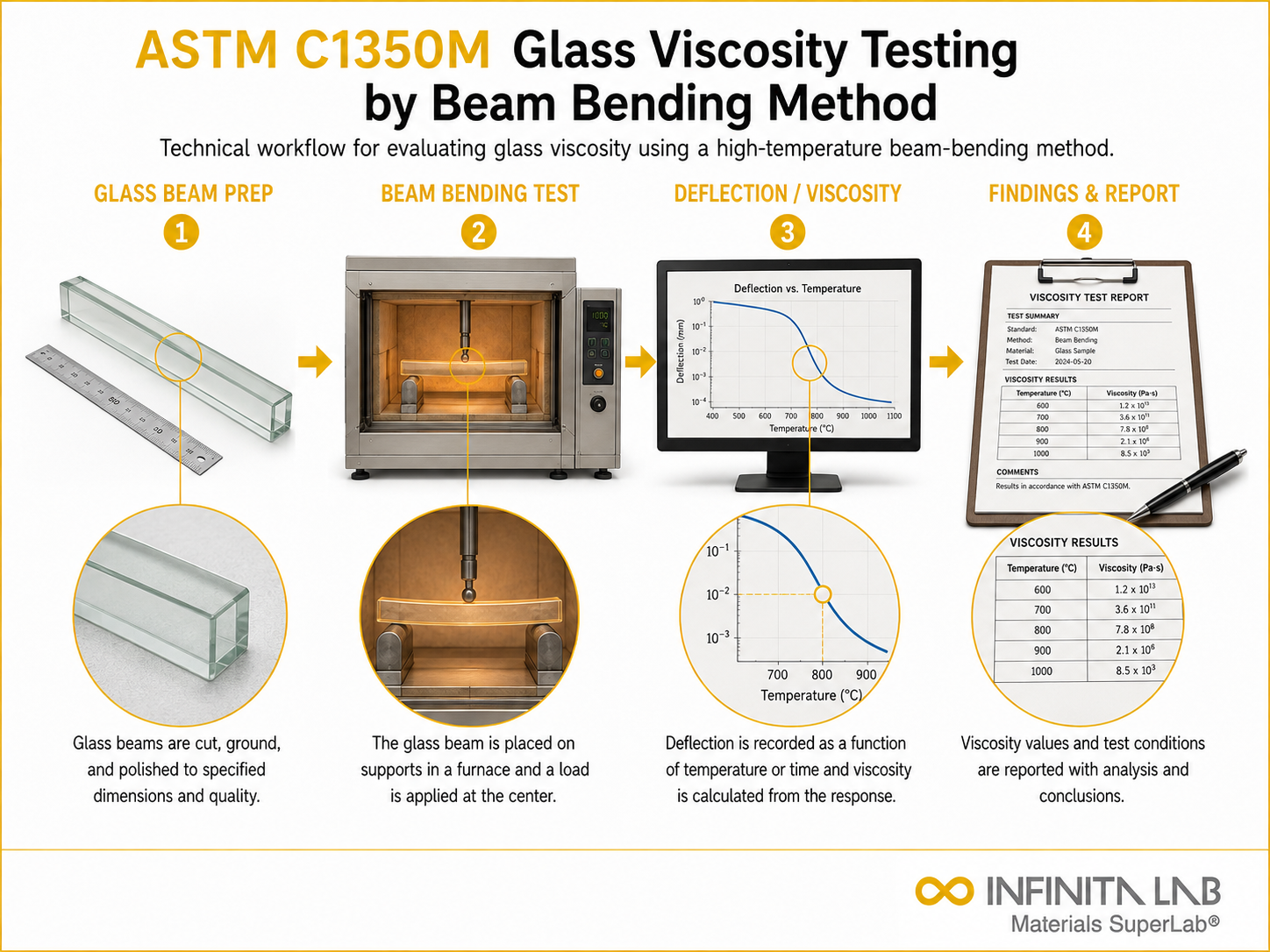
Our Testing Procedure
Specimen Preparation
Glass specimen is shaped into a beam with precise dimensions for bending analysis.
1Furnace Heating
Specimen is placed in a furnace and heated to specified temperatures under controlled conditions.
2Load Application
A constant load is applied to the beam, causing gradual deformation over time.
3Deflection Measurement
Beam deflection is measured and used to calculate viscosity based on standard formulas.
4Test parameters and requirements
| Parameter | Details |
|---|---|
| Material Type | Glass materials |
| Measurement Principle | Deflection under constant load |
| Temperature Range | High-temperature controlled environment |
| Specimen Geometry | Beam-shaped with defined dimensions |
| Loading Type | Constant load application |
| Output Parameter | Viscosity in metric units (Pa·s) |
| Data Output | Viscosity versus temperature relationship |


- High-temperature furnace
- Beam bending apparatus
- Load application system
- Displacement measurement device
- Thermocouples
- Data acquisition system
Equipment and Instrumentation Used for Testing
What You Receive: Test Report, Data, and Certification
- Viscosity test report
- Temperature versus viscosity data
- Deflection measurement records
- Test conditions and parameters
- Compliance certification as per ASTM C1350M
- Test summary and evaluation report
Glass Viscosity Beam Bending FAQs
ASTM C1350M is used to determine the viscosity of glass by measuring beam deflection under a constant load at elevated temperatures, providing essential data for glass processing, forming operations, and material performance evaluation in industrial and research applications.
Viscosity refers to the resistance of glass to flow or deformation under stress, especially at high temperatures, and is a critical property for understanding glass forming and processing behavior.
The method measures the deflection of a glass beam under a constant load at elevated temperatures, and viscosity is calculated based on deformation rate and applied stress.
Temperature significantly affects glass viscosity, and controlled heating ensures accurate measurement of viscosity across different thermal conditions.
The test provides accurate viscosity data, supports process optimization, and ensures consistent quality in glass manufacturing operations.
Why Choose Infinita Lab for Glass Viscosity Beam Bending Testing?
At the core of this breadth is our network of 2,000+ accredited laboratories across the USA, offering access to over 10,000 testing methods and analytical services. From advanced materials characterization (SEM, TEM, RBS, XPS) to mechanical, chemical, environmental, biological, and standardized ASTM/ISO-compliant testing, we deliver unmatched flexibility, specialization, and scale. You are never limited by geography, facility, or methodology — Infinita Lab connects you to the right expertise and testing solution, every time.

Looking for an Accredited Partner for Glass Viscosity Beam Bending Testing?
Send query us at hello@infinitalab.com or call us at (888) 878-3090 to learn more about our services and how we can support you.



Request a Quote
Submit your material details and receive testing procedures, pricing, and turnaround time within 24 hours.
 Quick Turnaround and Hasslefree process
 Confidentiality Guarantee
 Free, No-obligation Consultation
 100% Customer Satisfaction
