


Rheometry Guide Testing Services
Rheometry is used to determine the viscoelastic properties of materials, that is the qualitative and quantitative relationships between stresses and strains and their derivatives. Viscoelasticity is the property of a substance exhibiting both elastic and viscous behavior. Viscoelastic materials behave like both solids and liquids when undergoing deformation. When stress is applied, it causes temporary deformation if quickly removed and permanent deformation if the stress is maintained.
TRUSTED BY


Get compliant results — request your rheometry guide testing quote
- Overview
- Scope, Applications, and Benefits
- Test Process
- Specifications
- Instrumentation
- Results and Deliverables
What Is Rheometry Guide?
Rheometry refers to the experimental techniques used to measure the flow and deformation behavior of materials under applied forces such as stress or strain. It is used to determine rheological properties by analyzing how materials respond to shear, extension, or oscillatory forces.
The technique is widely used for characterizing complex materials such as polymers, suspensions, and soft solids. By measuring parameters such as viscosity and viscoelasticity, rheometry helps predict how materials behave during processing and in real-world applications, especially under varying flow conditions.

Applications and Benefits of Rheometry Guide Testing
Scope
Rheometry testing evaluates:
- Flow behavior under applied stress or strain
- Shear viscosity and shear rate dependence
- Viscoelastic properties (elastic and viscous response)
- Time-dependent deformation behavior
- Material response under different flow conditions
Applications
- Polymers and plastic processing
- Paints, coatings, and inks
- Food and beverage products
- Pharmaceuticals and cosmetics
- Suspensions, emulsions, and gels
Benefits
- Provides detailed flow and deformation analysis
- Enables prediction of processing behavior
- Supports formulation and product optimization
- Improves consistency and performance
- Helps in material classification and comparison
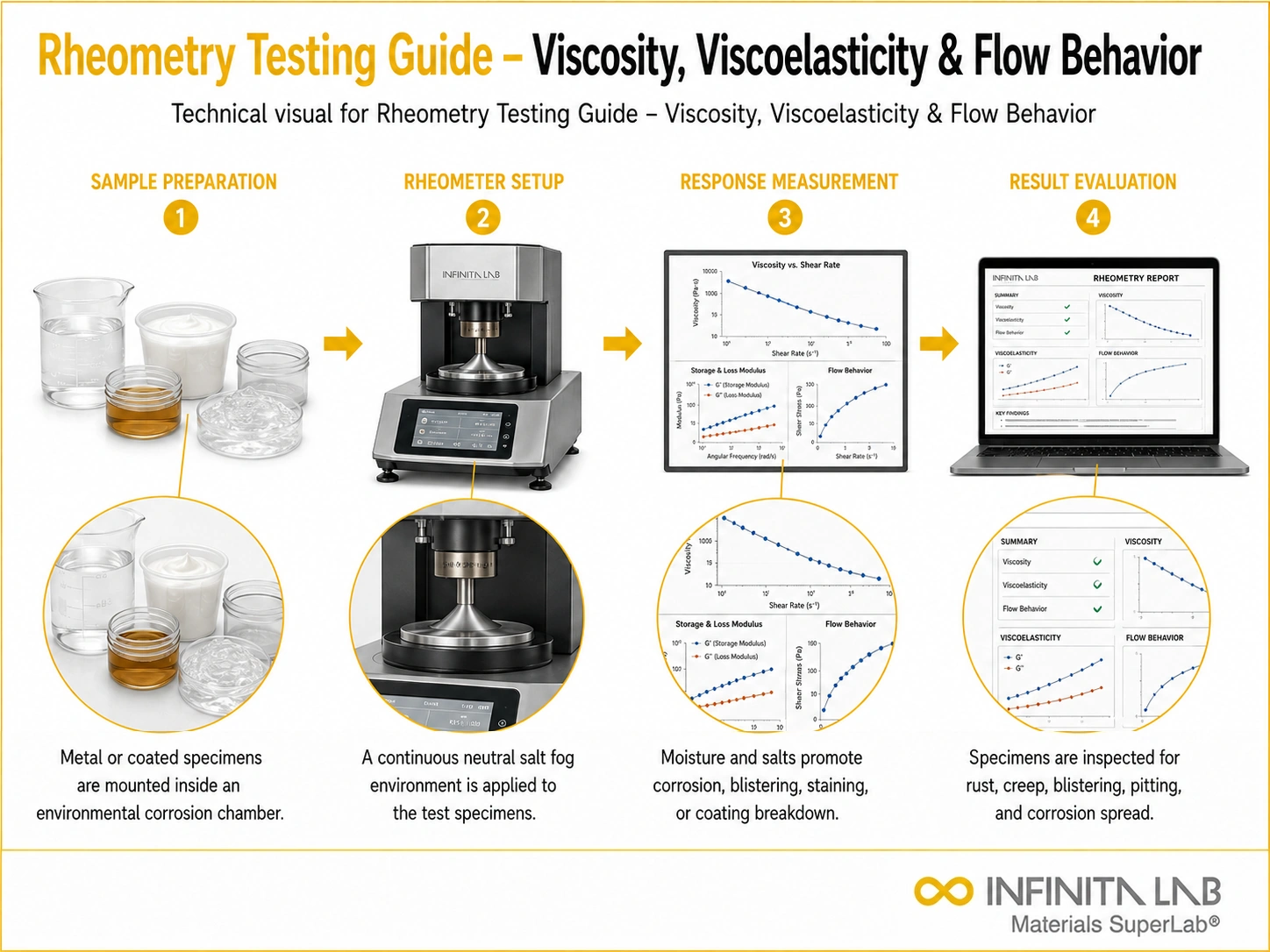
Our Testing Procedure
Sample Preparation
Sample is prepared and placed between rheometer geometries (cone-plate or parallel plate).
1Force Application
Controlled stress or strain is applied to the material.
2Measurement
Resulting deformation, torque, or flow behavior is recorded.
3Data Analysis
Rheological parameters such as viscosity and modulus are calculated.
4Rheometry Technical Specifications
| Parameter | Details |
|---|---|
| Standard | ASTM D4440, ISO 3219 (typical rheology standards) |
| Measurement Modes | Steady shear, oscillatory, extensional |
| Shear Rate Range | ~0.01 to 10⁴ s⁻¹ |
| Temperature Range | Ambient to ~300°C (instrument dependent) |
| Sample Type | Liquids, semi-solids, soft solids |
| Measured Outputs | Viscosity, shear stress, modulus (G', G'') |


- Rotational rheometer
- Oscillatory rheometer
- Cone and plate or parallel plate geometry
- Temperature control system (Peltier/furnace)
- Torque and displacement sensors
- Data acquisition and analysis software
Equipment and Instrumentation Used for Testing
What You Receive: Test Report, Data, and Certification
- Viscosity vs shear rate curves
- Flow behavior classification (Newtonian / non-Newtonian)
- Viscoelastic properties (G’, G”)
- Stress–strain relationships
- Material performance evaluation
- Test report
Rheometry Guide FAQs
Rheometry testing measures how materials flow and deform under applied forces such as stress or strain, helping determine properties like viscosity and viscoelasticity for understanding material behavior during processing and application.
Rheology is the study of flow and deformation of materials, while rheometry refers to the experimental techniques used to measure these properties using instruments like rheometers.
Rheometry measures viscosity, shear stress, shear rate, and viscoelastic properties such as storage and loss modulus, providing detailed insight into material flow behavior under different conditions.
Materials such as polymers, suspensions, emulsions, gels, coatings, food products, and pharmaceuticals can be tested to evaluate their flow and deformation characteristics.
Rheometry helps optimize material formulation, improve processing efficiency, and ensure product consistency by predicting how materials behave under real manufacturing and application conditions.
Why Choose Infinita Lab for Rheometry Guide Testing
At the core of this breadth is our network of 2,000+ accredited laboratories across the USA, offering access to over 10,000 testing methods and analytical services. From advanced materials characterization (SEM, TEM, RBS, XPS) to mechanical, chemical, environmental, biological, and standardized ASTM/ISO-compliant testing, we deliver unmatched flexibility, specialization, and scale. You are never limited by geography, facility, or methodology — Infinita Lab connects you to the right expertise and testing solution, every time.

Looking for an Accredited Partner for Rheometry Guide Testing?
Send query us at hello@infinitalab.com or call us at (888) 878-3090 to learn more about our services and how we can support you.



Request a Quote
Submit your material details and receive testing procedures, pricing, and turnaround time within 24 hours.
 Quick Turnaround and Hasslefree process
 Confidentiality Guarantee
 Free, No-obligation Consultation
 100% Customer Satisfaction
