


ASTM D6133: Solvent Content Paints Coatings Testing Services
The ASTM D6133 is a standard test method for the determination of the total concentration of acetone, p-chlorobenzotrifluoride, methyl acetate, or t-butyl acetate, or a combination of any of the four, in solvent-reducible and water-reducible paints, coatings, resins, and raw materials.
TRUSTED BY


Get ASTM D6133 compliant results — request your solvent content paints coatings testing quote
- Overview
- Scope, Applications, and Benefits
- Test Process
- Specifications
- Instrumentation
- Results and Deliverables
What Is ASTM D6133 Solvent Content Paints Coatings?
ASTM D6133 determines the content of specific exempt or regulated solvents such as acetone, p-chlorobenzotrifluoride, methyl acetate, and t-butyl acetate in paints and coatings. These solvents influence formulation performance and regulatory classification.
The method is widely used to quantify solvent composition for compliance with environmental regulations and formulation control. Accurate measurement ensures coatings meet limits for volatile organic compounds while maintaining desired application and drying characteristics.

Applications and Benefits of ASTM D6133 Solvent Content Paints Coatings Testing
Scope
This test method quantifies selected solvents in paints and coatings using analytical techniques such as gas chromatography. It supports compliance verification and formulation consistency.
Includes:
- Determination of specific solvent content
- Analysis of exempt and regulated solvents
- Applicability to liquid coatings and paints
- Quantitative measurement using analytical instruments
- Support for regulatory compliance evaluation
Applications
- Paint and coating formulation development
- Regulatory compliance testing
- Industrial and decorative coatings
- Automotive and protective coatings
- Solvent composition verification
- Quality control in manufacturing
Benefits
- Ensures compliance with solvent regulations
- Provides accurate solvent composition data
- Supports formulation optimization
- Helps control volatile organic compound content
- Improves product consistency
- Enables reliable quality assurance
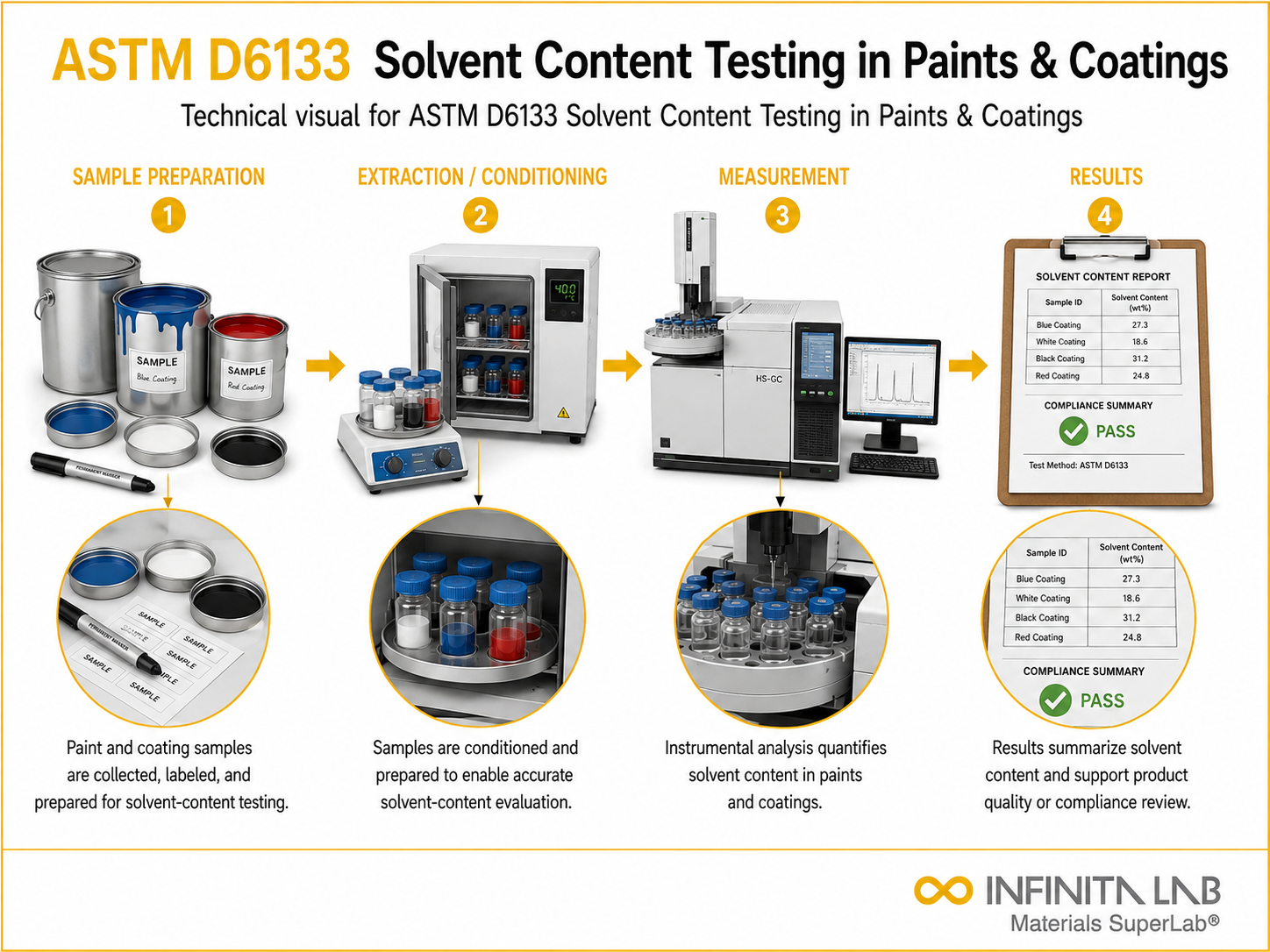
Our ASTM D6133 Testing Procedure
Sample Preparation
The coating sample is prepared and diluted as required for analytical testing.
1Instrument Setup
The gas chromatograph is calibrated using standards for target solvents.
2Analysis
The sample is injected and separated to identify and quantify solvent components.
3Data Interpretation
Solvent concentrations are calculated and reported based on calibration data.
4ASTM D6133 Test Parameters and Requirements
| Parameter | Details |
|---|---|
| Technique | Gas chromatography (GC) |
| Target Compounds | Specific solvents (acetone, PCBTF, esters) |
| Measurement Unit | Percentage or concentration |
| Sample Type | Liquid paints and coatings |
| Detection | Flame ionization detector or equivalent |
| Calibration | External standard method |
| Output | Individual solvent content |


- Gas chromatograph (GC)
- Flame ionization detector (FID)
- Analytical balance
- Volumetric glassware
- Sample preparation tools
- Data processing software
Equipment and Instrumentation Used for ASTM D6133 Testing
What You Receive: Test Report, Data, and Certification
- Concentration of each target solvent
- Chromatogram with peak identification
- Quantitative analysis report
- Calibration and method details
- Compliance evaluation data
- Quality assessment documentation
ASTM D6133 Solvent Content Paints Coatings FAQs
ASTM D6133 helps manufacturers accurately quantify specific solvents that impact regulatory classification and product performance. This ensures formulations meet environmental limits while maintaining required application properties, drying behavior, and overall coating quality.
The method identifies and quantifies exempt and regulated solvents, allowing manufacturers to verify compliance with limits on volatile organic compounds. Accurate data is essential for meeting regional environmental requirements and avoiding regulatory penalties.
These solvents are often considered exempt from certain regulations, making them useful for reducing regulated volatile organic compound content. However, their concentration must still be controlled to maintain performance and ensure accurate product labeling.
Gas chromatography separates individual solvent components and measures their concentration with high precision. This allows accurate identification and quantification even in complex formulations containing multiple volatile compounds.
By analyzing solvent composition, manufacturers can adjust ratios to balance performance and compliance. This helps achieve desired drying time, viscosity, and application properties while minimizing regulated solvent content.
Why Choose Infinita Lab for Solvent Content Paints Coatings Testing?
At the core of this breadth is our network of 2,000+ accredited laboratories across the USA, offering access to over 10,000 testing methods and analytical services. From advanced materials characterization (SEM, TEM, RBS, XPS) to mechanical, chemical, environmental, biological, and standardized ASTM/ISO-compliant testing, we deliver unmatched flexibility, specialization, and scale. You are never limited by geography, facility, or methodology — Infinita Lab connects you to the right expertise and testing solution, every time.

Looking for an Accredited Partner for ASTM D6133 Solvent Content Paints Coatings Testing?
Send query us at hello@infinitalab.com or call us at (888) 878-3090 to learn more about our services and how we can support you.



Request a Quote
Submit your material details and receive testing procedures, pricing, and turnaround time within 24 hours.
 Quick Turnaround and Hasslefree process
 Confidentiality Guarantee
 Free, No-obligation Consultation
 100% Customer Satisfaction
