


ASTM D7169: Crude Oil Residue High Temperature GC Testing Services
ASTM D7169 involves using high temperature gas chromatography to determine the boiling point distribution and cut point intervals of crude oils and residues. An external standard is used to determine the amount of residues. The values stated in SI should be considered as standard.
TRUSTED BY


Get ASTM D7169 compliant results — request your crude oil residue high temperature GC testing quote
- Overview
- Scope, Applications, and Benefits
- Test Process
- Specifications
- Instrumentation
- Results and Deliverables
What Is ASTM D7169 Crude Oil Residue High Temperature GC?
ASTM D7169 describes a test method for determining the boiling point distribution of crude oils, atmospheric residues, and vacuum residues by high-temperature gas chromatography (HTGC). The boiling point distribution, also known as simulated distillation (SimDis), provides critical information about the composition and distillability of heavy petroleum fractions that cannot be practically measured by conventional distillation.
This method is indispensable in petroleum refining for feedstock characterization, process optimization, and yield prediction of heavy crude oil processing units.

Applications and Benefits of ASTM D7169 Crude Oil Residue High Temperature GC Testing
Scope
ASTM D7169 covers petroleum samples with boiling points ranging from approximately 100°C to over 720°C (atmospheric equivalent boiling points) and determines:
- Cumulative weight percent recovered vs. boiling point curve
- Residue content (fraction boiling above column temperature limit)
- Yield prediction for distillation cuts
- True boiling point (TBP) correlation
Applications
- Crude oil assay and quality characterization
- Refinery vacuum distillation unit feed characterization
- Atmospheric and vacuum residue product quality testing
- Comparison of crude feedstock distillability
- Process monitoring in heavy oil upgrading operations
Benefits
- Extends simulated distillation to heavier fractions than earlier methods (ASTM D2887, D6352)
- Requires very small sample volume for complete boiling range characterization
- Provides data for refinery planning and economic models
- Faster and more reproducible than true distillation
- Enables characterization of high-boiling residual fractions previously unmeasured
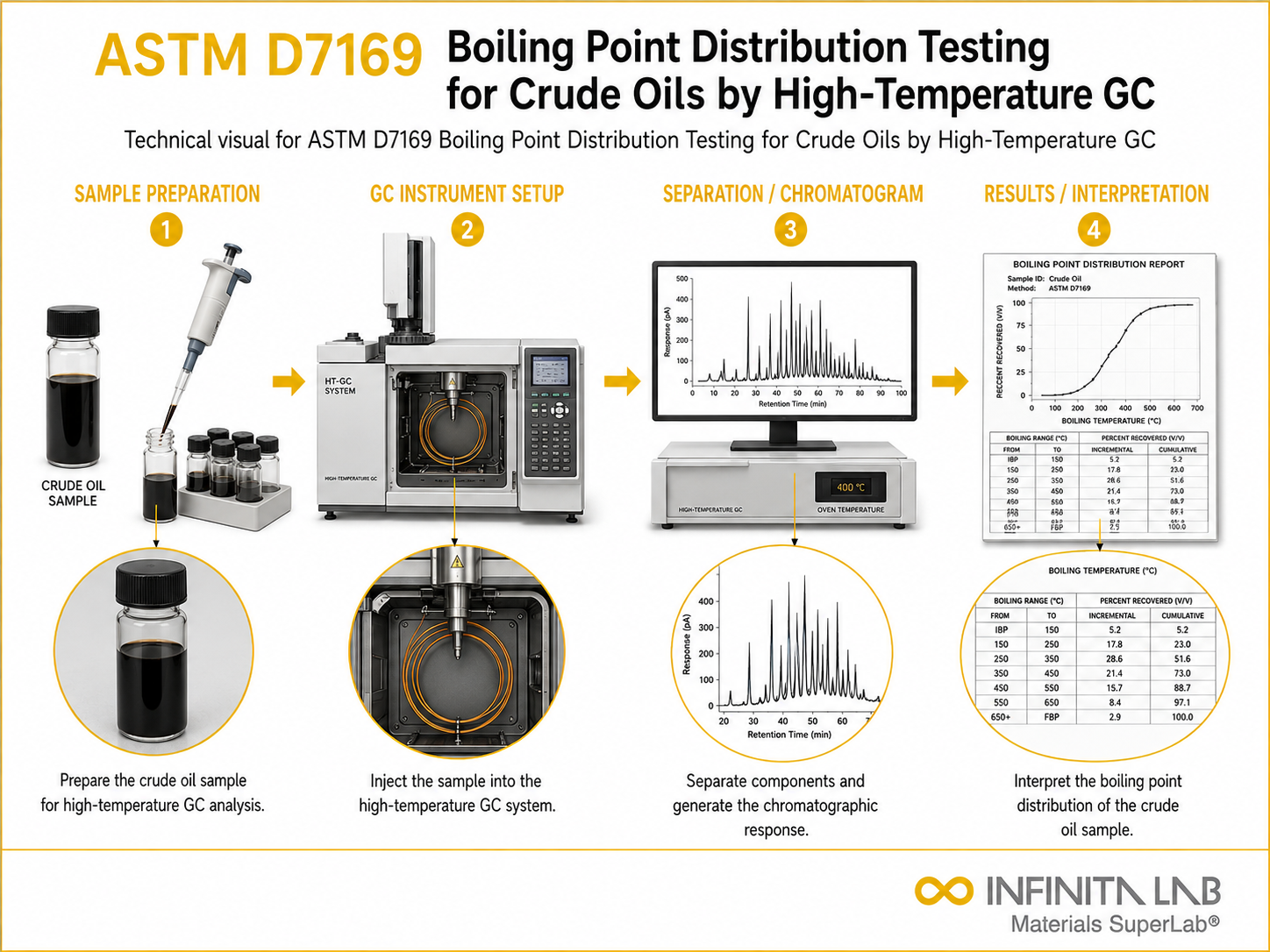
Our ASTM D7169 Testing Procedure
Sample Preparation
A small aliquot of the petroleum sample is dissolved in carbon disulfide or similar solvent for injection.
1HTGC Analysis
The solution is injected into a high-temperature GC with a non-polar column, programmed to temperatures up to 430–450°C
2Elution Curve Recording
The FID signal vs. time is recorded, and elution time is converted to boiling point using calibration.
3Boiling Point Distribution Calculation
Cumulative weight percent recovered vs. boiling temperature is calculated and reported as the SimDis curve.
4ASTM D7169 Test Parameters and Requirements
| Parameter | Details |
|---|---|
| Standard | ASTM D7169 |
| Test Principle | High-temperature simulated distillation by GC |
| Applicable Materials | Crude oils, atmospheric and vacuum residues |
| Boiling Range | ~100°C to 720°C+ (atmospheric equivalent) |
| Detector | Flame ionization detector (FID) |
| Calibration | Polywax or hydrocarbon mixture with known boiling points |


- High-temperature gas chromatograph (up to 450°C oven)
- Non-polar, thermally stable GC column (e.g., aluminum-clad fused silica) | FID with hydrogen and air supply
- Calibration mixture (polywax or n-paraffin blend)
- Data system for SimDis curve calculation
Equipment and Instrumentation Used for ASTM D7169 Testing
What You Receive: Test Report, Data, and Certification
- Boiling point distribution (SimDis) curve
- Cumulative weight percent at each boiling temperature point
- Initial boiling point (IBP) and final boiling point (FBP)
- Residue fraction above maximum column temperature
- Refinery-ready data report with yield cut breakdown
ASTM D7169 Crude Oil Residue High Temperature GC FAQs
D2887 covers up to ~538°C for lighter petroleum distillates, D6352 extends to ~650°C for heavy distillates, and D7169 extends further to ~720°C+ for residues, covering the heaviest refinery streams
Because high-boiling petroleum components decompose near their actual boiling points, the GC column temperature is converted to the equivalent atmospheric pressure boiling point using calibration data.
Yes — ASTM D7169 was specifically developed to handle very heavy, high-residue feedstocks such as bitumen-derived synthetic crudes that contain large fractions boiling above 650°C.
Material that elutes after the maximum column temperature program is reported as "residue above X°C" and is a key indicator of the proportion of non-distillable material in the feed.
Typically 50–500 µL of the diluted sample solution is injected; the original sample requirement before dilution may be as little as 0.1–1 g.
Why Choose Infinita Lab for Crude Oil Residue High Temperature GC Testing
At the core of this breadth is our network of 2,000+ accredited laboratories across the USA, offering access to over 10,000 testing methods and analytical services. From advanced materials characterization (SEM, TEM, RBS, XPS) to mechanical, chemical, environmental, biological, and standardized ASTM/ISO-compliant testing, we deliver unmatched flexibility, specialization, and scale. You are never limited by geography, facility, or methodology — Infinita Lab connects you to the right expertise and testing solution, every time.

Need ASTM D7169 Crude Oil Residue High Temperature GC Testing You Can Rely On?
Send query us at hello@infinitalab.com or call us at (888) 878-3090 to learn more about our services and how we can support you.



Request a Quote
Submit your material details and receive testing procedures, pricing, and turnaround time within 24 hours.
 Quick Turnaround and Hasslefree process
 Confidentiality Guarantee
 Free, No-obligation Consultation
 100% Customer Satisfaction
