


ASTM D7132: Xps Foam Retained Blowing Agent Testing Services
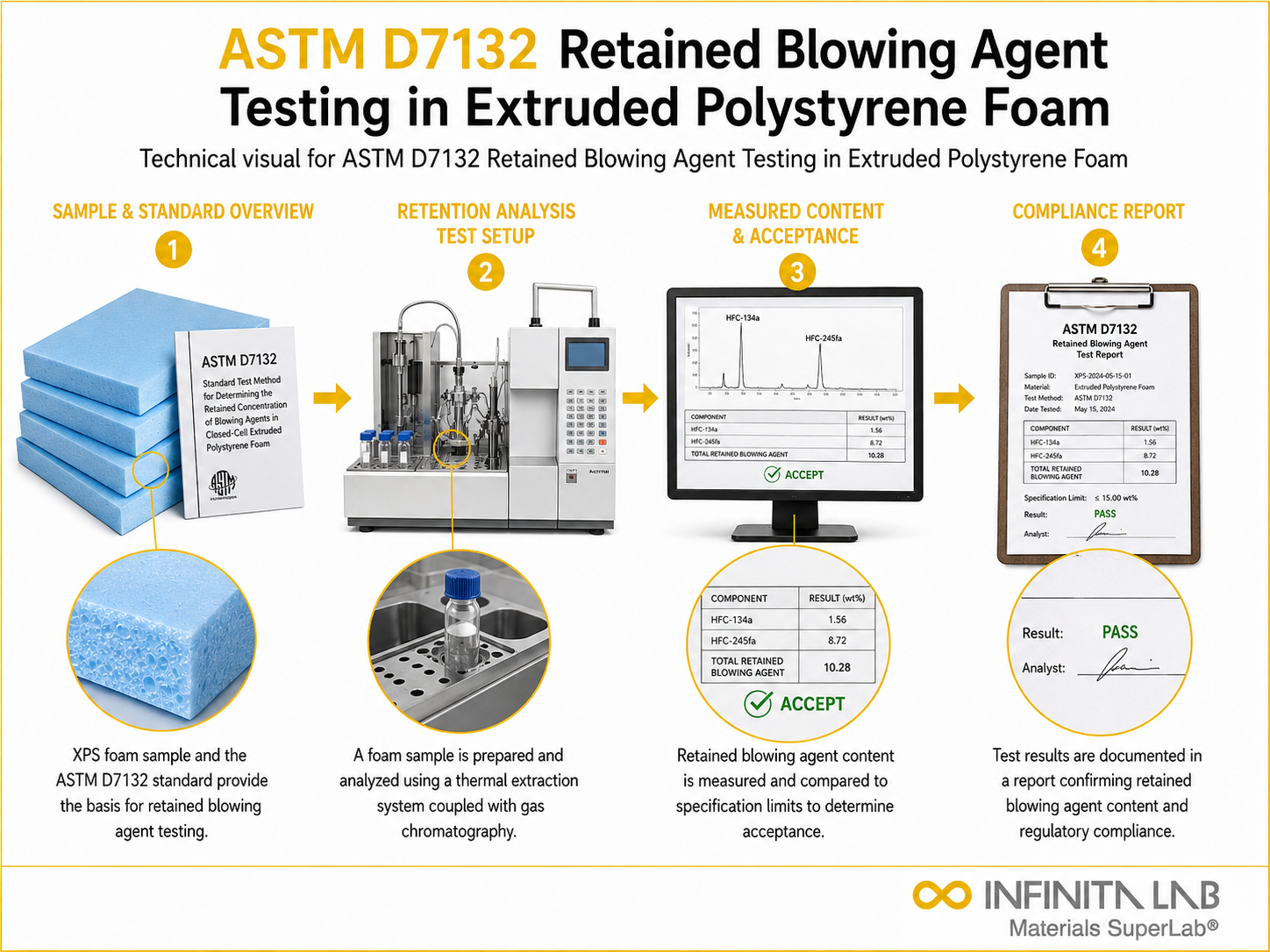
The test method in ASTM D7132 involves dissolving the polystyrene foam in a solvent, such as toluene, to release the retained blowing agent, and then testing the solution for its components using Gas Chromatography (GC). As a reference analyte, an internal standard is used, and the GC is calibrated with standard solutions to convert the GC response to the amount of blowing agent retained in the foam matrix.
TRUSTED BY


Get ASTM D7132 compliant results — request your xps foam retained blowing agent testing quote
- Overview
- Scope, Applications, and Benefits
- Test Process
- Specifications
- Instrumentation
- Results and Deliverables
What Is ASTM D7132 Xps Foam Retained Blowing Agent?
ASTM D7132 describes a test method for determining the concentration of retained blowing agents in extruded polystyrene (XPS) foam insulation using gas chromatography. Blowing agents used in XPS foam manufacturing contribute to thermal insulation performance, and their retention within the foam cells over time directly affects the foam’s long-term thermal resistance (R-value).
This method is used by XPS foam manufacturers, building product certification bodies, and energy performance researchers to measure the initial blowing agent content and to predict the thermal aging of insulation products.

Applications and Benefits of ASTM D7132 Xps Foam Retained Blowing Agent Testing
Scope
ASTM D7132 applies to extruded polystyrene foam insulation and determines:
- Identity and concentration of retained blowing agents (e.g., HFC-134a, CO2, HFO blends)
- Distribution of blowing agents between cells and polymer matrix
- Change in blowing agent content over time or after aging
- Correlation of blowing agent content with foam thermal conductivity
Applications
- XPS foam insulation quality control and specification compliance
- Long-term thermal resistance (LTTR) prediction and certification
- Environmental compliance with blowing agent regulations
- New blowing agent formulation development and screening
- Building energy code compliance documentation
Benefits
- Provides direct measurement of the insulation performance driver
- Enables prediction of thermal aging and R-value decline
- Supports transition to low-GWP blowing agents with performance verification
- Applicable to various blowing agent types and XPS formulations
- Correlates to measured thermal conductivity for validation
Our ASTM D7132 Testing Procedure
Sample Preparation
XPS foam specimens are weighed and prepared by dissolution or direct vapor sampling to release trapped blowing agents.
1GC Analysis
The released vapor or extracted solution is injected into a gas chromatograph with a flame ionization or thermal conductivity detector.
2Quantification
Blowing agent peaks are identified and quantified by comparison to certified calibration standards.
3Reporting
Results are expressed as mass fraction (%) or volume concentration; long-term aging calculations are applied if required.
4ASTM D7132 Test Parameters and Requirements
| Parameter | Details |
|---|---|
| Test Principle | Gas chromatographic analysis of extracted or vaporized blowing agents |
| Applicable Materials | Extruded polystyrene (XPS) foam insulation |
| Detection | FID or TCD depending on blowing agent type |
| Measured Output | Blowing agent concentration (wt% or vol%) |


- Gas chromatograph with FID or TCD
- Dissolution apparatus for polystyrene matrix
- Headspace sampler or direct injection syringe
- Certified blowing agent reference standards
- Analytical balance and sample preparation glassware
Equipment and Instrumentation Used for ASTM D7132 Testing
What You Receive: Test Report, Data, and Certification
- Blowing agent identity and concentration data
- Blowing agent retention as a percentage of initial content
- Correlation to measured or estimated thermal conductivity
- Aging curve data if time-series testing is performed
- Test report for product certification or specification compliance
ASTM D7132 Xps Foam Retained Blowing Agent FAQs
Blowing agents trapped in foam cells have lower thermal conductivity than air; as they diffuse out over time, thermal conductivity increases (R-value decreases), which is why long-term thermal resistance is lower than initial measured values.
Regulatory pressure has driven a shift from older HCFCs to HFCs (e.g., HFC-134a, HFC-152a) and newer HFOs (e.g., HFO-1234ze, HFO-1233zd) with lower global warming potential.
LTTR uses blowing agent concentration decay data combined with thermal conductivity vs. composition relationships to project the average R-value over a defined service period (typically 25 years).
Typically 1–5 grams of foam is sufficient, depending on the blowing agent type and detection method sensitivity.
Yes — GC with appropriate column selection can resolve and quantify multiple blowing agent species in a single injection, which is useful for foam produced with blowing agent blends.
Why Choose Infinita Lab for Xps Foam Retained Blowing Agent Testing?
At the core of this breadth is our network of 2,000+ accredited laboratories across the USA, offering access to over 10,000 testing methods and analytical services. From advanced materials characterization (SEM, TEM, RBS, XPS) to mechanical, chemical, environmental, biological, and standardized ASTM/ISO-compliant testing, we deliver unmatched flexibility, specialization, and scale. You are never limited by geography, facility, or methodology — Infinita Lab connects you to the right expertise and testing solution, every time.

Looking for an Accredited Partner for ASTM D7132 Xps Foam Retained Blowing Agent Testing?
Send query us at hello@infinitalab.com or call us at (888) 878-3090 to learn more about our services and how we can support you.



Request a Quote
Submit your material details and receive testing procedures, pricing, and turnaround time within 24 hours.
 Quick Turnaround and Hasslefree process
 Confidentiality Guarantee
 Free, No-obligation Consultation
 100% Customer Satisfaction
