


ASTM D7213: Petroleum Distillate Boiling Range GC Testing Services
Accredited ASTM D7213 petroleum distillate boiling range GC testing from Infinita Lab, performed to the exact standard requirements - accurate, reproducible results with full documentation for compliance, R&D, and quality control programs.
TRUSTED BY


Get ASTM D7213 compliant results - request your petroleum distillate boiling range GC testing quote
- Overview
- Scope, Applications, and Benefits
- Test Process
- Specifications
- Instrumentation
- Results and Deliverables
What Is ASTM D7213 Petroleum Distillate Boiling Range GC?
ASTM D7213 is the standard test method for determining the boiling range distribution of petroleum distillates with initial boiling points above 100°C and final boiling points below 615°C, using gas chromatography as a simulated distillation (SimDis) technique. Instead of physically boiling and condensing a sample fraction by fraction, as conventional distillation methods do, D7213 injects a small volume of sample into a temperature-programmed gas chromatograph fitted with a non-polar capillary column. Sample components elute from the column in order of increasing boiling point and are detected by a flame ionisation detector, producing a chromatogram that is converted into a boiling point distribution curve using a calibration built from a known hydrocarbon standard.
The method fills the analytical gap between ASTM D2887, which covers lighter fractions up to about 538°C, and ASTM D6352, which extends high-temperature simulated distillation up to roughly 700°C. Because D7213 results are considered theoretically equivalent to true boiling point (TBP) distillation performed under ASTM D2892, refiners rely on it as a fast, low-volume alternative for characterising middle distillates such as diesel, kerosene, jet fuel, and gas oils without running lengthy physical distillations.
Refiners, blenders, and petrochemical producers use D7213 data to support crude and product assay work, monitor fractionation and blending operations, verify feedstock composition ahead of downstream processing, and confirm that distillate products meet boiling range specifications. Because the method requires only a small sample and delivers a full, continuous boiling curve rather than a handful of discrete cut points, it is widely favoured over manual distillation for routine quality control and process optimisation in modern refining and testing laboratories.

Applications and Benefits of ASTM D7213 Petroleum Distillate Boiling Range GC Testing
Scope
- Determines the boiling range distribution of petroleum distillates by gas chromatography using simulated distillation principles.
- Applies to samples with initial boiling points above 100°C and final boiling points below 615°C at atmospheric pressure.
- Covers light and medium petroleum distillate fractions such as diesel fuel, kerosene, jet fuel, and gas oils.
- Excludes petroleum fractions containing low molecular weight components, including naphthas, reformates, gasolines, and crude oils.
- Excludes samples containing heterogeneous components such as alcohols, ethers, acids, or esters.
- Excludes samples containing residue, which fall outside the method’s calibration and elution range.
- Extends boiling range coverage above ASTM D2887 (limited to 538°C) and below ASTM D6352 (extending to 700°C).
- Produces results that are considered theoretically equivalent to true boiling point distillation performed under ASTM D2892.
- Is not intended to produce results equivalent to lower-efficiency distillation methods such as ASTM D86 or D1160.
- May be used for product specification testing when agreed upon between the interested parties.
Applications
- Characterising middle distillate products such as diesel, kerosene, jet fuel, and gas oil for boiling range specification compliance.
- Supporting crude and product assay programs that require detailed boiling point distribution data.
- Monitoring refinery fractionation performance to confirm that distillation columns are cutting product streams as designed.
- Evaluating distillate blend stocks to verify that blending targets for boiling range are being met.
- Assessing feedstock composition ahead of downstream conversion or hydroprocessing units.
- Screening incoming or outgoing distillate cargoes for quality assurance and contractual conformance.
- Supporting research and development work on distillate fuel formulations and additive packages.
Benefits
- Delivers a complete, continuous boiling point distribution rather than a limited number of discrete cut-point temperatures.
- Requires only a small sample volume compared with conventional physical distillation apparatus.
- Provides faster analysis turnaround than manual distillation methods while maintaining reproducible results.
- Produces data that correlates closely with true boiling point distillation, supporting confident process and specification decisions.
- Reduces manual handling and operator variability associated with physical distillation glassware and procedures.
- Generates chromatographic data that is well suited to computerised data handling, reporting, and archiving.
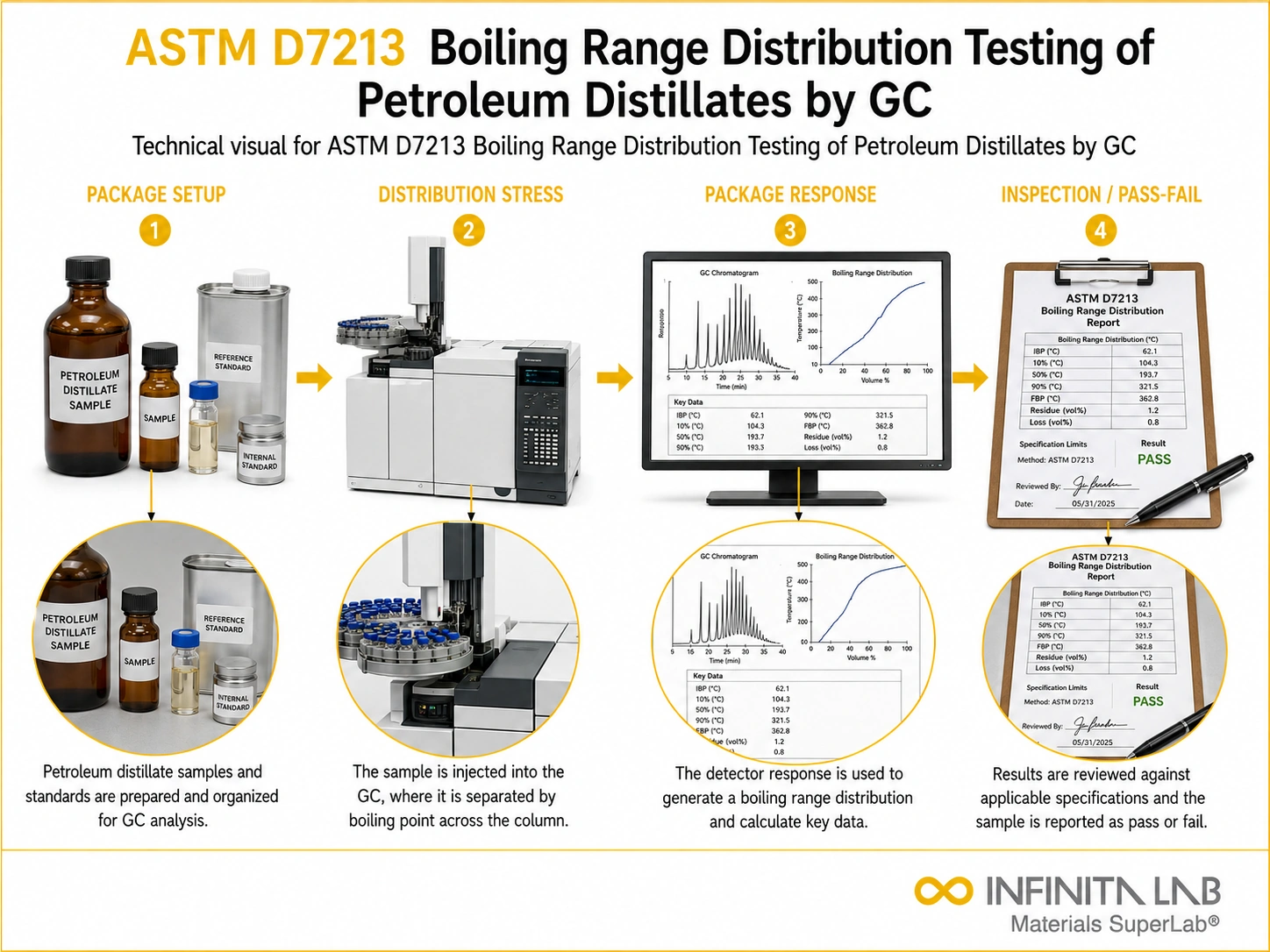
Our ASTM D7213 Testing Procedure
Sample Dissolution
The petroleum sample is dissolved in a volatile solvent (typically carbon disulfide) at a known concentration.
1GC Injection
The solution is injected into a GC with a non-polar column using a temperature-programmed method.
2Calibration Elution
A certified n-paraffin calibration mixture is run to establish the boiling point vs. retention time relationship.
3SimDis Curve Generation
The sample elution profile is converted to a cumulative weight percent vs. boiling temperature curve using calibration data.
4ASTM D7213 Test Parameters and Requirements
| Parameter | Details |
|---|---|
| Standard | ASTM D7213 |
| Test Principle | Simulated distillation by capillary GC |
| Applicable Materials | Petroleum distillates boiling from ~100°C to 615°C |
| Detector | Flame ionization detector (FID) |
| Calibration | n-Paraffin blend with known boiling points |
| Measured Output | Cumulative wt% vs. boiling temperature (SimDis curve) |


- Gas Chromatograph – Provides the temperature-programmed separation platform that performs the simulated distillation analysis.
- Non-Polar Capillary Column – Separates sample components by boiling point as the oven temperature is ramped.
- Flame Ionisation Detector (FID) – Detects eluting hydrocarbon components and generates the signal used to build the boiling point curve.
- Autosampler – Delivers consistent, repeatable sample injections and supports higher sample throughput.
- Temperature-Programmable Oven – Executes the defined heating ramp that drives component separation across the method’s boiling range.
- Carrier Gas Supply – Supplies the mobile phase gas, such as helium, nitrogen, or hydrogen, that moves the sample through the column.
- Data Acquisition Software – Converts raw chromatographic data into calibrated boiling point distribution results and formatted reports.
Equipment and Instrumentation Used for ASTM D7213 Testing
What You Receive: Test Report, Data, and Certification
- A boiling point distribution curve showing recovered percentage versus boiling temperature across the tested range.
- Reported boiling point values at standard recovery percentages consistent with the method’s reporting conventions.
- Raw chromatographic data supporting the calculated boiling range distribution, available on request.
- A summary report identifying the sample, test conditions, and applicable method reference.
- Quality control documentation confirming that calibration and system suitability checks were met during testing.
ASTM D7213 Petroleum Distillate Boiling Range GC FAQs
ASTM D2887 is the foundational simulated distillation method for petroleum distillates up to approximately 538°C; D7213 is an extension method covering heavier fractions up to ~615°C with modified instrumentation.
SimDis results correlate well with true boiling point (TBP) distillation data with good precision; they are faster and require far less sample but are not identical to physical distillation due to differences in mass vs. volume recovery.
With appropriate method modifications, D7213 can be applied to biodiesel and fatty acid methyl ester (FAME) blends; however, FAME-specific methods like ASTM D7398 may be more appropriate for pure FAME characterization.
Typically 0.05–0.5 mL of the neat sample before dilution; after dilution into CS2, the injection volume is 0.5–1.0 µL.
Yes — D7213 is cited in petroleum product specifications and quality testing protocols for middle distillate fuels as an alternative to D86 physical distillation for boiling range characterization.
Why Choose Infinita Lab for Petroleum Distillate Boiling Range GC Testing
When your Petroleum Distillate Boiling Range GC results have to hold up - for compliance, a customer audit, or an engineering decision - ASTM D7213 accuracy and an unbiased third-party report matter more than price. Infinita Lab routes your ASTM D7213 petroleum distillate boiling range GC testing to ISO/IEC 17025-accredited U.S. partner labs with hands-on method experience, so you get defensible data, transparent reporting, and turnaround times built around your project deadline - not ours.

Need ASTM D7213 Petroleum Distillate Boiling Range GC Testing You Can Rely On?
Send query us at hello@infinitalab.com or call us at (888) 878-3090 to learn more about our services and how we can support you.



Request a Quote
Submit your material details and receive testing procedures, pricing, and turnaround time within 24 hours.
 Quick Turnaround and Hasslefree process
 Confidentiality Guarantee
 Free, No-obligation Consultation
 100% Customer Satisfaction
