

Overview
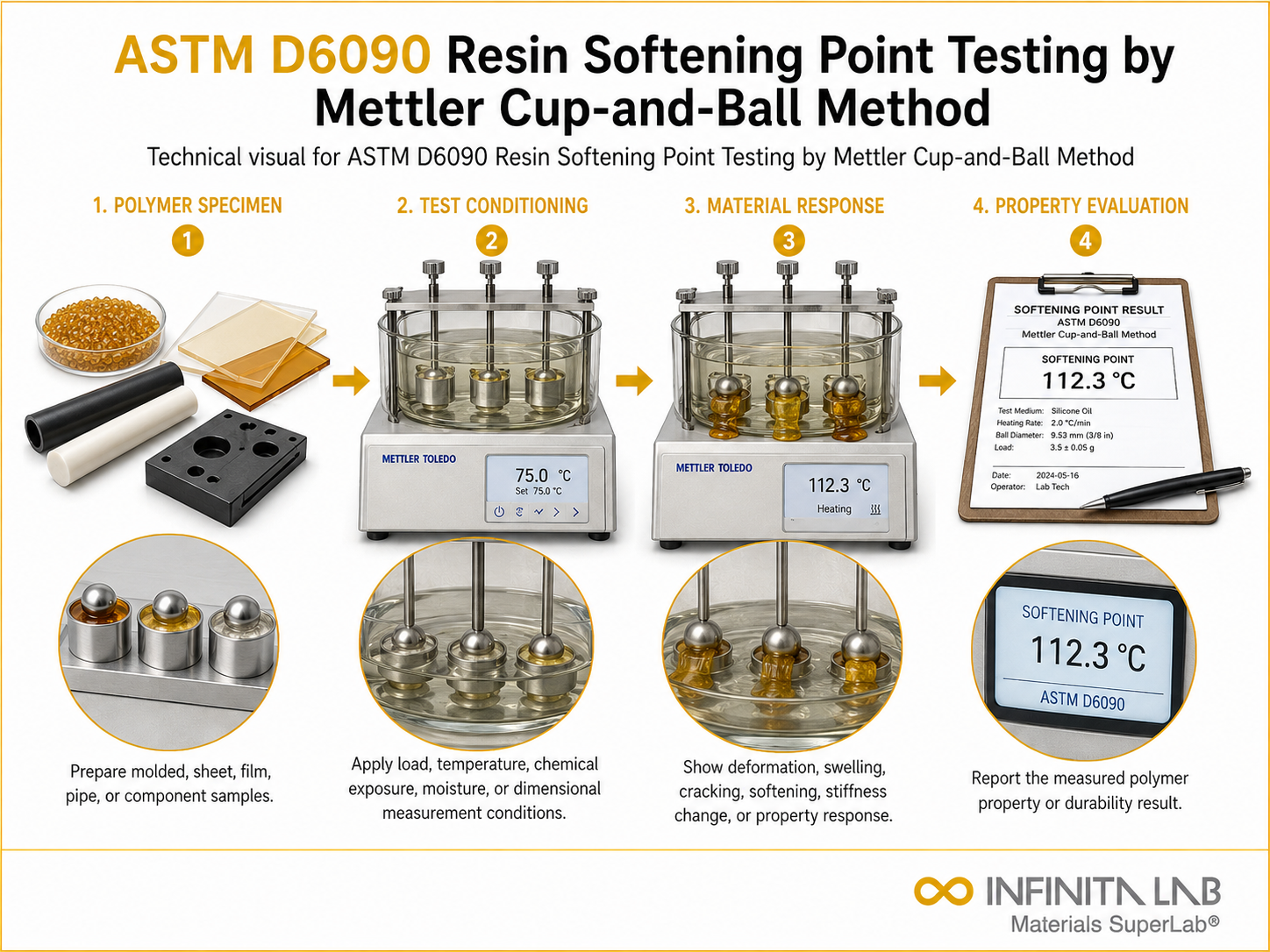
ASTM D6090 provides a test method for determining the softening point of resins using the Mettler cup-and-ball method. The softening point indicates the temperature at which a resin transitions from a solid to a softened state under specified conditions.
This test is important for evaluating thermal behavior and processing characteristics of resins used in coatings, adhesives, and polymer formulations.

Scope, Applications, and Benefits
Scope
ASTM D6090 determines the softening temperature of resin materials using a controlled heating system. It ensures consistency in evaluating thermal properties of resins.
The test evaluates:
- Softening temperature of resins
- Thermal behavior under controlled heating
- Suitability for processing applications
- Consistency of resin materials
Applications
- Adhesives and sealants
- Coatings and paints
- Polymer and resin manufacturing
- Hot-melt formulations
- Quality control in chemical industries
Benefits
- Provides accurate softening point data
- Supports material selection and processing
- Ensures product consistency
- Helps in formulation development
- Enables comparison between resin grades
Test Process
Sample Preparation
Resin sample is placed in the test cup.
1Heating
Sample is heated at a controlled rate.
2Ball Movement Observation
Steel ball movement indicates softening point.
3Data Recording & Evaluation
Temperature at softening is recorded and analyzed.
4Technical Specifications
| Parameter | Details |
|---|---|
| Applicable Materials | Resins (thermoplastic and thermosetting) |
| Test Temperature Range | Typically 30°C to 300°C |
| Heating Rate | 2°C/min ± 0.2°C/min |
| Sample Mass | Approximately 0.5 g to 1 g |
| Ball Material | Steel ball |
| Measured Outputs | Softening point temperature (°C) |


- Mettler softening point apparatus
- Heating system with temperature control
- Steel balls
- Sample cups
- Temperature sensor (thermocouple)
- Data acquisition system
Instrumentation Used for Testing
Results and Deliverables
- Softening point temperature
- Thermal behavior analysis
- Material consistency evaluation
- Test condition summary
- ASTM compliance report
Frequently Asked Question
ASTM D6090 is a standard test method used to determine the softening point of resins using the Mettler cup and ball method, indicating the temperature at which the material begins to soften.
ASTM D6090 helps evaluate thermal behavior of resins, ensuring proper performance in applications like coatings, adhesives, and plastics where temperature resistance is critical.
ASTM D6090 involves heating a resin sample in a controlled environment while a steel ball applies load, and the temperature at which the sample deforms is recorded as the softening point.
The test requires a Mettler softening point apparatus, sample cups, steel balls, and a controlled heating system to accurately determine softening temperature.
Results are reported as the temperature at which the resin softens under specified conditions, helping compare material properties and ensure consistency in production and applications.
Why Choose Infinita Lab for Advanced Materials Testing and Characterization?
At the core of this breadth is our network of 2,000+ accredited laboratories across the USA, offering access to over 10,000 testing methods and analytical services. From advanced materials characterization (SEM, TEM, RBS, XPS) to mechanical, chemical, environmental, biological, and standardized ASTM/ISO-compliant testing, we deliver unmatched flexibility, specialization, and scale. You are never limited by geography, facility, or methodology — Infinita Lab connects you to the right expertise and testing solution, every time.

Looking for a Trusted Partner for Accurate and Reliable Testing Services?
Send query us at hello@infinitalab.com or call us at (888) 878-3090 to learn more about our services and how we can support you.





