


ASTM D573: Rubber Heat Aging Air Oven Testing Services
Accredited ASTM D573 rubber heat aging air oven testing from Infinita Lab, performed to the exact standard requirements - accurate, reproducible results with full documentation for compliance, R&D, and quality control programs.
TRUSTED BY


Get ASTM D573 compliant results - request your rubber heat aging air oven testing quote
- Overview
- Scope, Applications, and Benefits
- Test Process
- Specifications
- Instrumentation
- Results and Deliverables
What Is ASTM D573 Rubber Heat Aging Air Oven?
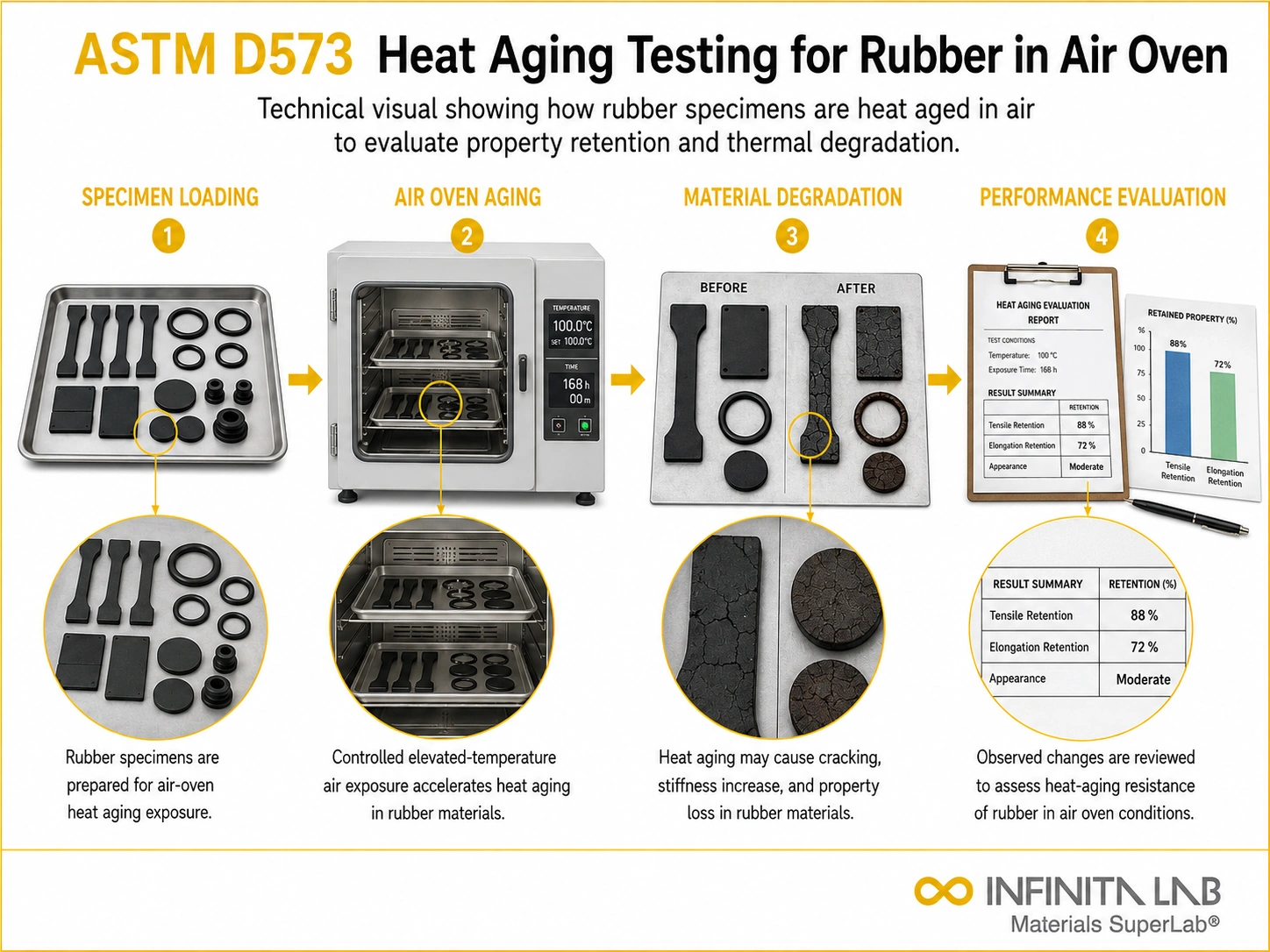
ASTM D573, “Standard Test Method for Rubber-Deterioration in an Air Oven,” ranks among the most widely used accelerated aging procedures for finding out how vulcanized rubber compounds hold up under prolonged exposure to elevated temperature and oxygen. Here’s how it works: physical properties of rubber specimens are compared before and after they’re conditioned in a forced-air or circulating-air oven held at a specified elevated temperature for a defined exposure period. Once the specimens come out of the oven and return to room temperature, they’re retested, and their tensile strength, ultimate elongation, and hardness are compared with the values recorded for unaged control specimens of the same compound. The resulting percentage changes reveal just how susceptible a given rubber formulation is to oxidative and thermal degradation – embrittlement, hardening, softening, cracking potential, and loss of elasticity can all show up over time.
Rubber components are routinely exposed to heat in real-world service, from engine bays and industrial equipment to outdoor seals and gaskets, so ASTM D573 gives manufacturers, compounders, and end users a standardized, repeatable way to compare candidate formulations in the lab before committing to production. The standard itself notes that accelerated oven aging can’t perfectly replicate every real-world service condition. Still, it remains an essential comparative benchmark for material selection, quality control, formulation development, and specification compliance. Infinita Lab connects manufacturers, compounders, and product engineers with accredited, well-equipped laboratories experienced in ASTM D573 heat-aging evaluations, delivering objective, defensible data to support material qualification, supplier validation, and long-term product reliability decisions across automotive, industrial, and consumer rubber goods applications.

Applications and Benefits of ASTM D573 Rubber Heat Aging Air Oven Testing
Scope
- The elevated temperature and oxygen exposure at the heart of this test method reveal their influence on the physical properties of vulcanized rubber compounds.
- It applies to natural rubber, synthetic rubber, and a broad range of thermoset elastomeric compounds used in finished and semi-finished products.
- A forced-air or circulating-air oven, maintained at a controlled, specified elevated temperature, does the aging work over a defined exposure duration.
- Percentage change in tensile strength, ultimate elongation, and hardness is measured relative to unaged control specimens.
- Rather than serving as an exact predictor of field service life, the method offers a comparative, laboratory-scale benchmark.
- Oxidative aging effects such as hardening, embrittlement, softening, and loss of elasticity fall squarely within its scope.
- Pairing it with related mechanical test methods, such as tensile and hardness testing, helps build out a complete aging profile.
- Test conditions – temperature and duration – can be tailored to the compound type and the specifying customer’s requirements.
- As a standardized reference point, it lets labs compare multiple rubber formulations under identical aging conditions.
- Material specifications, OEM standards, and quality assurance programs across multiple industries reference it frequently.
Applications
- Automotive seals, gaskets, O-rings, and weatherstripping face engine heat and under-hood environments every day.
- Tires and tire components depend on long-term heat resistance for both safety and service life.
- Industrial hoses, belts, and conveyor components are routinely subjected to elevated operating temperatures.
- Electrical and wire insulation compounds often require verified thermal aging resistance.
- HVAC, plumbing, and building product elastomers have to withstand sustained heat over their service life.
- Durability and shelf-life claims for consumer and industrial rubber goods need to be substantiated, and this is how it’s done.
- New compound development and formulation screening benefit from this kind of testing before full-scale production commitment.
Benefits
- Objective, standardized data make it possible to compare the heat aging resistance of different rubber formulations.
- Manufacturers can select compounds suited to the thermal demands of a specific application with more confidence.
- Quality control gets a boost too, since the test verifies that production batches meet specified aging performance requirements.
- The risk of premature field failures caused by unanticipated thermal or oxidative degradation drops significantly.
- Documentation generated along the way supports specification compliance, customer approval, and supplier qualification.
- Formulation weaknesses tend to surface early, well before products ever reach full-scale manufacturing.
Our ASTM D573 Testing Procedure
Specimen Preparation
Rubber specimens are prepared as per dimensional requirements.
1Thermal Aging
Specimens are placed in a forced-air oven and exposed to the specified temperature (70–100°C) for the defined duration.
2Post-Aging Testing
After cooling to room temperature, properties such as tensile strength, elongation, and hardness are measured.
3Data Evaluation
Pre- and post-aging results are compared to determine percentage change and material degradation.
4ASTM D573 Test Parameters and Requirements
| Parameter | Details |
|---|---|
| Applicable Materials | Vulcanized rubber and elastomers |
| Temperature Range | Typically 70°C–100°C (as specified) |
| Exposure Duration | Commonly 70–168 hours (or as required) |
| Measured Properties | Tensile strength, elongation at break, hardness, resilience |
| Evaluation Criteria | Percentage change from original properties |
| Output Units | MPa (tensile strength), %, Shore hardness units |


- Forced-Air/Circulating-Air Laboratory Oven – Keeps a controlled, uniform elevated temperature for the specified aging exposure period.
- Universal Tensile Testing Machine – Measures tensile strength and elongation at break for both unaged and aged specimens.
- Durometer (Shore Hardness Tester) – Records hardness values before and after oven aging so the change can be quantified.
- Specimen Die-Cutting Equipment – Produces dumbbell or specified-geometry test specimens with consistent, repeatable dimensions.
- Precision Callipers/Thickness Gauges – Verify specimen dimensions before testing, which keeps measurement accuracy in check.
- Calibrated Temperature Monitoring Instruments – Confirm and document oven temperature stability and uniformity throughout the aging period.
- Conditioning Chamber – Provides controlled environmental conditioning of specimens both before and after aging exposure.
Equipment and Instrumentation Used for ASTM D573 Testing
What You Receive: Test Report, Data, and Certification
- A detailed test report documents the aging temperature, exposure duration, and all applicable test conditions used.
- Tensile strength, elongation, and hardness values are tabulated for both unaged control and aged specimens.
- The percentage change calculated for each measured property quantifies just how much heat-induced deterioration occurred.
- Interpretive commentary rounds things out, summarizing the compound’s relative resistance to thermal and oxidative aging.
- Where applicable, supporting photographs or specimen records document visible changes such as surface cracking or discoloration.
- Everything is compiled into a formally signed report suitable for submission to customers, regulatory bodies, or internal quality assurance records.
ASTM D573 Rubber Heat Aging Air Oven FAQs
ASTM D573 is a test that determines the effect of high temperature on the properties of vulcanized rubber. The test procedure involves comparing the mechanical properties of the rubber before and after air oven aging.
The effects of heat aging are determined by the percentage change in tensile strength, elongation, and hardness instead of sudden failure. Decreases in elongation measure embrittlement, while changes in hardness measure further cross-linking or degradation of the polymer due to heat exposure.
ASTM D573 specifies several temperature-time conditions depending on the service conditions. These include 70 hours at 70 °C or higher temperature cycles. It is important to have precise temperature control in the oven to ensure repeatable aging performance.
Yes, the aging data obtained at higher temperatures can be used in conjunction with time-temperature relations to estimate the retention of properties at lower temperatures.
ASTM D573 specifies the use of forced air circulation to maintain constant temperature and oxygen supply. Proper Air circulation is necessary to avoid hot spots and ensure consistent oxidation conditions, leading to consistent rubber aging.
ASTM D573 evaluates the effect of accelerated aging on rubber by exposing specimens to circulating air at elevated temperatures and measuring changes in physical properties.
An ASTM testing oven provides controlled temperature and circulating air conditions required for standardized material aging tests, such as ASTM D573.
ASTM D572 evaluates the effect of heat aging on rubber by exposing specimens to elevated temperatures in a circulating-air oven and measuring changes in their properties.
Why Choose Infinita Lab for Rubber Heat Aging Air Oven Testing
When your Rubber Heat Aging Air Oven results have to hold up - for compliance, a customer audit, or an engineering decision - ASTM D573 accuracy and an unbiased third-party report matter more than price. Infinita Lab routes your ASTM D573 rubber heat aging air oven testing to ISO/IEC 17025-accredited U.S. partner labs with hands-on method experience, so you get defensible data, transparent reporting, and turnaround times built around your project deadline - not ours.

Need ASTM D573 Rubber Heat Aging Air Oven Testing You Can Rely On?
Send query us at hello@infinitalab.com or call us at (888) 878-3090 to learn more about our services and how we can support you.



Request a Quote
Submit your material details and receive testing procedures, pricing, and turnaround time within 24 hours.
 Quick Turnaround and Hasslefree process
 Confidentiality Guarantee
 Free, No-obligation Consultation
 100% Customer Satisfaction
