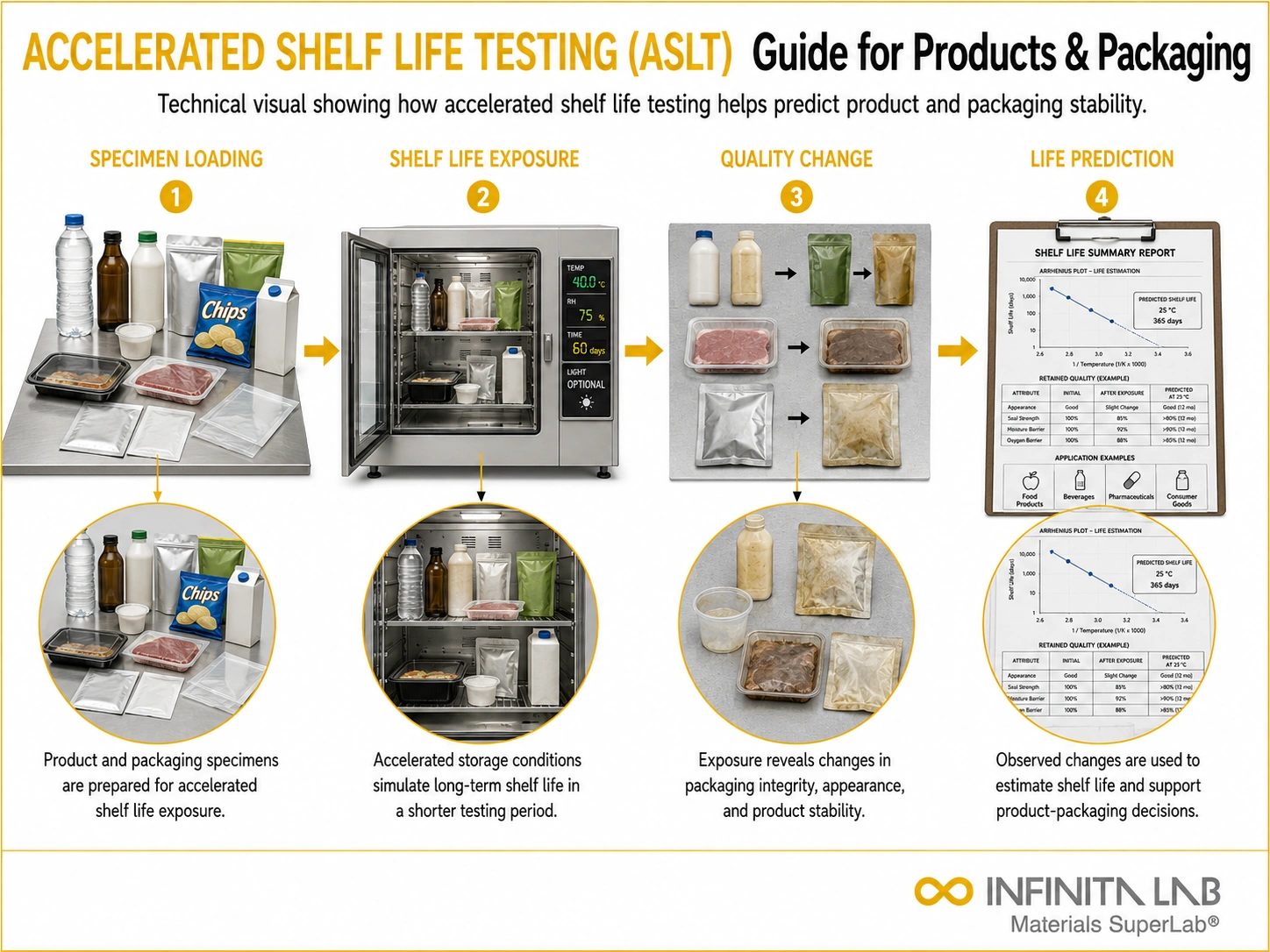


What Is Accelerated Shelf Life ASLT?
Accelerated Shelf Life Testing (ASLT) is used to estimate the shelf life of products by exposing them to elevated environmental conditions such as temperature and humidity. The test accelerates degradation reactions to predict how a product will perform over time under normal storage conditions.
ASLT is widely used in food, pharmaceuticals, packaging, and polymer industries to evaluate product stability, quality retention, and expiration timelines. The test helps identify degradation mechanisms and ensures products meet safety and performance requirements throughout their intended shelf life.

Applications and Benefits of Accelerated Shelf Life ASLT Testing
Scope
Accelerated Shelf Life Testing evaluates how product quality and performance change over time under controlled accelerated conditions. The test helps determine expiration periods and storage requirements.
The test evaluates:
- Product degradation rate under elevated conditions
- Shelf-life estimation using accelerated models
- Changes in physical, chemical, and mechanical properties
- Effect of temperature and humidity on stability
- Packaging performance during storage
Applications
- Food and beverage products
- Pharmaceutical formulations
- Medical device packaging
- Plastic and polymer materials
- Cosmetic and personal care products
- Consumer packaged goods
Benefits
- Reduces the time required for shelf-life determination
- Helps define expiration dates and storage conditions
- Identifies critical degradation pathways
- Supports regulatory and product validation requirements
- Enables comparison of product stability
Our Testing Procedure
Sample Preparation
Products are packaged and prepared in their final or intended form for testing.
1Accelerated Exposure
Samples are placed in controlled chambers with elevated temperature and humidity conditions.
2Periodic Evaluation
Samples are removed at defined intervals and tested for quality and performance changes.
3Data Recording & Evaluation
Results are analyzed using models such as Arrhenius to estimate shelf life.
4Test parameters and requirements
| Parameter | Details |
|---|---|
| Applicable Materials | Food, pharmaceuticals, polymers, packaging |
| Temperature Range | 40°C to 70°C |
| Relative Humidity | 60% to 90% RH |
| Acceleration Model | Arrhenius equation (Q10 ≈ 2–3) |
| Exposure Duration | 1 week to 6 months |
| Measured Outputs | Shelf life, degradation rate, product stability |


- Environmental test chambers
- Temperature and humidity control systems
- Sample storage racks
- Analytical testing instruments
- Packaging integrity testing tools
- Data acquisition and monitoring system
Equipment and Instrumentation Used for Testing
What You Receive: Test Report, Data, and Certification
- Shelf-life estimation results
- Degradation rate analysis
- Stability and performance data
- Packaging integrity evaluation
- Test condition summary
- ASTM compliance report
Accelerated Shelf Life ASLT FAQs
ASLT includes elevated temperature, humidity, light exposure, packaging conditions, and time intervals, accelerating degradation processes to estimate product shelf life and stability under controlled environmental conditions within reduced testing durations.
ASLT helps predict shelf life quickly, enabling faster product launches, quality assurance, and regulatory compliance for products requiring stability validation over extended storage periods.
ASLT is commonly applied to food products, pharmaceuticals, cosmetics, and packaging materials where shelf life, stability, and safety must be determined.
ASLT evaluates changes in chemical composition, physical properties, microbial growth, and sensory characteristics, helping determine product degradation and acceptable storage duration.
ASLT relies on accelerated conditions and predictive models, which may not perfectly represent real storage environments, requiring validation with real-time studies for accurate shelf life determination.
Accelerated shelf-life testing calculations estimate product stability by analyzing degradation under elevated temperature and humidity conditions. Researchers measure changes in quality indicators over time and may use the Arrhenius equation or suitable statistical models to estimate degradation rates and predict shelf life under intended storage conditions. Predictions depend on the product, degradation mechanism, and supporting stability data.
Accelerated Shelf-Life Testing (ASLT) exposes products to controlled, elevated temperatures, humidity, or other stress conditions to accelerate deterioration. Samples are tested at scheduled intervals for changes in properties such as color, texture, potency, moisture, or microbial quality. The results help estimate shelf life and identify suitable storage conditions.
Accelerated stability testing evaluates how a product’s quality changes under elevated environmental stress. Samples are stored under defined conditions and periodically analyzed for physical, chemical, and other relevant quality attributes. The results support stability assessment, formulation development, packaging selection, and shelf-life estimation. For pharmaceutical products, studies should follow applicable regulatory guidance and be supported by long-term stability data.
Why Choose Infinita Lab for Accelerated Shelf Life ASLT Testing
When your Accelerated Shelf Life ASLT results have to hold up - for compliance, a customer audit, or an engineering decision - accuracy and an unbiased third-party report matter more than price. Infinita Lab routes your accelerated shelf life ASLT testing to ISO/IEC 17025-accredited U.S. partner labs with hands-on method experience, so you get defensible data, transparent reporting, and turnaround times built around your project deadline - not ours.

Looking for an Accredited Partner for Accelerated Shelf Life ASLT Testing?
Send query us at hello@infinitalab.com or call us at (888) 878-3090 to learn more about our services and how we can support you.