


ASTM D3632: Adhesive Joint Oxygen Pressure Aging Testing Services
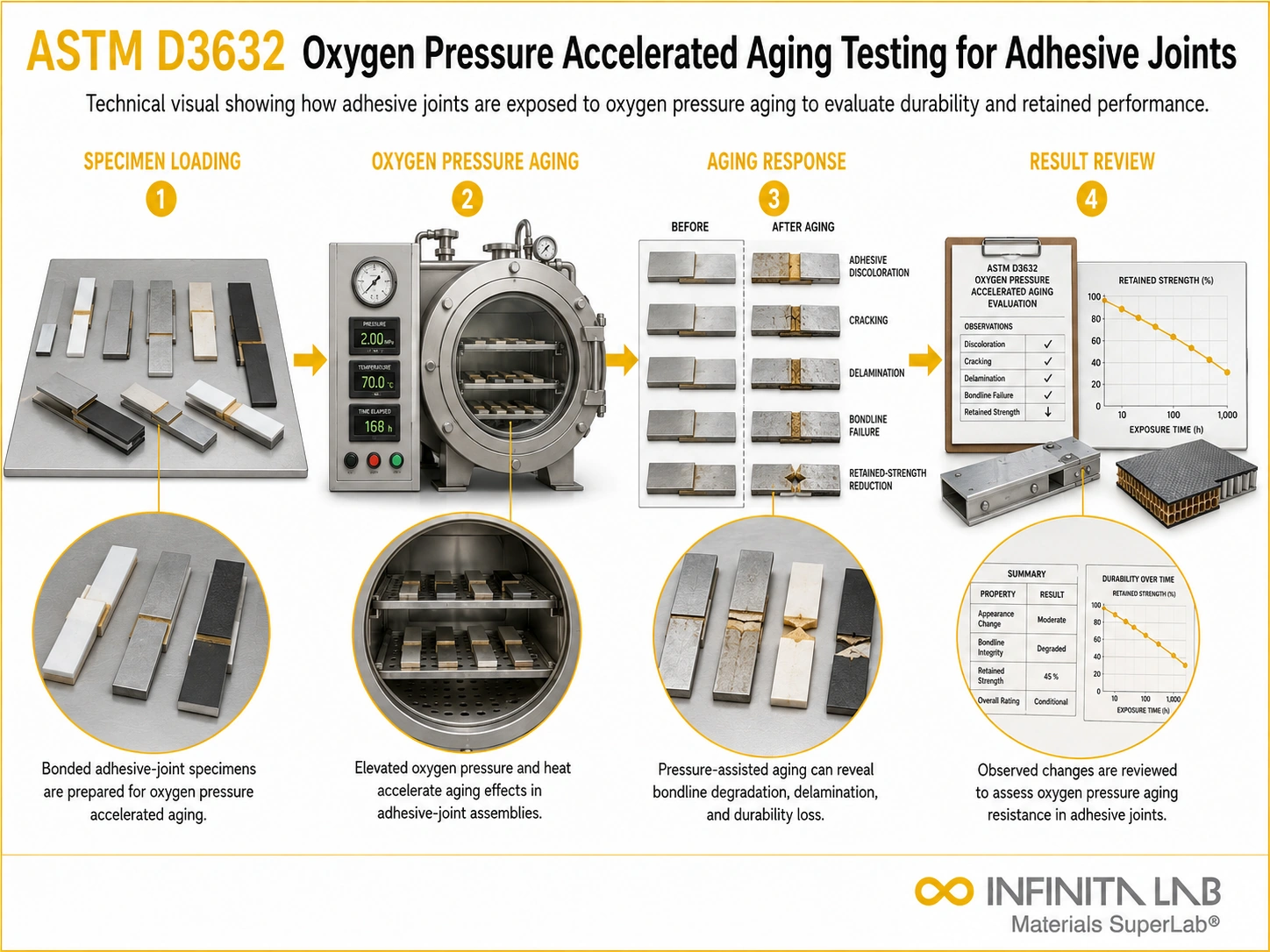
The ASTM D3632 test method is used to compare the resistance of various adhesive films and adhesive-bonded joints to degradation in a high-pressure oxygen environment. This test is useful for quality control, screening, research, and development of adhesives for field applications.
TRUSTED BY


Get ASTM D3632 compliant results — request your adhesive joint oxygen pressure aging testing quote
- Overview
- Scope, Applications, and Benefits
- Test Process
- Specifications
- Instrumentation
- Results and Deliverables
What Is ASTM D3632 Adhesive Joint Oxygen Pressure Aging?
ASTM D3632 evaluates the durability of adhesive joints by subjecting bonded specimens to accelerated aging in an oxygen-pressurized environment. The test simulates long-term oxidative degradation to assess how adhesive bonds perform over extended service conditions.
This method is essential for predicting the lifespan and reliability of adhesive joints exposed to oxygen-rich or oxidative environments. It helps identify degradation mechanisms, ensuring adhesives maintain strength and integrity under demanding conditions.

Applications and Benefits of ASTM D3632 Adhesive Joint Oxygen Pressure Aging Testing
Scope
ASTM D3632 defines procedures for accelerated aging of adhesive-bonded joints using oxygen pressure to simulate long-term environmental exposure and evaluate performance degradation.
- Applicable to adhesive-bonded joints and assemblies
- Uses oxygen pressure and elevated temperature conditions
- Simulates oxidative aging effects
- Evaluates durability and strength retention
- Suitable for research and quality control
- Supports material comparison and qualification
- Identifies degradation and failure mechanisms
Applications
- Aerospace adhesive joints
- Automotive bonded components
- Structural bonding systems
- High-performance industrial adhesives
- Research and durability studies
Benefits
- Simulates long-term aging in a short time
- Identifies oxidative degradation effects
- Improves adhesive selection and design
- Enhances product durability and safety
- Supports material comparison
Our ASTM D3632 Testing Procedure
Specimen Preparation
Adhesive-bonded specimens are prepared and cured under controlled conditions.
1Oxygen Exposure
Samples are placed in a pressurized oxygen chamber at elevated temperature.
2Aging Duration
Specimens are aged for a specified time to simulate long-term exposure.
3Post-Test Evaluation
Mechanical properties are measured and compared with initial values.
4ASTM D3632 Test Parameters and Requirements
| Parameter | Details |
|---|---|
| Material Type | Adhesive-bonded joints |
| Method | Oxygen-pressure aging |
| Conditions | Elevated temperature and pressure |
| Measurement | Strength retention after aging |
| Output Units | MPa or % retention |
| Environment | Oxidative atmosphere |
| Duration | Defined aging period |


- Oxygen pressure chamber
- Temperature control system
- Universal testing machine (UTM)
- Pressure gauges and regulators
- Specimen preparation tools
Equipment and Instrumentation Used for ASTM D3632 Testing
What You Receive: Test Report, Data, and Certification
- Strength retention percentage
- Pre- and post-aging comparison data
- Failure mode analysis
- Aging conditions and observations
- Compliance statement with ASTM D3632
ASTM D3632 Adhesive Joint Oxygen Pressure Aging FAQs
The ASTM D3632 test method compares the resistance of various adhesive films and adhesive-bonded joints to degradation in a high-pressure oxygen environment.
The test is essential for understanding adhesive performance, especially in high-pressure oxygen conditions. It helps guarantee that adhesives perform typically under prolonged periods of severe conditions.
Oxygen pressure accelerates oxidation reactions that naturally occur over time. This allows the test to simulate long-term aging effects in a shorter period, helping assess how adhesives will perform during extended service life.
Accelerated aging helps predict long-term performance within a shorter timeframe, allowing manufacturers to assess durability and reliability without waiting for real-time aging.
Factors include adhesive type, curing conditions, oxygen pressure, temperature, and aging duration. Proper control ensures reliable and reproducible results.
Why Choose Infinita Lab for Adhesive Joint Oxygen Pressure Aging Testing?
At the core of this breadth is our network of 2,000+ accredited laboratories across the USA, offering access to over 10,000 testing methods and analytical services. From advanced materials characterization (SEM, TEM, RBS, XPS) to mechanical, chemical, environmental, biological, and standardized ASTM/ISO-compliant testing, we deliver unmatched flexibility, specialization, and scale. You are never limited by geography, facility, or methodology — Infinita Lab connects you to the right expertise and testing solution, every time.

Looking for an Accredited Partner for ASTM D3632 Adhesive Joint Oxygen Pressure Aging Testing?
Send query us at hello@infinitalab.com or call us at (888) 878-3090 to learn more about our services and how we can support you.



Request a Quote
Submit your material details and receive testing procedures, pricing, and turnaround time within 24 hours.
 Quick Turnaround and Hasslefree process
 Confidentiality Guarantee
 Free, No-obligation Consultation
 100% Customer Satisfaction
