


ASTM D5629: ASTM D5629 Isocyanate Functionality for Polyurethane Applications Testing Services
ASTM D5629-16 test method determines the properties of polyurethane prepolymer and aromatic isocyanates by measuring the acidity expressed as ppm of hydrochloric acid. This test method also provides details about toluene diisocyanate and methylene diphenyl isocyanate. The final results of this test method are expressed in SI units.
TRUSTED BY


Get ASTM D5629 compliant results — request your ASTM D5629 isocyanate functionality for polyurethane applications testing quote
- Overview
- Scope, Applications, and Benefits
- Test Process
- Specifications
- Instrumentation
- Results and Deliverables
What Is ASTM D5629 ASTM D5629 Isocyanate Functionality for Polyurethane Applications?
ASTM D5629-16 determines the acidity present in low-acidity aromatic isocyanates and polyurethane materials using sensitive titration techniques. It measures trace acidic components that can influence reactivity, stability, and final product performance in polymer systems.
This method is critical for ensuring material quality and process control in polyurethane production. Even small amounts of acidity can affect curing behavior, catalyst efficiency, and product durability. Accurate determination supports consistent manufacturing and compliance with quality specifications.

Applications and Benefits of ASTM D5629 ASTM D5629 Isocyanate Functionality for Polyurethane Applications Testing
Scope
ASTM D5629-16 covers the determination of acidity in low-acidity aromatic isocyanates and polyurethane materials. It focuses on quantifying trace acidic content using precise analytical procedures under controlled conditions.
- Applicable to aromatic isocyanates and polyurethane systems
- Measures low-level acidity content
- Uses titration-based analytical techniques
- Supports quality control and process monitoring
- Suitable for trace-level detection
Applications
- Polyurethane raw material testing
- Chemical processing quality control
- Adhesive and coating formulation evaluation
- Polymer manufacturing monitoring
- Catalyst performance assessment
- Research and development of polymer systems
- Product quality verification
Benefits
- Ensures low acidity for stable reactions
- Improves polyurethane product quality
- Supports efficient curing processes
- Reduces risk of unwanted side reactions
- Enables consistent material performance
- Enhances process reliability
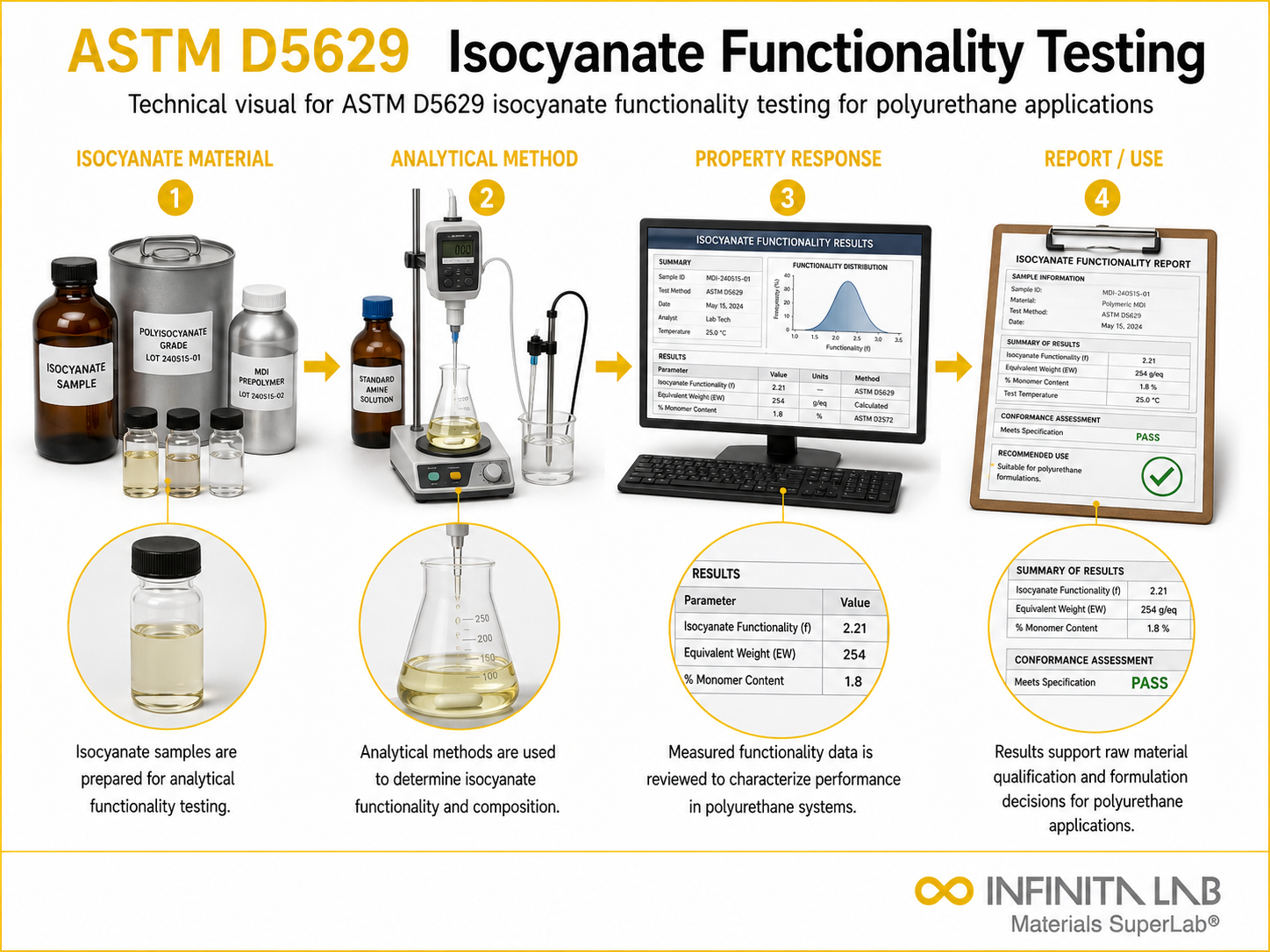
Our ASTM D5629 Testing Procedure
Sample Preparation
Sample is accurately weighed and dissolved in a suitable solvent system.
1Titration Setup
Standard titrant solution is prepared and instrument is calibrated.
2Acidity Measurement
Sample is titrated to determine acidic components based on endpoint detection.
3Result Calculation
Acidity is calculated from titration volume and reported in standard units.
4ASTM D5629 Test Parameters and Requirements
| Parameter | Details |
|---|---|
| Method Type | Titration (acid-base analysis) |
| Sample Type | Aromatic isocyanates and polyurethane |
| Measurement Parameter | Acidity level |
| Detection Level | Trace acidity measurement |
| Solvent System | Compatible organic solvent |
| Endpoint Detection | Indicator or potentiometric method |
| Output | Acidity value |
| Control Conditions | Moisture-free environment preferred |


- Titration apparatus (manual or automatic)
- Burette or automated titrator
- Analytical balance
- Magnetic stirrer
- pH meter or potentiometric system
- Solvent handling equipment
- Glassware for titration
Equipment and Instrumentation Used for ASTM D5629 Testing
What You Receive: Test Report, Data, and Certification
- Acidity value (meq/kg or equivalent)
- Titration data and endpoint details
- Material quality assessment
- Batch consistency evaluation
- Compliance analysis
- Detailed analytical report
ASTM D5629 ASTM D5629 Isocyanate Functionality for Polyurethane Applications FAQs
ASTM D5629-16 is important because trace acidity can significantly affect reactivity and stability of isocyanates and polyurethanes. Accurate acidity determination helps maintain consistent curing behavior, prevents side reactions, and ensures high-quality final polymer products.
ASTM D5629-16 shows that acidity can interfere with catalysts and reaction kinetics, leading to inconsistent curing, reduced mechanical properties, or defects. Controlling acidity ensures stable polymerization and improved product performance.
ASTM D5629-16 ensures consistent acidity levels across batches, helping manufacturers maintain uniform product quality and reliable processing behavior.
Factors such as sample handling, solvent purity, moisture presence, and titration accuracy influence results. ASTM D5629-16 requires controlled conditions for reliable measurements.
ASTM D5629-16 helps identify abnormal acidity levels that may cause processing problems, enabling corrective actions to improve product quality and consistency.
Why Choose Infinita Lab for ASTM D5629 Isocyanate Functionality for Polyurethane Applications Testing
At the core of this breadth is our network of 2,000+ accredited laboratories across the USA, offering access to over 10,000 testing methods and analytical services. From advanced materials characterization (SEM, TEM, RBS, XPS) to mechanical, chemical, environmental, biological, and standardized ASTM/ISO-compliant testing, we deliver unmatched flexibility, specialization, and scale. You are never limited by geography, facility, or methodology — Infinita Lab connects you to the right expertise and testing solution, every time.

Looking for an Accredited Partner for ASTM D5629 ASTM D5629 Isocyanate Functionality for Polyurethane Applications Testing?
Send query us at hello@infinitalab.com or call us at (888) 878-3090 to learn more about our services and how we can support you.



Request a Quote
Submit your material details and receive testing procedures, pricing, and turnaround time within 24 hours.
 Quick Turnaround and Hasslefree process
 Confidentiality Guarantee
 Free, No-obligation Consultation
 100% Customer Satisfaction
