


ASTM D1786 Toluene Diisocyanate (TDI) Specification Testing
The specifications for using toluene diisocyanate as a component in the creation of polyurethane goods are described in this ASTM D 1786 standard document. It outlines the requirements for its use, ensuring that it is properly incorporated into industrial processes while upholding standards for quality and safety.
TRUSTED BY


Precision Testing Solutions for Accurate, Reliable, and Standards-Compliant Results
- Overview
- Scope, Applications, and Benefits
- Test Process
- Specifications
- Instrumentation
- Results and Deliverables
ASTM D1786 Toluene Diisocyanate Overview
ASTM D1786 is a standard specification used to define the quality and characteristics of toluene diisocyanate (TDI), a key raw material used in the production of polyurethane foams and elastomers. It establishes requirements for composition, purity, and chemical properties to ensure consistent performance in industrial applications.
The specification classifies TDI by its isomer ratio and further categorizes it into types based on acidity and hydrolyzable chloride content. It ensures that materials meet defined limits for parameters such as purity, color, and total chlorine, enabling reliable use in polyurethane manufacturing processes.

Scope, Applications, and Benefits
Scope
ASTM D1786 evaluates:
- Toluene diisocyanate (TDI) composition
- Isomer ratio (2,4-TDI and 2,6-TDI)
- Acidity and hydrolyzable chloride content
- Purity and total chlorine levels
- Color and chemical consistency
Applications
- Polyurethane foam manufacturing
- Flexible and rigid foams
- Coatings, adhesives, and sealants
- Elastomers and insulation materials
- Automotive and construction products
Benefits
- Ensures consistent raw material quality
- Supports polyurethane production processes
- Enables material classification and grading
- Improves product performance and reliability
- Facilitates supplier and material comparison
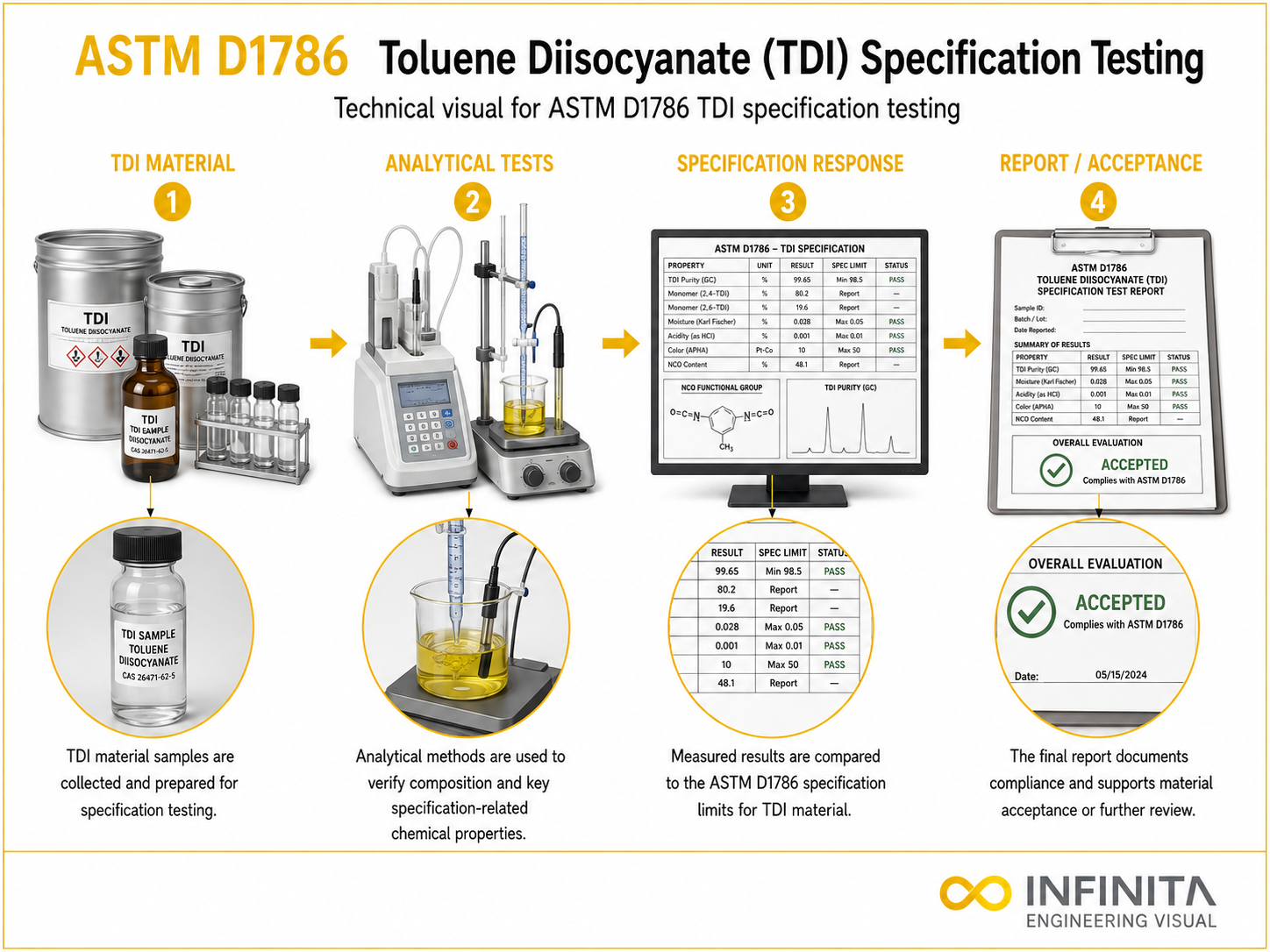
ASTM D1786 Test Process
Sample Preparation
TDI sample is collected and conditioned for analysis.
1Chemical Testing
Tests for isomer content, acidity, chlorine, and color are performed.
2Property Measurement
Key parameters such as purity and hydrolyzable chloride are measured.
3Data Analysis
Results are compared against ASTM D1786 specification limits.
4ASTM D1786 Technical Specifications
| Parameter | Details |
|---|---|
| Classification | 3 classes (based on isomer ratio) |
| Types | Type I (A), Type II (B), Type III (C) |
| Acidity (Type I) | Acidity (Type I) |
| Hydrolyzable Chloride | <0.01–0.015% (type dependent) |
| Measured Outputs | Purity, chlorine content, color, isomer ratio |
| Sample Type | Toluene diisocyanate (TDI) |


- Gas chromatography (for isomer ratio)
- Titration setup (for acidity measurement)
- Chlorine analysis instruments
- Spectrophotometer (APHA color measurement)
- Analytical balance
- Data acquisition and analysis tools
Instrumentation Used for Testing
Results and Deliverables
- Isomer ratio analysis (2,4-TDI / 2,6-TDI)
- Acidity and hydrolyzable chloride values
- Purity and total chlorine content
- Color (APHA scale)
- Compliance report with ASTM D1786
Frequently Asked Question
ASTM D1786 is a specification that defines quality requirements for toluene diisocyanate used in polyurethane production, ensuring consistency in composition, purity, and chemical properties for industrial applications.
TDI is primarily used in manufacturing polyurethane foams, coatings, adhesives, and elastomers, widely applied in automotive, construction, and insulation industries.
TDI is classified into three classes based on isomer ratio and further divided into types (A, B, C) based on acidity and hydrolyzable chloride content.
Properties such as isomer ratio, acidity, hydrolyzable chloride, purity, total chlorine, and color are measured to ensure material meets required specifications.
It ensures consistent quality and performance of TDI, supporting reliable polyurethane production and improving final product durability and performance across various industrial applications.
Why Choose Infinita Lab for Advanced Materials Testing and Characterization?
At the core of this breadth is our network of 2,000+ accredited laboratories across the USA, offering access to over 10,000 testing methods and analytical services. From advanced materials characterization (SEM, TEM, RBS, XPS) to mechanical, chemical, environmental, biological, and standardized ASTM/ISO-compliant testing, we deliver unmatched flexibility, specialization, and scale. You are never limited by geography, facility, or methodology — Infinita Lab connects you to the right expertise and testing solution, every time.

Looking for a Trusted Partner for Accurate and Reliable Testing Services?
Send query us at hello@infinitalab.com or call us at (888) 878-3090 to learn more about our services and how we can support you.



Request a Quote
Submit your material details and receive testing procedures, pricing, and turnaround time within 24 hours.
 Quick Turnaround and Hasslefree process
 Confidentiality Guarantee
 Free, No-obligation Consultation
 100% Customer Satisfaction
