

What Is Condensate?
Condensate testing is an elaborate examination of condensate liquids that form when steam condenses. The examination is conducted in steam lines, boilers, and hydrocarbon processing plants. The process seeks to identify the exact chemical composition of condensate liquids and their general quality.
The process is critical in detecting impurities, dissolved gases, hydrocarbons, and corrosion products that could affect plant performance and product quality. The results of these tests help us determine how condensate liquids should be reused, discharged, or further processed.

Applications and Benefits of Condensate Testing
Scope
Condensate testing encompasses a wide variety of industrial operations, such as condensate loops in boilers, steam and power generation, oil and gas treatment, chemical and petrochemical processing, and even cooling and heating systems. The main idea is to monitor the condensate streams closely and check their quality, any impurities present in them, and their safe reuse or disposal. This is vital in keeping the operations smooth, preventing corrosion, and protecting the equipment in use.
The main condensate properties that are closely monitored include:
– pH and conductivity
– Total dissolved solids (TDS)
– Hydrocarbons
– Dissolved gases such as oxygen and carbon dioxide
– Corrosion products such as iron and copper
– Silica and hardness
Applications
- Boiler feedwater quality monitoring
- Steam system maintenance
- Oil and gas condensate characterisation
- Corrosion monitoring and control
- Process efficiency optimisation
- Environmental testing
- Power plant operations
Benefits
- Prevents corrosion and scaling in systems
- Ensures efficient heat transfer
- Detects contamination early
- Supports water reuse and conservation
- Enhances equipment lifespan
- Improves operational efficiency
- Reduces maintenance costs
Our Testing Procedure
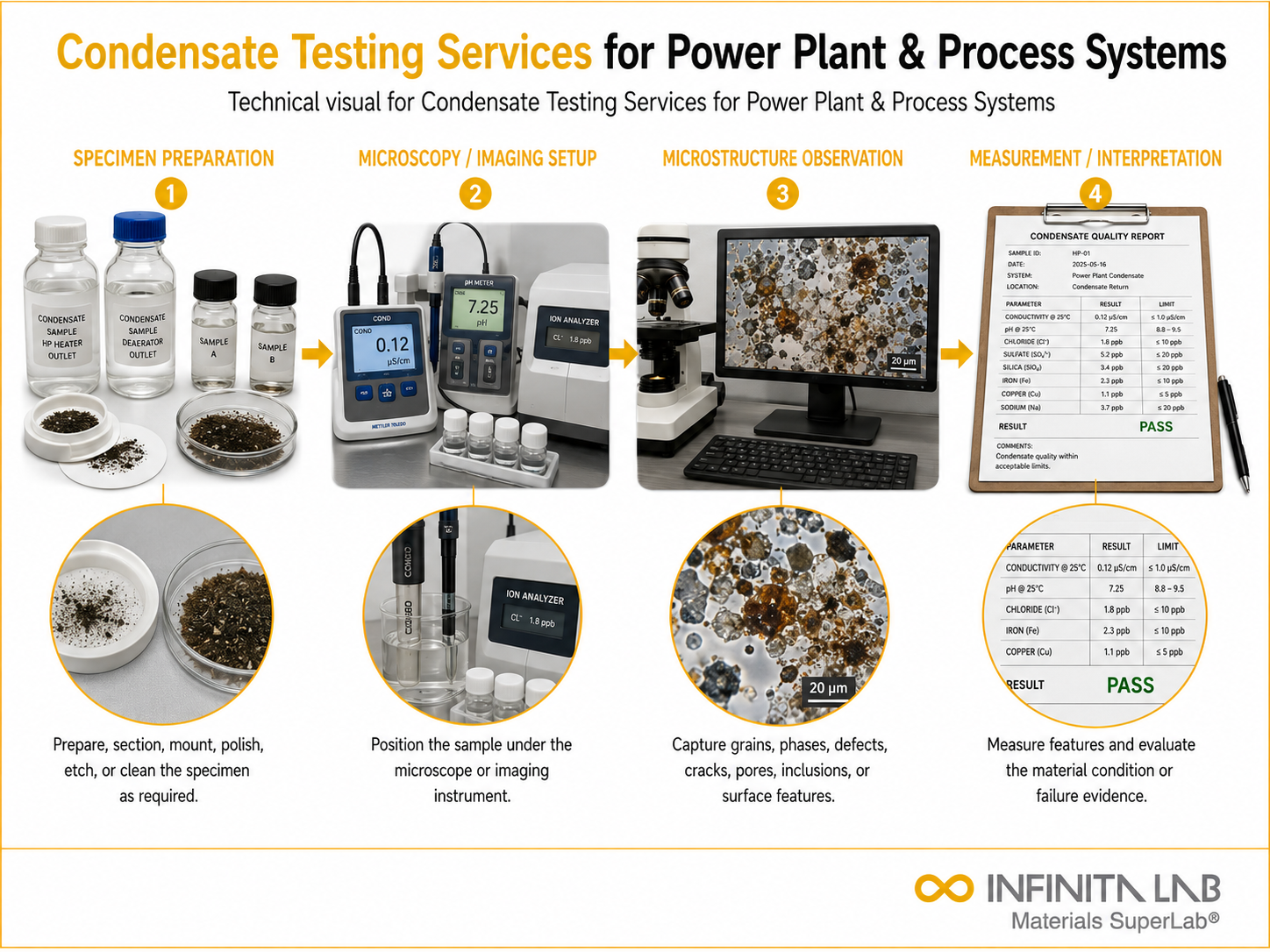
Sample Collection & Preparation
Condensate samples are collected from designated points and filtered to remove suspended impurities.
1Physicochemical Analysis
Parameters such as pH, conductivity, and TDS are measured.
2Chemical & Metal Analysis
Hydrocarbons, oil & grease, dissolved gases, and trace metals are analyzed.
3Data Interpretation & Reporting
Results are evaluated against standards to determine quality and suitability.
4Test parameters and requirements
| Parameter | Details |
|---|---|
| Applicable Materials | Condensate from steam, industrial, and hydrocarbon systems |
| Measured Parameters | pH, conductivity, TDS, hydrocarbons, dissolved gases, metals |
| Sample State | Liquid |
| Detection Techniques | Titration, chromatography, spectroscopy, gravimetric methods |
| Output Units | mg/L, ppm, pH units, µS/cm |


- pH meter
- Conductivity meter
- Total dissolved solids (TDS) meter
- Gas chromatograph (GC)
- UV-Vis spectrophotometer
- Atomic absorption spectrometer (AAS) or ICP-OES
- Oil and grease analyser
- Filtration apparatus
- Analytical balance
- Data analysis software
Equipment and Instrumentation Used for Testing
What You Receive: Test Report, Data, and Certification
- Physicochemical properties report
- Hydrocarbon and contamination levels
- Dissolved gas analysis
- Corrosion and metal content data
- Water quality assessment report
- Recommendations for reuse or treatment
Condensate FAQs
It helps detect contamination, prevent corrosion and scaling, improve system efficiency, and ensure compliance with environmental and operational standards.
Common parameters include pH, conductivity, total dissolved solids (TDS), oil and grease, hydrocarbons, dissolved gases (oxygen, CO₂), metals (iron, copper), silica, and hardness.
Industries such as power generation, oil & gas, petrochemicals, chemical processing, and manufacturing commonly require condensate testing.
Condensate is typically purer than raw water but can contain dissolved gases, hydrocarbons, or corrosion products depending on the system it originates from.
Yes, condensate is often reused as boiler feedwater or in other processes, provided it meets required quality standards after testing.
Condensate testing evaluates the quality of water formed when steam cools and changes into liquid. A representative sample is collected using a clean sampling system and analyzed for parameters such as pH, electrical conductivity, dissolved oxygen, silica, iron, copper, and total dissolved solids. These measurements help identify contamination, corrosion products, and chemical impurities in the steam-water cycle. The results are used to monitor system performance, protect equipment, and maintain water quality for reuse.
Why Choose Infinita Lab for Condensate Testing?
When your Condensate results have to hold up - for compliance, a customer audit, or an engineering decision - accuracy and an unbiased third-party report matter more than price. Infinita Lab routes your condensate testing to ISO/IEC 17025-accredited U.S. partner labs with hands-on method experience, so you get defensible data, transparent reporting, and turnaround times built around your project deadline - not ours.

Looking for an Accredited Partner for Condensate Testing?
Send query us at hello@infinitalab.com or call us at (888) 878-3090 to learn more about our services and how we can support you.