


ASTM D1653 Water Vapor Transmission of Coatings
The rate at which water vapor travels through paint, varnish, lacquer, and other organic coatings is determined using the test procedure ASTM D1653. The films can be applied on porous substrates or be free-standing. The final results of this method are displayed as per the international standards in inch-pound units.
TRUSTED BY


Precision-driven testing for dimensional accuracy and compliance
- Overview
- Scope, Applications, and Benefits
- Test Process
- Specifications
- Instrumentation
- Results and Deliverables
ASTM D1653 Water Vapor Transmission of Coatings Overview
ASTM D1653 is the standard test method for determining the water vapor transmission (WVT) rate of organic coating films applied to porous substrates. The test measures the rate at which water vapor passes through a coating under controlled temperature and humidity conditions, providing values such as water vapor transmission rate, permeance, and permeability. These results indicate the coating’s ability to resist or allow moisture vapor movement.
Water vapor transmission is an important property for coatings used on buildings, packaging, wood, concrete, masonry, and metal surfaces. Excessive vapor transmission can lead to corrosion, decay, and moisture-related damage, while insufficient transmission can trap moisture and cause blistering or delamination. ASTM D1653 uses both wet- and dry-cup methods to evaluate coating performance under varying humidity conditions, providing a comprehensive assessment of moisture management characteristics.

ASTM D1653 Water Vapor Transmission of Coatings Scope, Applications, and Benefits
Scope
ASTM D1653 applies to organic coatings — paints, varnishes, lacquers, sealers, and similar film-forming materials — applied to porous substrates such as paper, wood, or other sheet materials that support the coating film during testing. The method does not apply to free films tested without a substrate, a condition addressed by ASTM E96. The standard specifies two test procedures:
- Procedure A — Wet Cup Method — the test dish contains water, establishing a high relative humidity (approximately 100% RH) inside the dish. The exterior of the coated substrate faces a controlled, lower-humidity environment, typically at 50% RH. The humidity gradient drives vapor from the high-humidity interior through the substrate and coating to the drier exterior.
- Procedure B — Dry Cup Method — the test dish contains a desiccant, establishing a low relative humidity (approximately 0% RH) inside the dish. The exterior faces the same controlled humidity environment. The gradient drives vapor from the exterior through the coating and substrate into the desiccant interior.
Material categories and coating types within scope include:
- Architectural and protective coatings — exterior and interior paints, primers, and sealers applied to wood, masonry, concrete, and gypsum substrates
- Wood finishes and sealers — penetrating oils, film-forming varnishes, and moisture-excluding finishes for wood siding, decking, windows, and millwork
- Concrete and masonry coatings — elastomeric coatings, waterproof membranes, and breathable sealers, where vapor transmission governs the moisture management strategy for the coated assembly
- Packaging coatings — moisture barrier coatings on paper, paperboard, and flexible packaging substrate,s where vapor transmission directly determines shelf life and product protection performance
- Industrial and maintenance coatings — corrosion-protective coatings on metal substrates where vapor transmission influences the rate of underfilm corrosion and coating adhesion retention
- Specialty barrier coatings — coatings formulated specifically for vapor retarder or vapor barrier performance in building envelope applications
Applications
- Coating product development and formulation — quantifying the effect of resin type, pigment volume concentration, film thickness, and additive inclusion on the vapor transmission characteristics of a coating formulation during development
- Building envelope moisture design — supplying vapor transmission data for coatings used in wall assemblies, roof systems, and foundation treatments to support moisture modeling and vapor retarder classification
- Product certification and labeling — generating the water vapor transmission or permeance data required for product listings, technical data sheets, and building code compliance documentation where vapor retarder classification is specified
- Comparative evaluation of coating systems — testing multiple coating formulations, application rates, or substrate combinations under identical conditions to identify the system with the vapor transmission characteristics best suited to the application
- Quality control and production verification — confirming that production batches of coating materials maintain the vapor transmission performance established during product qualification
- Packaging material qualification — evaluating moisture barrier coatings on paper and board substrates for food, pharmaceutical, and consumer product packaging applications, where vapor transmission rate directly determines product protection and shelf life
Benefits
- Dual test condition coverage — the wet cup and dry cup procedures together characterize coating vapor transmission behavior across both high-to-low and low-to-high humidity gradients, providing a more complete performance picture than a single test condition yields
- Direct relevance to service conditions — the temperature and humidity specified in the standard are representative of ambient service environments, making the results directly applicable to performance predictions in building and packaging applications.s
- Quantitative output for specification and design — water vapor transmission rate and permeance values are directly usable in moisture balance calculations, vapor retarder classification, and packaging shelf life modeling without requiring additional conversion or interpretation.n
- Applicable across coating types and substrates — the method accommodates the full range of organic coating chemistries on porous substrates, from thin architectural paint films to thick elastomeric membranes and specialty barrier coatings.s
- Supports regulatory and code compliance — permeance values generated by ASTM D1653 are the basis for vapor retarder classification under building codes and standards, including the International Building Code and ASHRAE 160, enabling direct use of test data in compliance documentation
- Sensitive to formulation and application variables — the method detects differences in vapor transmission resulting from changes in resin chemistry, pigment loading, film thickness, and surface treatment, making it useful for both development screening and quality verification.
ASTM D1653 Water Vapor Transmission of Coatings Test Process
Specimen & Test Dish Preparation
Apply the coating to the specified substrate, cure as required, and seal the specimen onto a test dish containing water or desiccant.
1Conditioning & Setup
Place the assembled test dishes in a controlled-temperature, controlled-humidity chamber to establish vapor flow conditions.
2Weighing & Steady-State Measurement
Weigh the dishes at regular intervals until a consistent rate of mass change is achieved.
3Calculation & Reporting
Calculate water vapor transmission rate (WVTR), permeance, and permeability (if applicable), then report the average results.
4ASTM D1653 Water Vapor Transmission of Coatings Technical Specifications
| Parameter | Details |
|---|---|
| Procedure A | Wet cup — water interior, ~100% RH inside dish |
| Procedure B | Dry cup — desiccant interior, ~0% RH inside dish |
| Test Temperature | 23°C ± 1°C |
| Chamber Relative Humidity | 50% RH ± 2% RH |
| Result Parameters | Water vapor transmission rate (WVT), permeance, permeability |
| WVT Units | g/(m²·day) or grains/(ft²·hr) |
| Permeance Units | ng/(Pa·s·m²) or perms |
| Substrate | Porous paper or specified sheet substrate |
| Minimum Specimens | Three per test condition |


Instrumentation Used for ASTM D1653 Water Vapor Transmission of Coatings
- An analytical balance readable to 0.1 mg for periodic mass measurement of test dishes throughout the weighing cycle
- A temperature and humidity-controlled environment chamber maintained at 23°C ± 1°C and 50% RH ± 2% RH for the duration of the test.
- Calibrated thermometer and hygrometer or combined temperature-humidity probe for continuous verification of chamber conditions
- Test dishes of defined geometry — typically aluminum or glass — with flat rims suitable for specimen sealing
- Distilled water for Procedure, A wet cup interior charge
- Anhydrous desiccant — typically calcium chloride — for Procedure B dry cup interior charge
- Wax or compatible sealant for specimen-to-dish rim sealing
- Film thickness gauge — wet film comb or dry film micrometer — for coating thickness verification on applied specimens
- Timer for weighing interval control and steady-state monitoring
- Calibrated reference masses for balance verification at the time of testing
ASTM D1653 Water Vapor Transmission of Coatings Results and Deliverables
- Test report — complete documentation of standard applied, coating identification and description, substrate type, application method and rate, curing conditions, test procedure applied, chamber conditions maintained, individual dish mass measurements, and calculated transmission values for each specimen
- Water vapor transmission rate — steady-state WVT expressed in g/(m²·day) or grains/(ft²·hr) for each specimen and as a mean for the replicate set under each test procedure applied
- Permeance values — calculated permeance in ng/(Pa·s·m²) or perms for each specimen and as a reported mean, directly usable for vapor retarder classification and moisture design calculations
- Permeability values — calculated permeability where film thickness is measured and reported, enabling comparison of coating formulations on a thickness-normalized basis
- Wet cup and dry cup comparison — results from both Procedure A and Procedure B,e B where both conditions are tested, characterizing transmission behavior under both humidity gradient directions
- Steady-state confirmation data — tabulated mass change rate versus time data demonstrating that steady-state conditions were achieved before the reported transmission rate was calculated
- Pass/fail determination — compliance assessment against specified maximum permeance or minimum vapor resistance requirements, with acceptance criteria defined in a product standard or project specification.
Frequently Asked Questions
The method can evaluate free-standing coating films or coatings applied to porous substrates. ASTM E96 should be considered when testing materials outside the scope of organic coatings.
Test Method A uses a dry cup to create a humidity difference across the coating film. It is preferred for applications such as conventional buildings where high relative humidity is not normally expected.
Test Method B uses a wet, or Payne, cup to expose the coating to high humidity on one side. It is preferred when the coating will operate near environments with elevated relative humidity.
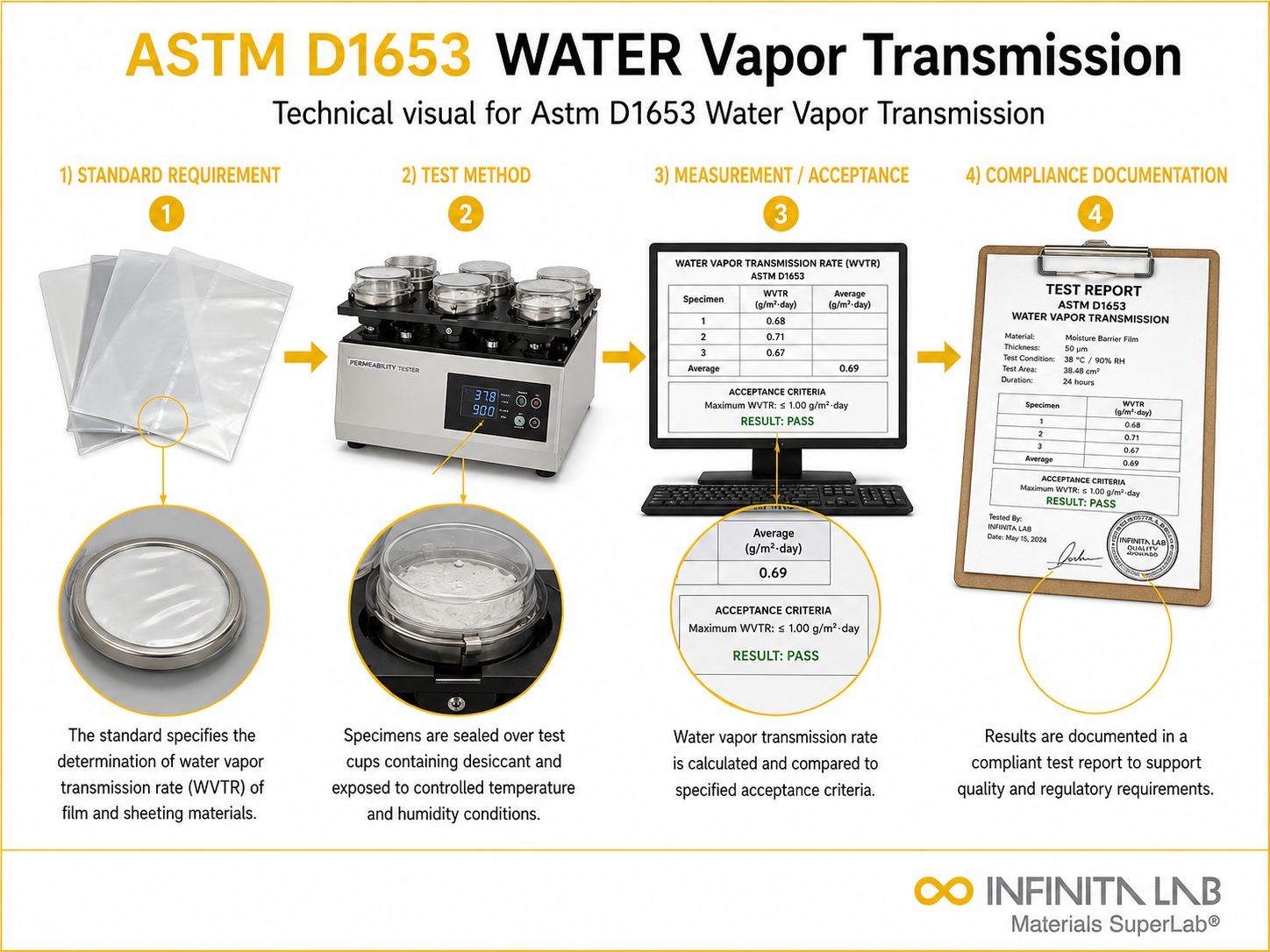
The coating film is sealed over a permeability cup containing either a desiccant or water. Changes in cup mass are measured over time under controlled temperature and humidity conditions.
Film thickness, temperature, relative humidity, coating composition and substrate condition can influence results. Water vapour transmission is not a linear function of thickness, temperature or humidity.
Why Choose Infinita Lab for Advanced Materials Testing and Characterization?
At the core of this breadth is our network of 2,000+ accredited laboratories across the USA, offering access to over 10,000 testing methods and analytical services. From advanced materials characterization (SEM, TEM, RBS, XPS) to mechanical, chemical, environmental, biological, and standardized ASTM/ISO-compliant testing, we deliver unmatched flexibility, specialization, and scale. You are never limited by geography, facility, or methodology — Infinita Lab connects you to the right expertise and testing solution, every time.

Looking for a Trusted Partner for Accurate and Reliable Testing Services?
Send query us at hello@infinitalab.com or call us at (888) 878-3090 to learn more about our services and how we can support you.



Request a Quote
Submit your material details and receive testing procedures, pricing, and turnaround time within 24 hours.
 Quick Turnaround and Hasslefree process
 Confidentiality Guarantee
 Free, No-obligation Consultation
 100% Customer Satisfaction
