


ASTM C424: Ceramic Whiteware Crazing Resistance Autoclave Testing Services
Accredited ASTM C424 ceramic whiteware crazing resistance autoclave testing from Infinita Lab, performed to the exact standard requirements - accurate, reproducible results with full documentation for compliance, R&D, and quality control programs.
TRUSTED BY


Get ASTM C424 compliant results - request your ceramic whiteware crazing resistance autoclave testing quote
- Overview
- Scope, Applications, and Benefits
- Test Process
- Specifications
- Instrumentation
- Results and Deliverables
What Is ASTM C424 Ceramic Whiteware Crazing Resistance Autoclave?
ASTM C424, Standard Test Method for Crazing Resistance of Fired Glazed Whitewares by Autoclave Treatment, is a Committee C21 (Ceramic Whitewares and Related Products) standard maintained under Subcommittee C21.03 and published in ASTM Volume 15.02. The current edition is C424-26, which ASTM lists as active. It supersedes the earlier C424-93(2024) reapproval, now designated historical. The method determines the crazing resistance of fired glazed whitewares using autoclave treatment under the conditions specified in the standard. Crazing is the network of fine, hairline cracks that can open in a glaze when the ceramic body beneath it holds the glaze in tension. The autoclave speeds this behavior up. Glazed specimens sit in pressurized steam, which drives moisture into the body and encourages the moisture expansion that stresses the glaze. Once cooled, they’re examined to see whether the glaze has crazed. ASTM states that the method is particularly useful for porous materials that can exhibit moisture expansion, which is why it is generally associated with nonvitreous and semivitreous ware rather than fully vitrified products. It is described as a primary test method suitable for specifications, quality control, and research and development, and it may serve as a referee method in purchasing contracts or agreements. A companion method, ASTM C554, addresses crazing from other causes, such as residual stresses left by glost firing, using a thermal shock approach instead of moisture expansion. The standard runs just two pages. Inch-pound units are the standard, with SI conversions given for information. For specific pressures, hold times, and acceptance wording, always go to the purchased edition, because this summary intentionally describes them only in general terms.

Applications and Benefits of ASTM C424 Ceramic Whiteware Crazing Resistance Autoclave Testing
Scope
ASTM C424 assesses the susceptibility of glazed ceramic products to crazing by exposing them to saturated steam under controlled pressure and temperature. The test determines whether the glaze remains intact and does not crack.
The test evaluates:
- The standard covers the determination of the crazing resistance of fired glazed whitewares using autoclave treatment.
- Ware must already be glazed and fired, so the result reflects the finished glaze and body combination rather than raw materials.
- Crazing that develops through moisture expansion of the ceramic body under the glaze is the target.
- Porous materials that can exhibit moisture expansion are where the method is particularly useful.
- Considered a primary test method, it suits specifications, quality control, and research and development.
- Buyers and sellers can also use it as a referee test method in purchasing contracts or agreements.
- Nonvitreous and semivitreous ware is the usual subject, while ASTM C554 is generally preferred for vitreous and impervious ware.
- Inch-pound units are the standard, and SI equivalents are provided for information only.
- Safety isn’t fully addressed by the standard, so users must establish appropriate safety, health, and environmental practices before testing.
- C424-26 is the current active edition. The earlier C424-93(2024) is designated historical.
Applications
- Qualifying glazed tableware and dinnerware for resistance to moisture-driven crazing.
- Glazed wall tile and other porous glazed ceramic bodies can be screened during product development.
- Production quality control of glaze and body fit in nonvitreous and semivitreous ware.
- Checking how a change in glaze recipe, body composition, or firing schedule affects crazing behavior.
- Referee data, for when a buyer and supplier disagree on glaze durability.
- Supplier qualification and incoming inspection of glazed whiteware.
- Failure analysis after crazing appears on ware in storage or service.
Benefits
- An accelerated indication of moisture-expansion crazing, with no need for long-term field exposure.
- A recognized ASTM method, accepted for specifications and contracts.
- Crazing is either present or absent on the examined specimens, which makes the observation clear.
- Manufacturers can adjust glaze fit before large production runs are shipped.
- Defensible referee data for commercial and quality disputes.
- It complements other crazing methods so that a product can be evaluated for more than one stress mechanism.
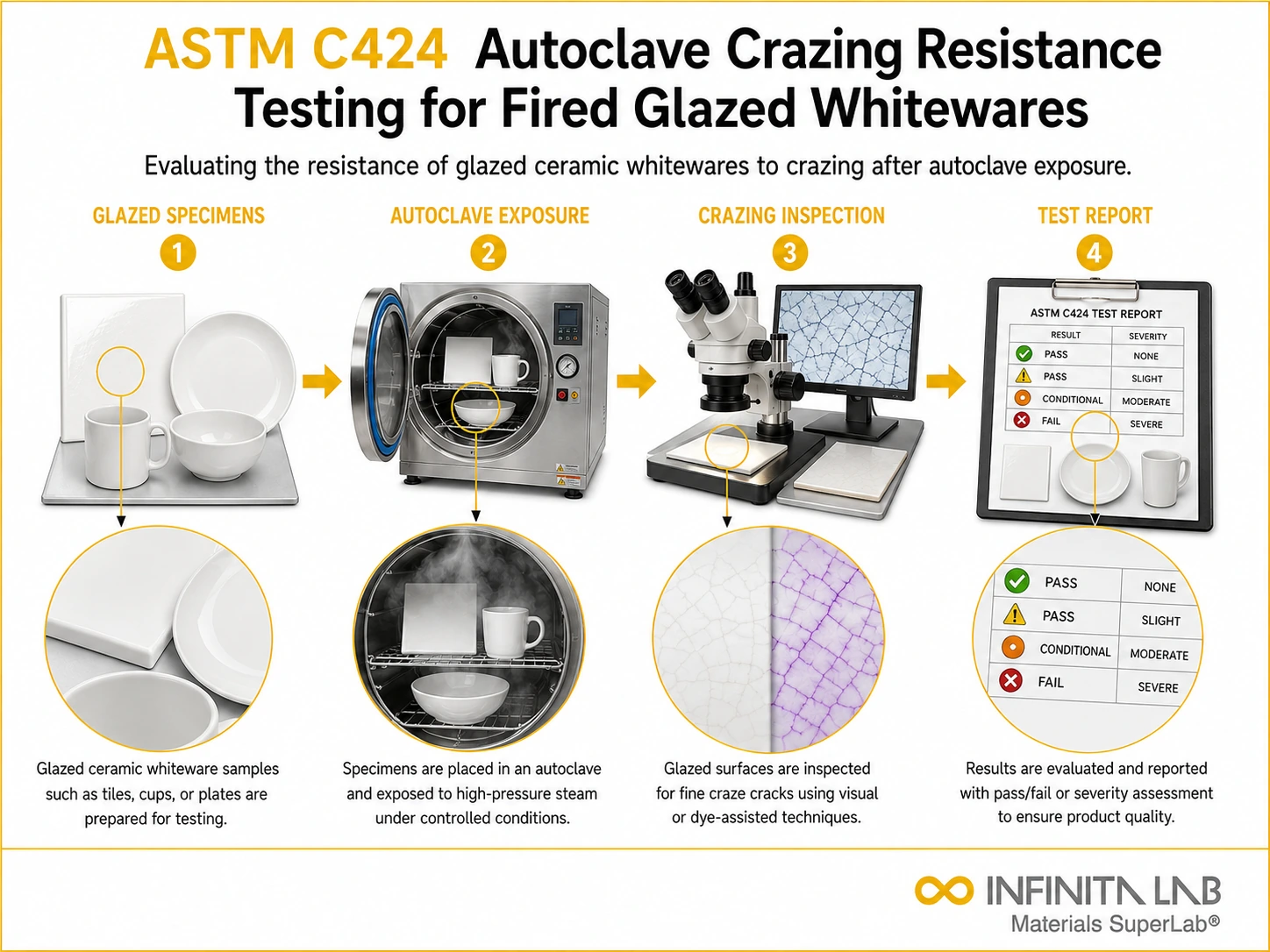
Our ASTM C424 Testing Procedure
Sample Preparation
Glazed ceramic specimens are cleaned and visually inspected.
1Autoclave Exposure
Samples are subjected to high-pressure steam in an autoclave.
2Cooling and Inspection
Specimens are cooled and examined for visible crazing.
3Data Recording & Evaluation
Results are recorded based on presence or absence of cracks.
4ASTM C424 Test Parameters and Requirements
| Parameter | Details |
|---|---|
| Applicable Materials | Glazed whiteware ceramics |
| Test Temperature | ~120°C to 150°C |
| Pressure Range | ~0.1 MPa to 0.3 MPa |
| Exposure Time | ~1 hour to 2 hours |
| Evaluation Method | Visual inspection (magnification optional) |
| Measured Outputs | Presence/absence of crazing |


- Laboratory Autoclave – The vessel that generates and holds the pressurized steam environment for the crazing treatment.
- Pressure Gauge and Controls – Used to monitor and regulate steam pressure, so the specified conditions can be followed.
- Specimen Support Rack – Keeps glazed pieces clear of the water. Steam only.
- Oblique Lighting Source – Fine craze lines on the glaze surface show up far better under a low, raking light during examination.
- Magnifier or Stereo Microscope – Hairline cracks that are hard to see unaided can be confirmed under magnification.
- Marking Ink or Dye Materials – These highlight craze lines in the glaze, making them easier to see and photograph.
Equipment and Instrumentation Used for ASTM C424 Testing
What You Receive: Test Report, Data, and Certification
- A specimen-by-specimen statement of whether crazing was observed after autoclave treatment.
- The samples tested are identified, including product type and the edition of ASTM C424 followed.
- What conditions were actually applied, plus any deviations from the standard procedure.
- Photos of the glazed surfaces after treatment, where requested.
- A formal test report that works for quality files, supplier qualification, or referee use.
- Technical staff can help interpret findings alongside other crazing and glaze durability tests.
ASTM C424 Ceramic Whiteware Crazing Resistance Autoclave FAQs
ASTM C424 includes autoclave pressure, temperature typically around 150°C, exposure duration, cooling conditions, and visual inspection, evaluating resistance of glazed whiteware surfaces to crazing under accelerated moisture and pressure conditions.
ASTM C424 determines presence or absence of crazing cracks on glazed surfaces after autoclave treatment, indicating resistance to moisture-induced stress.
ASTM C424 is commonly applied to glazed ceramic whiteware products such as tiles, sanitary ware, and tableware used in domestic and industrial applications.
ASTM C424 requires an autoclave, temperature and pressure control system, and inspection tools to evaluate surface conditions after testing.
ASTM C424 evaluates crazing resistance under accelerated conditions and may not fully represent long-term service environments where repeated thermal and moisture cycles influence glaze performance.
Crazing resistance testing evaluates a material’s ability to resist fine, crack-like surface marks caused by stress and chemical exposure. A specimen is exposed to a specified chemical under controlled stress and temperature, then examined for crazing to determine its resistance. ASTM F791 covers stress crazing of transparent plastics.
Why Choose Infinita Lab for Ceramic Whiteware Crazing Resistance Autoclave Testing
When your Ceramic Whiteware Crazing Resistance Autoclave results have to hold up - for compliance, a customer audit, or an engineering decision - ASTM C424 accuracy and an unbiased third-party report matter more than price. Infinita Lab routes your ASTM C424 ceramic whiteware crazing resistance autoclave testing to ISO/IEC 17025-accredited U.S. partner labs with hands-on method experience, so you get defensible data, transparent reporting, and turnaround times built around your project deadline - not ours.

Looking for an Accredited Partner for ASTM C424 Ceramic Whiteware Crazing Resistance Autoclave Testing?
Send query us at hello@infinitalab.com or call us at (888) 878-3090 to learn more about our services and how we can support you.



Request a Quote
Submit your material details and receive testing procedures, pricing, and turnaround time within 24 hours.
 Quick Turnaround and Hasslefree process
 Confidentiality Guarantee
 Free, No-obligation Consultation
 100% Customer Satisfaction
