


ASTM C338 Glass Softening Point Testing Services
ASTM C338-93 is a test method that measures the ‘flow points’ or temperature at which the viscosity of glass reaches 105 poise. It uses a flow point apparatus to estimate the softening points accurately. The information is helpful in the development and research of glass.
TRUSTED BY


Precision-driven testing for dimensional accuracy and compliance
- Overview
- Scope, Applications, and Benefits
- Test Process
- Specifications
- Instrumentation
- Results and Deliverables
Overview
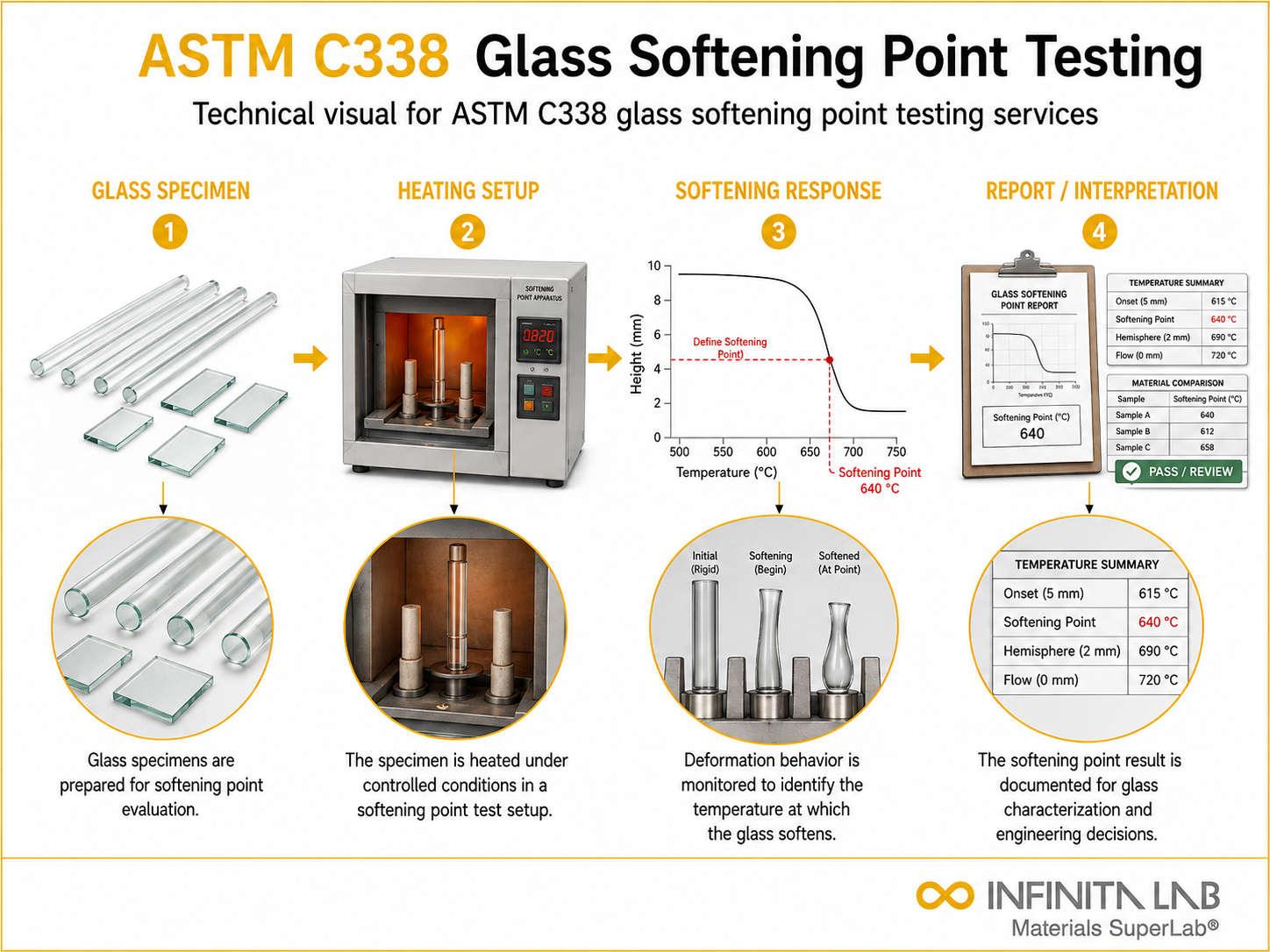
ASTM C338-93 defines a test method for determining the softening point of glass, which is the temperature at which the glass begins to deform under its own weight. This property is critical for understanding the thermal behavior and forming characteristics of glass materials.
This test is widely used in glass manufacturing, optics, and materials research. It helps evaluate thermal stability, processing temperatures, and the suitability of glass for high-temperature applications.

Scope, Applications, and Benefits
Scope
ASTM C338 evaluates the softening temperature of glass by observing deformation under controlled heating conditions. The test provides insight into thermal performance and viscosity-related behavior.
The test evaluates:
- Softening temperature of glass materials
- Thermal deformation characteristics
- Viscosity-related behavior at elevated temperatures
- Suitability for forming and processing
- Thermal stability of glass compositions
Applications
- Glass manufacturing and processing
- Optical and specialty glass materials
- Electronic and display glass
- Laboratory and scientific glassware
- High-temperature glass components
- Research and material development
Benefits
- Provides an accurate determination of softening temperature
- Supports glass processing and forming operations
- Helps in selecting materials for thermal applications
- Assists in quality control and product consistency
- Enables comparison of different glass compositions
Test Process
Sample Preparation
Glass specimens are prepared in specified dimensions and cleaned.
1Heating Setup
Samples are placed in a furnace with controlled heating rate.
2Temperature Increase
Temperature is gradually increased until the glass begins to deform.
3Data Recording & Evaluation
The softening point temperature is recorded based on deformation criteria.
4Technical Specifications
| Parameter | Details |
|---|---|
| Applicable Materials | Soda-lime, borosilicate, and specialty glass |
| Temperature Range | ~500°C to 900°C |
| Heating Rate | ~5°C/min to 10°C/min |
| Specimen Size | ~5 mm to 10 mm diameter |
| Measurement Method | Deformation under load/self-weight |
| Measured Outputs | Softening point temperature (°C) |


- High-temperature furnace
- Temperature control system
- Sample holders and fixtures
- Thermocouples and sensors
- Optical observation system
- Data acquisition system
Instrumentation Used for Testing
Results and Deliverables
- Softening point temperature values
- Thermal deformation behavior analysis
- Comparative glass performance evaluation
- Test condition summary
- Material suitability assessment
- ASTM compliance report
Frequently Asked Question
ASTM C338-93 includes heating rate, specimen dimensions, temperature measurement, deformation observation, and furnace conditions, determining softening point of glass by identifying temperature at which material begins to deform under specified conditions.
ASTM C338-93 determines the softening point temperature, indicating when glass transitions from rigid to deformable state.
ASTM C338-93 is commonly applied to various glass types including soda-lime glass, borosilicate glass, and specialty glasses used in industrial and scientific applications.
ASTM C338-93 requires a controlled furnace, temperature measurement system, and apparatus to observe deformation of glass specimens during heating.
ASTM C338-93 evaluates softening under controlled conditions and may not fully represent glass behavior under different heating rates, mechanical loads, or environmental conditions affecting performance in practical applications.
Why Choose Infinita Lab for Advanced Materials Testing and Characterization?
At the core of this breadth is our network of 2,000+ accredited laboratories across the USA, offering access to over 10,000 testing methods and analytical services. From advanced materials characterization (SEM, TEM, RBS, XPS) to mechanical, chemical, environmental, biological, and standardized ASTM/ISO-compliant testing, we deliver unmatched flexibility, specialization, and scale. You are never limited by geography, facility, or methodology — Infinita Lab connects you to the right expertise and testing solution, every time.

Looking for a Trusted Partner for Accurate and Reliable Testing Services?
Send query us at hello@infinitalab.com or call us at (888) 878-3090 to learn more about our services and how we can support you.



Request a Quote
Submit your material details and receive testing procedures, pricing, and turnaround time within 24 hours.
 Quick Turnaround and Hasslefree process
 Confidentiality Guarantee
 Free, No-obligation Consultation
 100% Customer Satisfaction
