


ASTM C1368 Slow Crack Growth Parameters of Advanced Ceramics
The ASTM C1368 test technique uses a constant stress rate to determine the slow crack growth (SCG) parameters of advanced ceramics. Flexural testing is a method of determining flexural strength as a function of the applied stress rate in a particular environment at room temperature.
TRUSTED BY


Precision-driven testing for dimensional accuracy and compliance
- Overview
- Scope, Applications, and Benefits
- Test Process
- Specifications
- Instrumentation
- Results and Deliverables
Overview
ASTM C1368 defines a standardized approach to evaluate slow crack growth (SCG) behavior in advanced ceramic materials under controlled stress and environmental conditions. It focuses on determining the relationship between crack velocity and stress intensity factor to assess long-term durability. The method is essential for understanding subcritical crack propagation in brittle materials where failure may occur without reaching ultimate strength.
This test is particularly important for applications requiring high reliability, as ceramics are sensitive to delayed fracture caused by environmental interactions and sustained loading. By quantifying SCG parameters such as the crack growth exponent and material constants, ASTM C1368 supports accurate life prediction, material selection, and performance optimization in demanding engineering environments.

Scope, Applications, and Benefits
Scope
ASTM C1368 provides procedures to measure slow crack growth parameters using controlled loading and environmental conditions, enabling evaluation of time-dependent fracture behavior in advanced ceramics.
- Applicable to monolithic and composite advanced ceramics
- Covers static and dynamic fatigue testing approaches
- Evaluates crack velocity versus stress intensity factor
- Includes environmental effects such as humidity and temperature
- Defines specimen preparation and crack introduction methods
- Supports both ambient and elevated temperature testing
Applications
- Aerospace structural ceramic components
- Biomedical implants and prosthetics
- Electronic substrates and insulating ceramics
- Energy systems such as turbines and fuel cells
- High-temperature engineering applications
- Advanced material research and development
Benefits
- Enables prediction of long-term material reliability
- Identifies susceptibility to delayed fracture
- Supports material selection and design improvements
- Enhances safety in critical applications
- Provides standardized and repeatable results
- Assists in failure analysis and quality control
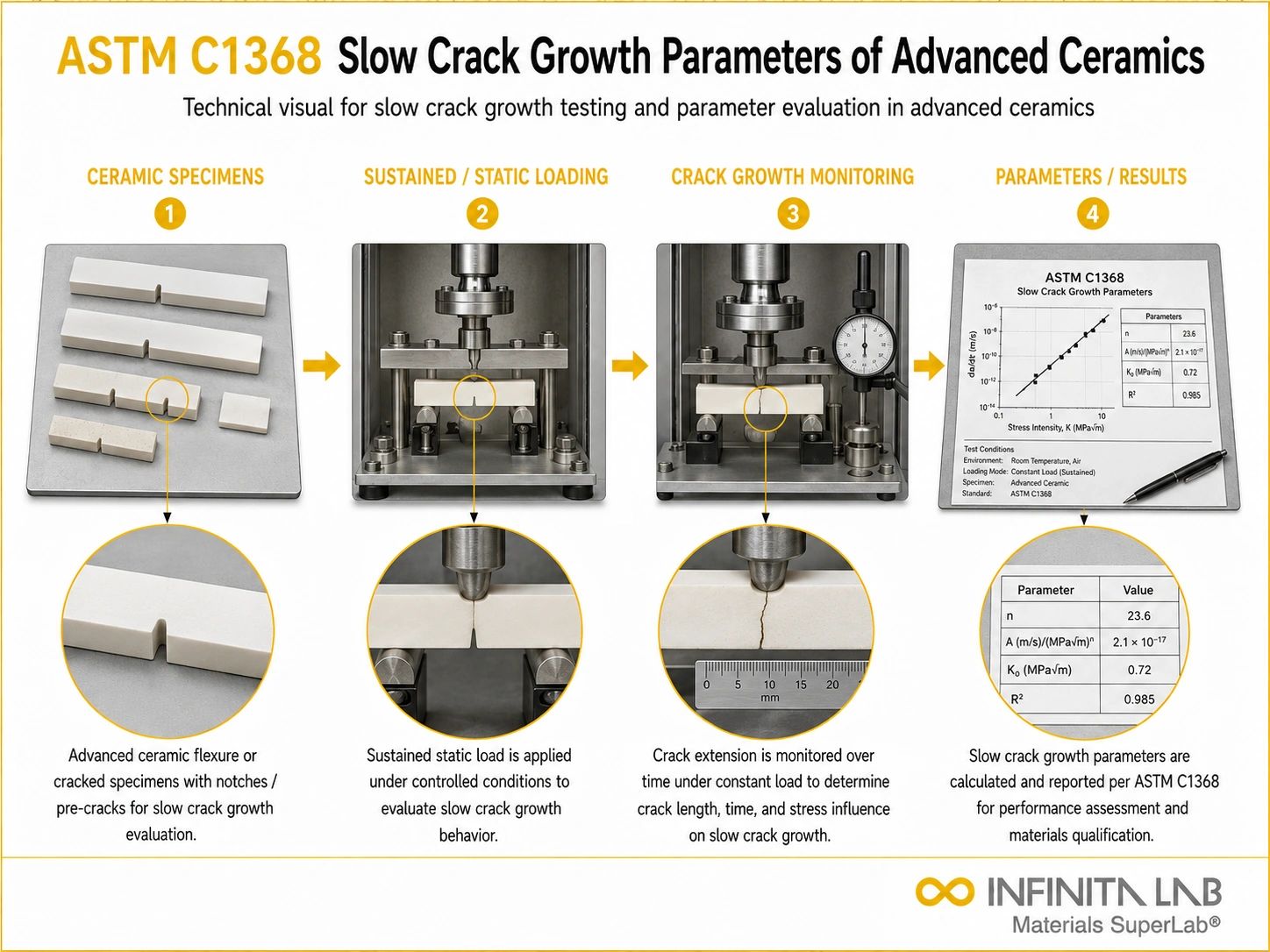
Test Process
Specimen Preparation
Prepare test specimens with defined geometry and surface finish as per standard requirements.
1Crack Introduction
Introduce a controlled flaw or pre-crack to simulate real material defects.
2Controlled Loading
Apply constant or varying stress under specified environmental conditions.
3Data Acquisition
Measure crack growth rate and calculate SCG parameters from recorded data.
4Technical Specifications
| Parameter | Details |
|---|---|
| Material | Advanced ceramics and ceramic composites |
| Test Type | Static and dynamic fatigue methods |
| Measurement | Crack length using optical/compliance techniques |
| Stress Range | Controlled stress intensity factor range |
| Environment | Ambient or elevated temperature conditions |
| Loading Mode | Constant load or stress rate |
| Output Data | Crack velocity vs stress intensity curve |
| Specimen Geometry | Standard-defined configurations |
| Failure Mode | Subcritical crack propagation behavior |


Instrumentation Used for Testing
- Universal testing machine (UTM)
- High-temperature furnace
- Optical microscope or crack monitoring system
- Extensometer or displacement sensors
- Environmental chamber
- Data acquisition and analysis system
Results and Deliverables
- Crack growth rate vs stress intensity curves
- SCG parameters (n-value and material constant A)
- Stress corrosion susceptibility analysis
- Time-to-failure estimation
- Comparative material performance data
- Comprehensive test report with graphs and observations
Frequently Asked Questions
ASTM C1368 evaluates slow crack growth behavior in advanced ceramics by measuring crack propagation under controlled stress and environmental conditions. It helps predict long-term reliability and failure risk in brittle materials used in critical structural and functional applications.
Slow crack growth is the gradual extension of cracks in ceramics under stress levels below their fracture strength. It occurs due to environmental interactions and stress corrosion, leading to delayed failure even when materials are not subjected to maximum loads.
This test is important because ceramics are brittle and prone to delayed fracture. Understanding slow crack growth helps engineers predict service life, avoid unexpected failures, and design components that perform reliably under long-term mechanical and environmental stress conditions.
The n-value represents the sensitivity of crack growth rate to stress intensity. A higher n-value indicates greater resistance to crack propagation, meaning the material performs better under sustained stress and has improved long-term reliability.
Environmental factors such as humidity and temperature significantly influence crack growth rates. Moisture can accelerate stress corrosion, increasing crack propagation speed, which makes environmental control critical for accurate and repeatable test results.
Why Choose Infinita Lab for Advanced Materials Testing and Characterization?
At the core of this breadth is our network of 2,000+ accredited laboratories across the USA, offering access to over 10,000 testing methods and analytical services. From advanced materials characterization (SEM, TEM, RBS, XPS) to mechanical, chemical, environmental, biological, and standardized ASTM/ISO-compliant testing, we deliver unmatched flexibility, specialization, and scale. You are never limited by geography, facility, or methodology — Infinita Lab connects you to the right expertise and testing solution, every time.

Looking for a Trusted Partner for Accurate and Reliable Testing Services?
Send query us at hello@infinitalab.com or call us at (888) 878-3090 to learn more about our services and how we can support you.



Request a Quote
Submit your material details and receive testing procedures, pricing, and turnaround time within 24 hours.
 Quick Turnaround and Hasslefree process
 Confidentiality Guarantee
 Free, No-obligation Consultation
 100% Customer Satisfaction
