

What Is ASTM C1465 Ceramic Slow Crack Growth Elevated Temperature Constant Stress Rate?
ASTM C1465, Standard Test Method for Determination of Slow Crack Growth Parameters of Advanced Ceramics by Constant Stress-Rate Flexural Testing at Elevated Temperatures, defines how to measure the susceptibility of advanced ceramics to slow crack growth (SCG) at high temperatures. Flexural specimens are loaded to fracture at several different constant stress rates in a specified environment, and the flexural strength is recorded at each rate. When loading is slow, cracks have more time to extend subcritically, so measured strength falls as the stress rate falls. That strength degradation is the signal the method uses to characterize SCG. The standard relates strength to stress rate through a log-log linear expression, log σf = [1/(n+1)] log σ̇ + log D. The regression slope and intercept yield the two SCG parameters: n, the dimensionless crack growth exponent, and D, a scaling parameter. The method applies to advanced ceramics that are macroscopically homogeneous and isotropic. It may extend to certain whisker- or particle-reinforced ceramics that behave uniformly at the macroscopic scale. Testing may be run in air, vacuum, inert, or other gaseous environments. The standard is intended primarily for materials that show negligible creep, so it places explicit limits on creep strain during the test. C1465 is the elevated-temperature counterpart to C1368, which covers constant stress-rate testing at ambient temperature. It differs from C1576, which determines SCG parameters at ambient temperature by constant-stress (stress-rupture) testing. The resulting parameters are empirical measures for comparing materials and supporting development, quality control, characterization, and limited design data. They don’t necessarily correspond to crack velocities in service. ASTM lists C1465-26 as the current active edition.

Applications and Benefits of ASTM C1465 Ceramic Slow Crack Growth Elevated Temperature Constant Stress Rate Testing
Scope
ASTM C1465 outlines procedures for determining slow crack growth parameters of advanced ceramics under controlled environmental conditions.
It evaluates:
- The standard covers the determination of slow crack growth parameters of advanced ceramics by constant stress-rate flexural testing at elevated temperatures.
- Flexural strength is measured as a function of applied stress rate in a given environment. The decline in strength at lower rates is used to evaluate SCG.
- Data reduction gives two parameters, n and D, from a linear regression of log strength against log stress rate.
- Advanced ceramics that are macroscopically homogeneous and isotropic fall within the method.
- Certain whisker- or particle-reinforced ceramics may also be tested, provided they behave as macroscopically uniform materials.
- Permitted environments include air, vacuum, inert gases, and other gaseous environments. The environment remains consistent throughout each test.
- Intended primarily for materials with negligible creep, the standard imposes limits on creep so that strength reflects crack growth rather than bulk deformation.
- ASTM C1368 addresses ambient-temperature constant stress-rate testing separately, and ASTM C1576 does the same for ambient-temperature stress-rupture testing.
- Terminology matters here: the standard says constant stress-rate testing in place of dynamic fatigue, which avoids confusion with cyclic fatigue and is consistent with ASTM E1823.
- The parameters are empirical. Nothing guarantees they’ll match the crack velocities a component sees in service.
Applications
- Ranking the slow crack growth susceptibility of competing ceramic grades at their intended operating temperature.
- Seeing how processing variables and composition influence SCG behavior in structural ceramics.
- Material development programs for silicon nitride, silicon carbide, alumina, and similar high-temperature structural ceramics.
- Quality control data that confirms lot-to-lot consistency in SCG resistance.
- Limited design data for components whose lifetime is governed by subcritical crack extension.
- Screening candidate materials first, before committing to longer, more costly constant-stress lifetime testing.
Benefits
- Shorter test durations than constant-stress rupture programs, since each specimen is loaded to fracture at a controlled rate.
- The procedure is standardized and repeatable, so results compare across materials, laboratories, and programs.
- You measure directly at the temperature and environment of interest. No extrapolating from room-temperature behavior.
- Quantitative n and D values come with associated statistics, which can be tracked over time or compared across grades.
- Creep limits are built in, helping confirm the data reflect slow crack growth rather than another mechanism.
- Fractographic reporting links strength data to the failure origins found in each specimen.
Our ASTM C1465 Testing Procedure
Specimen Preparation
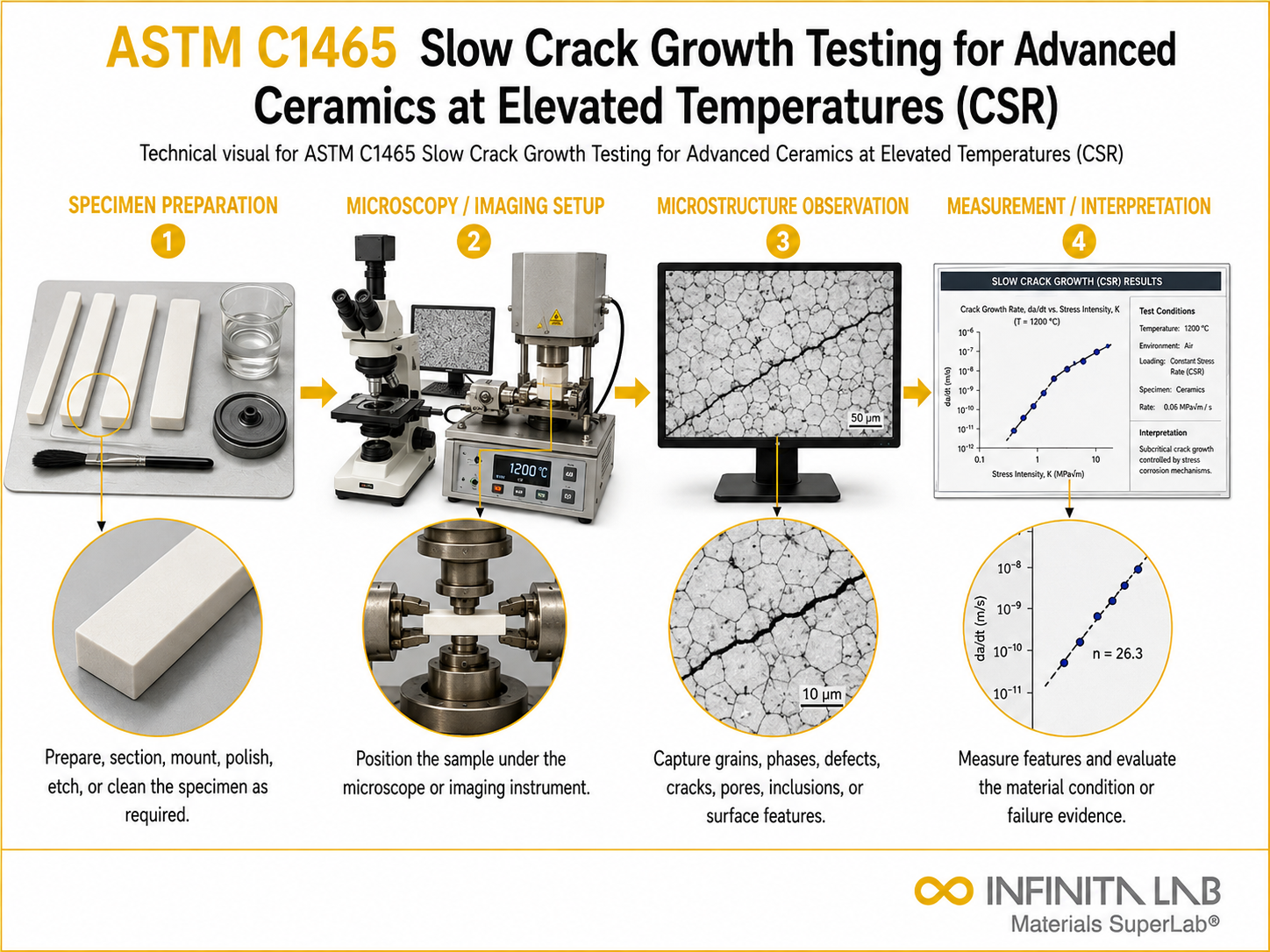
Rectangular ceramic specimens are machined to standardized dimensions, with at least 10 specimens per stress rate.
1Fixture & Environment Setup
Specimens are four-point flex tested under controlled environments and elevated temperatures.
2Constant Stress-Rate Loading
A constant stress rate is applied using four-point bending until fracture occurs. Multiple stress rates are used to evaluate crack growth behavior.
3Data Collection & Analysis
Fracture load, stress rate, and flexural strength are recorded and used to calculate slow crack growth parameters.
4ASTM C1465 Test Parameters and Requirements
| Parameter | Details |
|---|---|
| Test Principle | Constant stress-rate flexural testing |
| Specimen Shape | Rectangular beam |
| Recommended Specimens | Minimum 10 per stress rate |
| Typical Stress Rates | At least four different rates |
| Test Configuration | Four-point flexural bending |
| Test Environment | Air, vacuum, inert gas, or controlled atmosphere |
| Test Temperature | Ambient or elevated |


- Universal Testing Machine – supplies the controlled load or displacement rate needed to maintain a constant stress rate through fracture.
- High-Temperature Furnace – brings the specimen and fixture up to the test temperature, then holds it stable throughout loading.
- Flexure Fixture – supports the bar and applies load through the configuration the standard specifies. It’s built from materials suited to the test temperature.
- Thermocouples and Temperature Controller – measure and regulate specimen temperature, keeping conditions consistent from specimen to specimen.
- Environmental Control System – the specified air, vacuum, or inert atmosphere stays around the specimen during heating and loading.
- Data Acquisition System – records load and displacement versus time, so actual stress rates, fracture loads, and creep behavior can be evaluated.
- Stereo Microscope or SEM – for fractographic examination of fracture origins after failure.
Equipment and Instrumentation Used for ASTM C1465 Testing
What You Receive: Test Report, Data, and Certification
- Flexural strength values for every specimen at each stress rate, with mean, standard deviation, and coefficient of variation per rate.
- A log-log plot of strength versus stress rate, showing the fitted regression line.
- The calculated slow crack growth parameters n and D, along with their associated statistics and goodness of fit.
- Full documentation of specimen geometry, material identification, preparation method, test temperature, environment, and loading mode.
- Creep strain observations plus fractography findings, including fracture origin type and location.
- A formal test report suitable for material qualification, quality control files, or engineering review.
ASTM C1465 Ceramic Slow Crack Growth Elevated Temperature Constant Stress Rate FAQs
The data produced from this test is the flexural strength, stress rate, and slow crack growth parameters (n and D). These values are essential in understanding the durability and performance of a material under different stress and environmental conditions.
The test results help improve ceramics design by revealing the performance of the materials under stress. The data supports material development, quality control, and better design for high-stress applications.
The four-point flexural bending test helps deduce slow crack growth parameters. In this test, force is applied from two points, so the specimen experiences bending at four contact points.
The main drawback of ASTM C1465 is that it does not measure crack growth velocity directly. Although providing the important slow crack growth parameters, the rate at which the cracks grow under specific conditions can only be inferred rather than directly measured.
This test consistently and reliably provides information regarding the material's behavior under stress, thus becoming a significant quality control tool in producing advanced ceramics. It would also help identify any weaknesses or defects in the material that may lead to failure in practical applications.
Why Choose Infinita Lab for Ceramic Slow Crack Growth Elevated Temperature Constant Stress Rate Testing
When your Ceramic Slow Crack Growth Elevated Temperature Constant Stress Rate results have to hold up - for compliance, a customer audit, or an engineering decision - ASTM C1465 accuracy and an unbiased third-party report matter more than price. Infinita Lab routes your ASTM C1465 ceramic slow crack growth elevated temperature constant stress rate testing to ISO/IEC 17025-accredited U.S. partner labs with hands-on method experience, so you get defensible data, transparent reporting, and turnaround times built around your project deadline - not ours.

Need ASTM C1465 Ceramic Slow Crack Growth Elevated Temperature Constant Stress Rate Testing You Can Rely On?
Send query us at hello@infinitalab.com or call us at (888) 878-3090 to learn more about our services and how we can support you.





