


ASTM C1834 Slow Crack Growth Testing for Advanced Ceramics at Elevated Temperatures
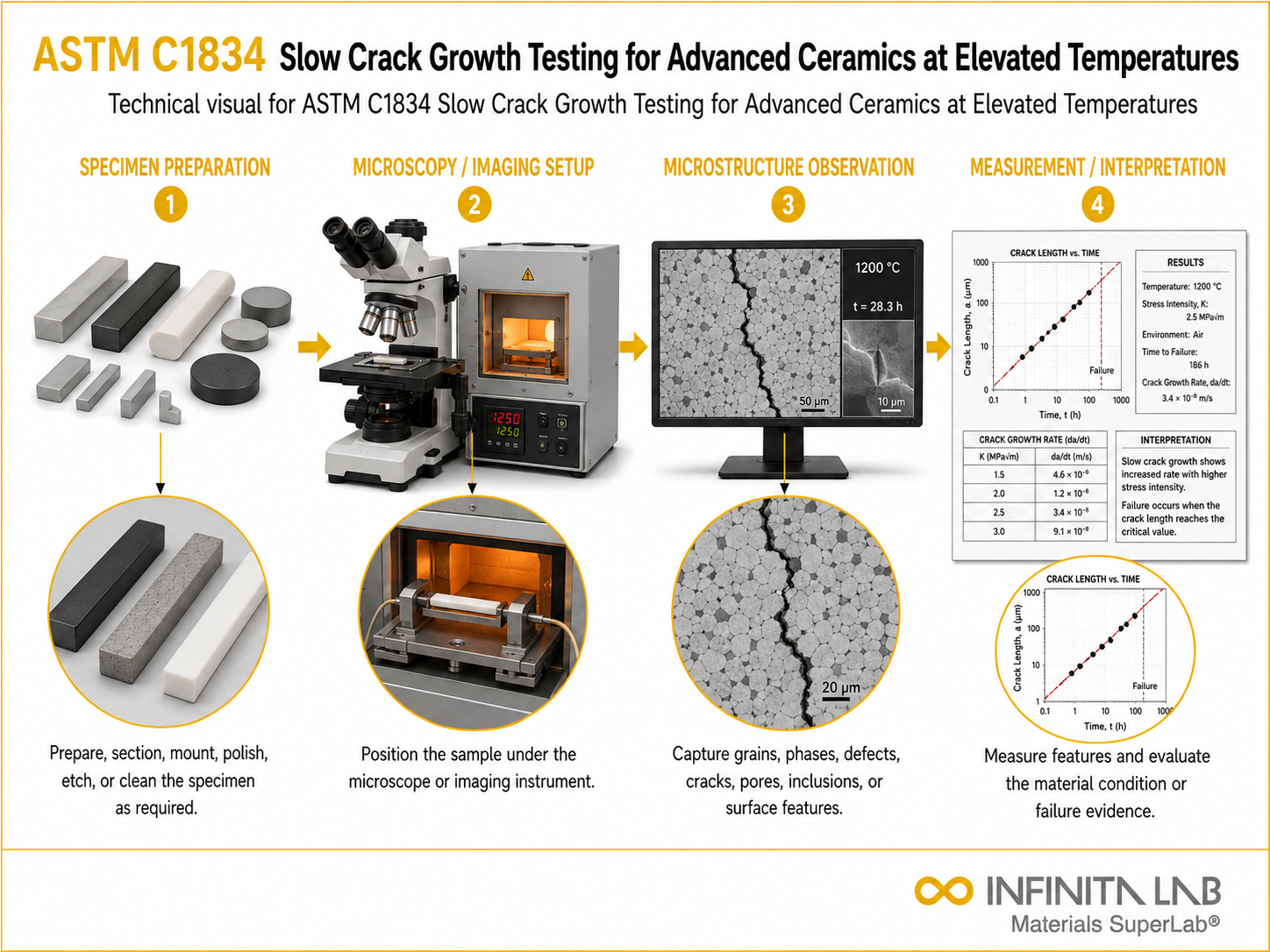
ASTM C1834 is used to determine the slow crack growth (SCG) parameters of advanced ceramics in a given test environment at elevated temperatures in which the time-to-failure of four-point-1/4 point flexural test specimens is determined as a function of different levels of constant applied stress.
TRUSTED BY


Precision-driven testing for dimensional accuracy and compliance
- Overview
- Scope, Applications, and Benefits
- Test Process
- Specifications
- Instrumentation
- Results and Deliverables
Overview
ASTM C1834 describes a standardized test procedure for characterizing the SCG behavior of advanced ceramic materials under constant-stress four-point flexural testing. The test method consists of applying a sustained bending load to ceramic test specimens under controlled environmental and, if necessary, elevated-temperature conditions until failure occurs.
The test method described here represents the in-service conditions in which ceramic components are very often subjected to long-term thermal and mechanical stresses. ASTM C1834 provides critical data on crack growth behavior, fracture origins, and flaw extension, enabling the assessment of the long-term reliability and durability of advanced ceramics used in high-performance applications.

Scope, Applications, and Benefits
Scope
ASTM C1834 outlines procedures for determining the susceptibility of ceramic materials to subcritical (slow) crack growth under constant applied stress in specified environments and temperatures.
It evaluates:
- Time-dependent crack growth behavior
- Slow crack growth parameters (n and D)
- Fatigue life under constant flexural stress
- Influence of environment and temperature on crack propagation
The method primarily uses a four-point 1/4-point flexure configuration and applies to monolithic, macroscopically homogeneous, and isotropic advanced ceramics. It is also applicable to whisker-reinforced, particle-reinforced, and discontinuous fiber-reinforced ceramic composites exhibiting homogeneous behavior.
Applications
- Long-term reliability assessment of advanced ceramic components
- Material development and composition optimization
- Evaluation of processing variables on crack growth behavior
- Quality control and material consistency verification
- Design code and life-prediction model validation
- Characterization of ceramic performance in high-temperature environments
Benefits
- Simulates in-service mechanical and thermal loading conditions
- Determines time-to-failure under constant stress
- Provides slow crack growth parameters for life prediction models
- Supports fracture origin and flaw population analysis
- Enables comparison of ceramic materials under identical environments
- Improves confidence in long-term durability and reliability assessments
Test Process
Specimen Preparation
Flexural test specimens are prepared to standard dimensions to minimize stress concentrations and ensure proper alignment. Careful handling prevents surface damage or contamination.
1Test Environment Setup
Testing is conducted in a controlled environment, often at elevated temperatures and specified atmospheres, to simulate service conditions.
2Constant-Stress Flexural Loading & Monitoring
Specimens are tested in a four-point (¼-point) flexure fixture under constant load, with time to failure recorded. Non-failed specimens are reported as run-outs.
3Post-Test Fractographic Analysis
Fractured specimens are collected, cleaned, and analyzed to identify fracture origins, flaw characteristics, and evidence of slow crack growth.
4Technical Specifications
| Parameter | Details |
|---|---|
| Test Configuration | Four-point flexure (1/4-point loading) |
| Applicable Materials | Monolithic and reinforced advanced ceramics |
| Test Environment | Controlled atmosphere at ambient or elevated temperatures |
| Measured Outputs | Time to failure, applied stress, fatigue behavior |
| Analysis Basis | Fatigue curve and slow crack growth parameters (n, D) |
| Failure Criteria | Specimen fracture or run-out within the specified time |


Instrumentation Used for Testing
- High-temperature universal testing machine
- Four-point 1/4-point flexural test fixtures
- Environmental and temperature-controlled test chambers
- Precision load cells and displacement sensors
- Time-measurement and data acquisition systems
- Fractographic analysis tools (optical microscopy, SEM)
- Software for fatigue and slow crack growth analysis
Results and Deliverables
- Time-to-failure data as a function of applied stress
- Fatigue curves for ceramic materials
- Slow crack growth parameters (n and D)
- Fracture origin and flaw population characterization
- Comparative material performance under specified environments
- Data supporting life prediction, quality control, and design validation
Frequently Asked Questions
The test evaluates slow crack growth parameters of advanced ceramics, providing insights into their fracture behavior, flaw characterization, and reliability under thermal and mechanical stress.
A four-point flexural test is used, where a specimen is supported on two structures and loaded via two upper pins.
Fractographic analysis ensures that fracture origins are from the same population, identifies flaw types and locations, and evaluates slow crack growth.
Why Choose Infinita Lab for Advanced Materials Testing and Characterization?
At the core of this breadth is our network of 2,000+ accredited laboratories across the USA, offering access to over 10,000 testing methods and analytical services. From advanced materials characterization (SEM, TEM, RBS, XPS) to mechanical, chemical, environmental, biological, and standardized ASTM/ISO-compliant testing, we deliver unmatched flexibility, specialization, and scale. You are never limited by geography, facility, or methodology — Infinita Lab connects you to the right expertise and testing solution, every time.

Looking for a Trusted Partner for Accurate and Reliable Testing Services?
Send query us at hello@infinitalab.com or call us at (888) 878-3090 to learn more about our services and how we can support you.



Request a Quote
Submit your material details and receive testing procedures, pricing, and turnaround time within 24 hours.
 Quick Turnaround and Hasslefree process
 Confidentiality Guarantee
 Free, No-obligation Consultation
 100% Customer Satisfaction
